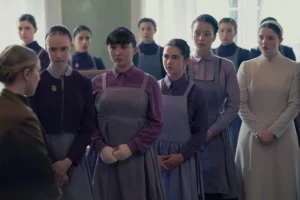

After six seasons immersed in the darkness of The Handmaid’s Tale, is the spin-off The Testaments feeling too light? Episode 7 proves that the answer lies with a character who delivers a necessary reality check: Rita, whose brief return serves as a powerful reminder that Gilead’s fight is far from over.
Episode 7 of Season 1 of The Testaments highlighted why Rita’s brief reintroduction to the story is much more important than it appears. Daisy, the young spy for Mayday, is casually annoyed that life is unfair because she’s been forced to live a life hidden away due to the dangers of Gilead agents looking for her after learning her deceased parents lived a double life. This flashback felt casual and almost selfish from Daisy, at least from an audience perspective. But what makes it more surprising is how uncaring Rita is regarding Daisy’s complaints.
In my view, this is a writing choice; Rita not sympathizing with Daisy’s whining is realistic. Daisy had lived a sheltered, good life until her parents were murdered. Her lack of understanding of what Gilead entails is almost a reset to the story, reminding audiences of June’s first introduction to Gilead, where one wrong move led to torture among the other Handmaids.
Rita holds an “it is what it is” attitude, and can anyone blame her? Rita has lived the horrors of Gilead; she’s seen the people she cares about experience various levels of horror and violence regularly, and she was ultimately powerless until the revolution that was escalated under the stewardship of June. Daisy’s experiences are a speck in comparison. Rita is a reminder, mainly to the audience, of what is at stake. Gilead still exists. It’s no joke. It still needs to be eradicated.
Daisy’s careless comments and naivety are almost comedic in some sense. But her actions in the flashbacks weave back to the earlier episodes, where she was shocked at the lengths of Gilead’s punishments and executions.
June was similar to Rita with Daisy. She didn’t react to Daisy’s ‘woe is me’ behavior, which echoes June’s own history of having little patience for naiveté among others. This tough-love approach is a tool she earned through trauma and survival; she knew Daisy would return and would need answers more than running away.
Both women may see that Daisy will experience an awakening eventually – an eyes-wide-open moment – where the depths of the world become apparent. Daisy’s character development is easy to write, but it’s made even easier by the legends’ brief return to remind the audience of the difference in mentality.
For Agnes, it’s the opposite, which we’ve been witnessing since Episode 7, as she begins to imagine what the world outside Gilead is like by ruminating on items from the outside that she doesn’t yet understand. The spirit of June exists inside her, which is why her falling in love with a Guardian is not ironic, and Daisy, ironically, is teasing her to awaken – to see a world beyond the constraints they live in. Daisy and Agnes both need to wake up, but in different ways.
Her scenes with Daisy are far more important than we think. Rita is a character who represents a threshold where ‘fairness’ is irrelevant when it comes to the experiences of Gilead. Ultimately, Rita functions as the necessary dose of darkness – a living embodiment of the original show’s tone – that The Testaments needed to challenge its lighter feel without sacrificing the story’s forward momentum. And one day, it’s likely Daisy will have the same attitude as Rita and June, which is appealing and worth the patience.