
Summary
Despite solid performances from Andrew Scott and Brendan Fraser, Pressure fails to live up to its title or the true story, making for a generic wartime drama that struggles to manufacture genuine tension.
Pressure is a war film that is desperate to burst at the seams. It’s desperate to up the ante and give the audience something worth standing up for. It’s dying to be something – but that moment never comes, making for a generic wartime drama that can only be proud that it’s dramatising a true story.
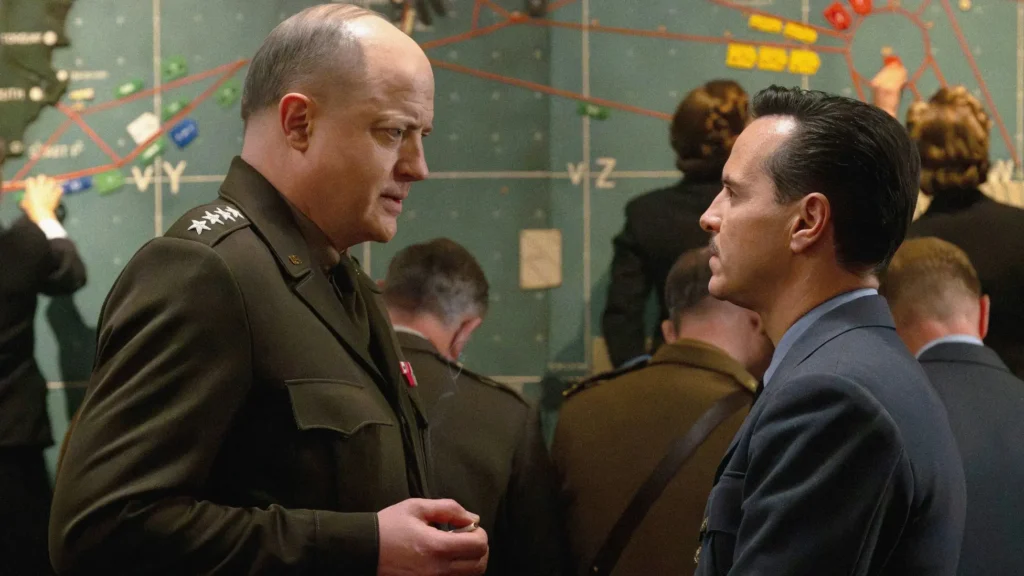
Seventy-two hours before World War II’s D-Day, the Allies faced a weather crisis. The question they faced was: do they storm Normandy on June 5th as planned in the biggest sea-and-airborne invasion in history? General Dwight D. Eisenhower (Brendan Fraser) recruits Scottish chief meteorological officer James Stagg (Andrew Scott; Wake Up Dead Man, Back in Action, Ripley) to make ambitious predictions about the weather. The crux of the film lies in whether Stagg should make the ultimate call, despite the potential consequences of giving the Nazis more time to bolster their resources – a mistake that could ultimately cost them the war and the world.
As the 34th U.S. President, Dwight D. Eisenhower famously said when asked how the Allies defeated the Nazis within a year following D-Day: they “had better meteorologists than the Germans.” This implied that being smarter, more strategic, and using the tools at their disposal was a more significant contribution than sheer military force. It implies there was a moment of brilliance, a crescendoing decision.
Pressure, as a film, while it understands the true story it’s telling, does not live up to its title. James Stagg is presented as a brilliant but serious man. A man who dotes on his wife, yet at work, is the exact opposite – barely acknowledging his colleagues. This is clearly a representation of a real man: introverted, taking on a task that will influence the course of history.
However, I think they took the representation of his character too far. Often, I was desperate for him to lift his emotion a little higher, or to speak in a more timely manner rather than patiently lingering in the moment during a stressful situation. This is intentional, of course, but director Anthony Maras stretches the weather genius too thin. It’s all built up to feed into the moments seen in the trailers – when he finally snaps and tells the war generals the true reality of weather: that we cannot bend nature to our will for the sake of an ambitious invasion.
That’s not to say that Pressure lacks good performances. Andrew Scott plays Stagg brilliantly, and I expected nothing less from Brendan Fraser. Special mention has to go to Damian Lewis (Dream Horse) as British Army General Bernard Montgomery, who adds real weight to the situation.
Yet, I never once felt tense in the way the trailer suggested I would be. I didn’t feel like the fate of the world relied on a single weather forecast, or that D-Day was in genuine jeopardy. There’s even a moment where Stagg tells the war generals that they need to delay until June 18th. It’s my understanding that Eisenhower never considered this date, but rather that Stagg raised it as the next fallback opportunity if the new date, June 6th, didn’t work out. For narrative effect, Stagg states June 18th in the film as the immediate next potential D-Day, making the actual date feel like an afterthought following further weather calculations.
Maybe I’m nitpicking, but even that slight historical alteration alone shows that the director was searching for ways to ramp up the tension and make the film more interesting. It felt entirely unnecessary because, as history shows, the fateful day was only delayed by 24 hours – and in real life, this was a decision by Eisenhower, not some last-ditch effort to make D-Day work.
It’s possible that there have been too many good (and average) war movies, meaning I’m not as easily impressed by World War II true stories as I’d like to be. But if you are going to call a film Pressure, at least make it feel like it.