Summary
Leviathan has a premise bursting with cool ideas and images, but the show itself is an overly simplistic YA morality tale.
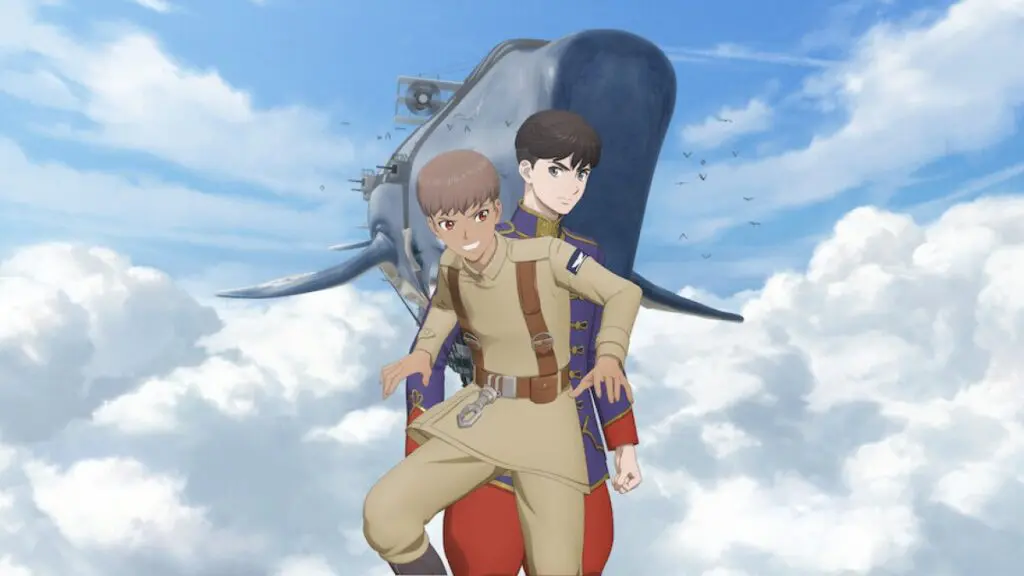
You’d need both hands and at least half a foot to count all the cool stuff in Leviathan, Netflix’s anime adaptation of Scott Westerfeld’s World War I alt-history trilogy. The Great War is reimagined as a fracas between two opposing sides: the Central Powers, or “Clankers”, who use steampunk mechs for warfare, and the Allies, aka the “Darwinists”, who use genetically engineered animals. We’re talking aerial dogfights with what look like flying whales, protracted action scenes with hulking techno-beasts, and much more besides. The material’s bounty of conceptual riches makes one wonder why all of them are sidelined in favour of a torpid teen romance.
I get it – it’s hard to make the Great War light-hearted, which is probably why nobody has had a serious go at it. Fantastical tweaks to the conflict notwithstanding, this is still, fundamentally, a recreation of a great human failing, famous mostly for the extraordinary death toll and the technological advances developed in record-time to increase it. Even the political circumstances were pretty complex, so it’s hardly laugh-a-minute stuff. But Leviathan curiously downplays the scale and severity of the war to a degree that’s not only simplistic but arguably childlike, barely acknowledging the historical significance of the setting and putting all its eggs instead in the “alt” basket.
Only, not really, because the bulk of the runtime is devoted primarily to the relationship between the leads. Aleksandar is the son of Austria-Hungary’s Archduke Franz Ferdinand and, following his father’s assassination, is forced to flee with the painfully serious Count Volger and the mechanic Klopp, who must spirit him away to a safehouse on the Swiss border. Running in parallel to this is the story of Deryn Sharp, a Scottish teenage girl who reinvents herself as “Dylan” Sharp to illegally enlist in the military. Two teenagers, one male and one female, both on opposing sides of an escalating conflict that they’re too young to truly understand – whatever might happen next?
It’s worth noting that the action is pretty thrilling, and the creature/vehicle designs are pretty out there, both of which are fine by me. Alek’s initial escape is great stuff and sets a superb tone, embellished by the novelty of Deryn cutting about on a giant jellyfish. If nothing else, Studio Orange have done fantastic work here, and the art and animation of Leviathan is never less than stellar.
But blimey, does it grind to a halt when Alek and Deryn come across each other early on in the 12-episode first season. As well as developing a relationship between these two, the show also wants to use their arcs as shorthand for a sophomoric “can’t we all just get along?” theme that feels dangerously simplistic in the context of World War I. Blowing out the opposing sides into these very arch factions gives the storytelling and worldbuilding an almost patronising quality, like all things could be solved if everyone just had a nice conversation and respected animals a bit more (this is, ironically, probably true in a very macro sense, but it still feels too thin.)
It doesn’t help that Alek, in particular, is extremely aggravating, because his coming-of-age arc requires him to start at a position of such implausibly sheltered obliviousness that he quickly becomes actively annoying. Deryn fares a bit better, especially in the push-pull dynamic of a flourishing bond and a Mulan-style androgynous disguise gimmick, but she still isn’t particularly rounded. I haven’t read the original books, but I do know that all three of them are adapted in this season in rough, four-episode arcs. At twenty-ish minutes an episode, that seems like a terribly condensed version of the story. I’d wager there’s a lot more depth and nuance in the written material that has been left on the cutting room floor for the sake of tighter pacing, but getting to the finish only really matters when it feels like the journey was worthwhile.
There’s a reasonable possibility that I’m simply too old and jaded for any of this to matter to me, but I think that’s letting Leviathan off the hook too easily. We’ve had plenty of kid-focused shows that also have genuine depth and proper character development. And I’m not blaming the transition to animation, either, though there are some odd idiosyncrasies in the distinctly Western material being adorned with quintessentially anime flourishes. Sure, a lot of anime is like this, but a lot of anime isn’t, and there was no mandate for Leviathan to take the most simplistic possible approach to its plotting, characters, politics, and history. The odd stirring speech feels like a bit of a cheat code, trying to convince the audience that the characters have learned the lessons that the script never actually bothered to teach them.
Am I being overly harsh? Maybe. But adapting a property with this much imagination and built-in spectacle should be easier to sit through than Leviathan ends up being. At the very least, and uncharacteristically for a Netflix series, it has the decency to end. Perhaps that’s for the best.
RELATED: