Summary
Trigger imagines a dystopian Korea awash with guns, but its enthusiasm for carnage feels a little worrying, and some of its ideas are overly simplistic.
The central idea of Trigger is that a lot of people are just waiting for the opportunity to shoot someone. Based on the shooting rates in countries where guns are easily accessible, this isn’t a particularly far-fetched idea. But the worrying thing about this K-Drama is that it seems to take an uncomfortable amount of delight in proving its point. In the first episode alone, there are two protracted massacres, one in a school and another in an apartment building, and things don’t exactly get pacifistic from there.
You don’t need me to tell you why this is a striking approach for Korean media. Guns aren’t rare in the nation’s film and TV anymore, but the country itself has stringent gun control laws, and gun-related crime is very rare. The streets aren’t awash with firearms, so the premise of Trigger has a high-concept, dystopian feel to it. It’s deliberately discordant to see everyday Koreans indiscriminately mowing down their classmates and neighbours.
The most provocative idea, though, is that the entire country is on the cusp of going postal, and if access to firearms were unchecked, chaos would descend almost immediately. The obvious parallels to America are made early – how can a developed nation so cavalierly and consistently see its citizens butcher each other? Trigger argues that any nation with easy access to guns would behave the same way, and perhaps Korea, with its wealth disparity, inordinately high suicide rate, and famously extreme academic pressure and career expectations, would fare worst of all.
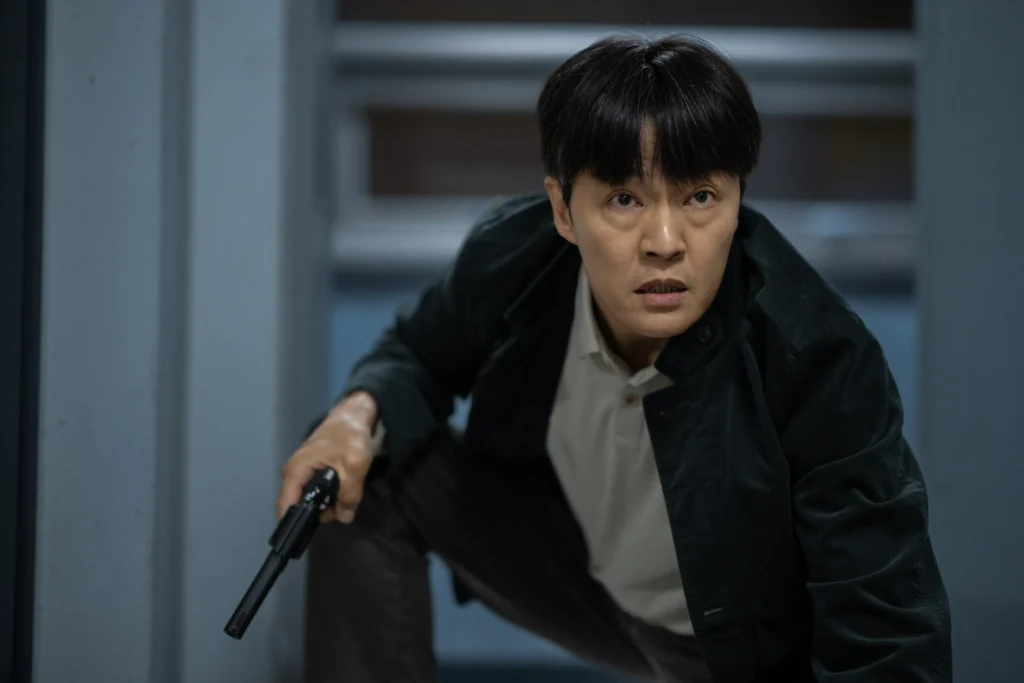
So, while Trigger begins with one young man flipping out on the noisy, disrespectful residents of his apartment building, he’s merely the symptom of a much deeper societal malaise. His personal arsenal is the tip of the iceberg. Military-grade firearms are cropping up all over the place in mysterious packages delivered by anonymous couriers, generally finding their way to the most downtrodden, volatile, and likely to make use of them. Korea’s only defence against this crisis is Lee Do (Kim Nam-gil, Song of the Bandits), an empathetic cop with a dark military past who immediately realises the connections. Quickly, he teams up with Moon Baek (Kim Young-kwang, Somebody), an enigmatic stranger who is, all together now, hiding his real identity as the Joker-like anarchist string-puller of the entire affair.
Across ten episodes, Trigger recycles a basic structure. A supporting character is in some kind of personal peril and, through various unlucky – and sometimes unlikely – circumstances, are driven to extremes of desperation and violence. To these people, guns are solutions to their ills, or at least a way of striking back against their oppressors, be they school bullies or the system itself. Lee Do remains, for the most part, a couple of steps behind, at least until it’s prudent for him to intervene in the final moment and save the day, which is part of the problem.
Trigger introduces its dystopian concept without a real sense of how to solve it beyond the usual handsome hero K-Drama theatrics, which feel too silly and too easy in this context. It similarly renders its villainous contingent so arch and ridiculous that it’s hard to connect them to a plot that is frightening precisely because of its believability. It wants to make the argument that Korea is basically a tinder box on the verge of complete self-annihilation, but then not to commit to that idea fully; it’s a K-Drama take on a Korea-sized premise.
This aside, ten episodes is too many, and that aforementioned structure, while effective at building tension, begins to feel reiterative and predictable. Lee Do and Baek both feel thin and generic, the former too clichéd and the latter too ridiculous, and the overabundance of supporting players and attendant subplots becomes overwhelming. It’s handsomely styled and intermittently striking in its presentation, but ultimately Trigger bites off a bit more than it can chew.
RELATED: