
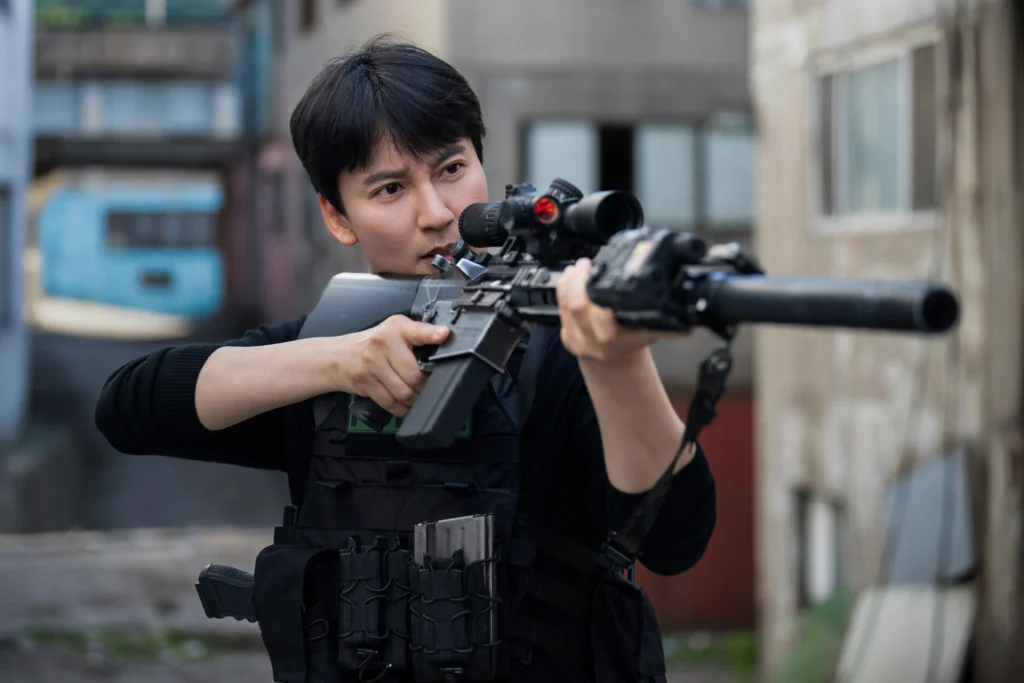
Trigger has a fascinating and provocative dystopian premise, which imagines Korea awash with free, easily accessible firearms. The only man fighting against the tide is Lee Do, an empathetic cop with a dark past, and across ten episodes, he tries to save a litany of oppressed citizens on the cusp of going postal while simultaneously getting to the bottom of an anarchic conspiracy. It’s a lot to be getting on with, so luckily I’m on hand to break down the entirety of Season 1 in this handy recap full of details, observations, and spoilers.
You can’t say I never do anything for you.
Episode 1
What’s the firearm equivalent of not pulling any punches? Well, that’s the vibe of Trigger’s first episode. It has two extended scenes of gun massacres – albeit one of them that’s imagined – and a gleeful sense of mania about it, giving the K-Drama a dystopian feeling despite a distressingly recognisable real-world setting.
This premiere is about making the necessary introductions, but also establishing this quite shocking sensibility for violence. It imagines Korea as a country on the cusp of carnage, and a sudden influx of guns to be the outlet for an entire nation’s frustration. In Episode 1, this is primarily expressed through Jeong-tae, a young man struggling with noise and disrespect in his apartment building. He’s mentally ill, which is established early, but improperly medicated and cared for. The key point of tension in this episode is his gradual slide into outright psychopathy, turning an Uzi on the residents of his building.
Meanwhile, we meet Officer Lee Do and his new partner, Officer Jeong-u. The latter plans to shoot and arrest everyone on his way to a civil society, but the former knows better. He’s an even-keel, reasonable guy who understands and appreciates the law, but isn’t above disarming a suspect if the need arises. He also prefers to use his taser and has flashbacks to his military service, so we can probably imagine where that’s going.
The essential question: How are guns and military-grade rifle rounds, found at the scene of a suicide, getting into South Korea, a country with notoriously stringent gun-control laws?
Episode 2
As if it wasn’t obvious already, Episode 2 of Trigger quickly confirms that Jeong-tae’s killing spree in the apartment building is connected to the ammunition found at the suicide scene. He had multiple disassembled rifles that all take the same ammo. After his apprehension, he claims they were delivered by a courier, prompting Lee Do to begin investigating the connections.
This episode mostly leaves Lee Do to it, though, and follows multiple other POV characters as subplots develop that are all presumably connected to the main arc in some way. We see Won-seong, the sex offender from the previous episode, realising that one of the packages addressed to his mother contains rifles. He sets out on a personal mission, ditching his ankle monitor and phone, and his intentions probably aren’t good.
We also meet Gyu-jin, a schoolboy who is being relentlessly bullied by Seong-jun and his cronies, who want him to steal his mother’s ID card so they can use it to borrow money from a loan shark, and Jeong-man, who, along with his team of ruffians, works as a gopher for Seok-ho, a corrupt businessman. When Seok-ho fails to grant Jeong-man control of a business he promised him for his hard work, Jeong-man begins working against him, retrieving a gun from the car of Mr. Kim, a business rival Seok-ho had earlier instructed him to kill.
At the end of the episode, Lee Do investigates Won-seong’s apartment looking for clues as to what he might be doing, and runs into a mysterious man who says his name is Moon Baek.
Episode 3
The third episode of Trigger is essentially an elongated action sequence that transforms from a car chase to a siege and then a shootout. It puts any clarity about Moon Baek, whom Lee Do is forced to work with for at least the chase sequence, on the back burner. But far from being a facile installment, this chapter imparts some important information about Lee Do’s past and the deeper thematic ideas at play.
The hook is that Won-seong is out for revenge against the police department and the parole officer who he believes controls his life. Lee Do and Moon Baek, back at his house, have to race after him using surveillance footage to track him, eventually deducing that he’s targeting the station. The officers there are ill-equipped to fend off an armed invader — though they were perfectly willing to turn off the cameras and beat Won-seong, which is part of his point — so it’s up to Lee Do to again save the day. In so doing, though, he has to lift the lid on part of his past — his military service — that he’d rather keep buried.
Light on plot but well-orchestrated and exciting, this all works to highlight Lee Do’s particular set of skills and introduce some intrigue around Moon Baek, but it’s notably lighter and shorter than the previous installments to account for its action focus.
Episode 4
After taking down Won-seong in the previous episode, Lee Do ends up being suspended for three months, which doesn’t slow down his investigation one iota — on the contrary, he makes more progress in Episode 4 than in the rest of Trigger combined. We also learn a little more about his military background. He would apparently volunteer for high-risk conflict zones and had a body count of 99, which has just increased to 100, and is probably going to increase another couple of notches before the season’s out.
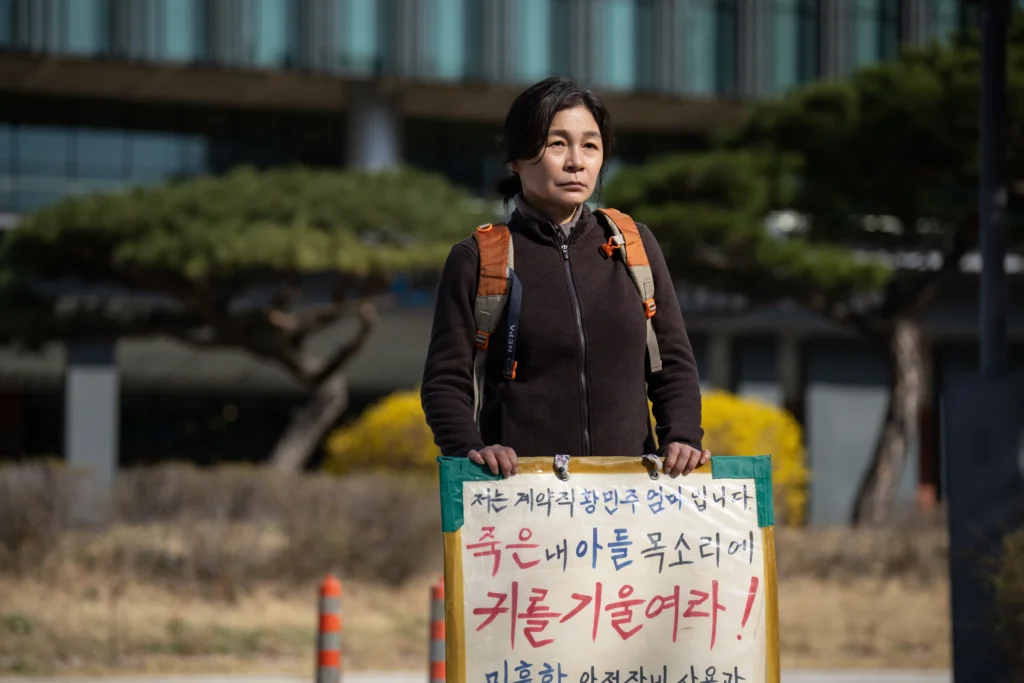
This is where Trigger begins tying things together. Lee Do starts tracking Seok-ho’s gophers — even going so far as to threaten Seok-ho himself — while Jeong-man has them looking into the weapon shipments and trying to heist the guns. This all coalesces around Mrs Oh, of all people. She, too, was one of the recipients of the guns, and since Lee Do was too busy to take her call during the previous episode’s car chase, there was nobody to talk her out of turning it against her son’s former employer. Mrs Oh confesses to Lee Do and is willing to turn herself in, but asks for the chance to make a final meal for her son first.
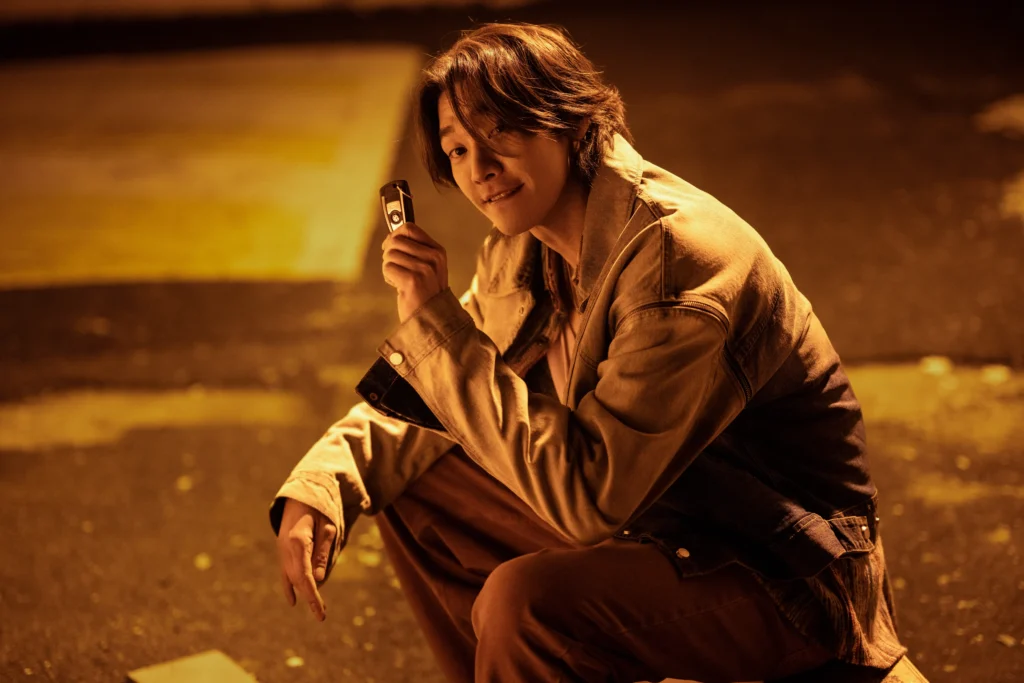
Jeong-man’s goons get to Mrs. Oh first, looking for the gun, and Lee Do arrives shortly after with Moon Baek, who earlier claimed that he was planning to end his life with one of the guns because he’s dying of cancer. He has the scars to prove it, but his story, along with everything else about him, seems completely bogus, and you really see shades of his potential mania here when he’s antagonizing Jeong-man’s team.
In a protracted and very good hand-to-hand fight, Lee Do takes on all of Jeong-man’s men at once, but Mrs. Oh’s fate is left hanging in the balance as the episode ends.
Trigger Cr. Son Ik-chung/Netflix © 2025
Episode 5
With Mrs. Oh on the brink of death, Lee Do gets closer to the edge than ever in Episode 5 of Trigger, but his own situation is more of a window through which to analyze Moon Baek’s. The two men bonding over their respective backstories triggers some explanatory flashbacks for us, highlighting Baek’s unknowing abandonment into the hands of sinister traffickers, which resulted in the loss of one of his eyes. But it isn’t until the end of the episode that it’s properly revealed that Baek is the bad guy, the guy behind the free gun distributions in order to bring about a “new world”, one that he presumably presides over.
As situations worsen for Jeong-man and Gyu-jin in the high school subplot, we keep coming back to Baek. Lee Do seems to trust him, though, seeing him as something of a kindred spirit thanks to the loss of his own parents, which has already been briefly teased in flashbacks. Both of these characters, as children, were introduced to guns as the solution for their ills. But Baek is doing a good job of pretending. He wears a contact lens that obscures the blue iris of his fake eye.
For now, it remains a little unclear exactly what Baek’s endgame is, how his operation works, and who he’s working at the behest of (if anyone). But it’s clear that his plan is working. Given all the carnage that has already ensued from flooding the streets with guns, and several parallel subplots hitting a boiling point, it stands to reason there’s going to be a lot more tragedy and violence before we’re done.
Episode 6
Episode 6 is undoubtedly the standout episode of Trigger. This isn’t to say it’s the best, or the one in which the most developments occur, but it’s the one that fully commits to the bit, delivering a haunting extended school shooting that Baek has subtly helped to orchestrate. It’s chilling stuff and helps to solidify Baek as a true villain, despite his general demeanour not really matching his actions.
This is what Baek considers “putting pawns into play”. He targets Gyu-jin by orchestrating and then stopping a street brawl using a BB gun that looks just like the real thing. Gyu-jin is understandably taken with Baek’s abilities and the efficacy of the firearm, so when Baek offers to teach him and Yeong-dong to shoot, he eagerly accepts.
It’s very obvious what this is building to. While Baek calls Seok-ho and directs him to the weapon stockpile, telling him that Jeong-man is looking for the guns and that him having had Mr. Kim killed makes him directly responsible for what happens to them, Gyu-jin spends some meaningful time with his mother, all of it leaden with foreboding. At school the next day, the students discover they have been locked inside, and we see that Gyu-jin is carrying a machine pistol. Seong-jun believes it’s just a BB gun… and he’s right. The real active shooter is Yeong-dong, who is intent on massacring the entire school, but especially Seong-jun.
Baek gives Lee Do the list of addresses and draws his attention to the school, so they race there while Yeong-dong shoots up the place pursuing Seong-jun. He also gives Gyu-jin a loaded revolver. Lee Do is able to disarm Yeong-dong before he can execute Seong-jun, but then Gyu-jin arrives and opens fire while Baek watches excitedly in the background.
Episode 7
The good news is that Lee Do is able to talk Gyu-jin down. The bad news is that this doesn’t exactly constitute a happy ending. Gyu-jin still helped perpetrate a school shooting, and many people died. His mother crying as he’s folded into a police car is arguably more emotionally impactful than the shooting itself, and helps to reiterate the stakes here. The number of guns on the streets is creating many more victims than those being shot.
In all this, Lee Do becomes deeply suspicious of Moon Baek, right around the time that it becomes obvious he isn’t quite who he has been claiming to be. This has the unfortunate consequence of sidelining him for a lot of Episode 7 while Trigger instead focuses on the police’s efforts to backtrace the weapons through Mr Kim by playing Seok-ho and Jeong-man off against each other.
This is effective in how it ropes in characters and parallel subplots and weaves them into the main narrative arc. It’s a game of crossing and double-crossing, with the police wanting to use Seok-ho to locate Mr. Kim, Seok-ho wanting to use the police to take out Jeong-man and his men, and Jeong-man sensing the opportunity for a hostile takeover. It’s Jeong-man who emerges from this episode with the upper hand, but everything remains to be played for.
Kim Young-kwang as Moon Baek in Trigger Cr. Son Ik-chung/Netflix © 2025
Episode 8
Episode 8 of Trigger picks up right where we left off, with Jeong-man’s men butchering Seok-ho’s, and Mr. Kim getting the drop on Seok-ho himself. It’s a bloodbath, and Seok-ho and Mr. Kim eventually kill each other, leaving Jeong-man and his crew on top, though not for long. In another solid action sequence, Lee Do raids their hideout and seizes most of the guns, finally giving the police some kind of advantage, but they’re still on the back foot given how many remain on the streets.
The National Security Council shares that the CIA identified the International Rifle Union (IRU) as a major player in the black market, heavily involved in the sales and distribution of weapons and shielded by immense power from lobbying for U.S. politicians and global corporations. Blue Brown, aka Moon Baek, is in charge of overseeing firearm distribution in South Korea. Whenever the IRU plans to move into an area, they leave bullets to signify their intention. These were the rounds discovered in Episode 1. The guy who supposedly took his own life was one of the men who trafficked Baek when he was a child.
Lee Do discovers that all of the guns were fitted with GPS tracking devices, allowing Baek to monitor them. The police want to reverse-engineer this functionality to locate Baek, but he’s a step ahead. After hacking the police network, he drops an address where he claims an active shooting is about to take place. Lee Do recognises it. Sergeant Jo, who has just lost his daughter, is about to go on the warpath.
Episode 9
Episode 9 of Trigger makes for a melancholy penultimate episode. As is generally expected in such shows, this is the point when Baek and his cronies really get the upper hand, and to make the point clear the installment lays Lee Do up for almost the entire runtime after forcing him to suffer his most deeply personal loss yet.
Picking up from where things left off, Sergeant Jo has gone postal, and Lee Do is attempting to talk him down. This calls back to his own past, since when he was a child and pointed a gun at his mother’s killer, it was Sergeant Jo who made sure he didn’t ruin his life. He has been a father figure to Lee Do ever since, so the least he can do is return the favour.
This isn’t ideal for Baek, though, who was expecting a much more dramatic outcome to push his propaganda. So, he makes his presence felt and shoots Sergeant Jo to death himself, with Lee Do catching a few strays. Baek broadcasts his “confession” that he’s responsible for all the shootings in South Korea, and explains that anyone who wants a gun will have one provided to them, free of charge. The video sends the nation into chaos, and there’s a swell of public support for gun ownership in Korea, only emboldening Baek in his hostile takeover.
The penultimate episode ends with Lee Do coming round in the hospital and immediately looking for Sergeant Jo. He has to experience the loss all over again, bringing his anger and resentment for Baek to a fever pitch just in time for the finale.
Episode 10
As is always the case, the finale deserves an article of its own, so I broke down the ending of Trigger separately. However, since you’ve made it this far, here’s a cliff’s notes version so you at least know the gist of it:
- Baek’s actions cause a gun legalization rally to be held. Both sides are extremely tense, and the atmosphere is very combustible.
- Baek supplies everyone present at the rally with free guns as part of his plan to cause a riot. When Lee Do tries to intervene, Baek leads him outside into the crowd.
- Someone shoots Baek in the chest — it isn’t clear who — and the rally erupts into chaos. Lee Do heroically saves a young boy, shielding him with his own body, which becomes a symbol of peace and disarmament.
- Korea re-establishes a gun-free status quo with people voluntarily surrendering their arms.
- Baek is unlikely to survive his injuries, and it’s strongly implied that he’s killed by an assassin sent by his bosses.
- Lee Do resumes being a patrolman, checks in on Mrs Oh, and maintains a relationship with the young boy whose life he saved.