It takes an effort to remember this now, but everyone used to keep track of what phase the Marvel Cinematic Universe was in. It used to matter. Marvel used to have a coherent plan for what the wider story was going to look like, and every film and show became a whirring cog in the wider storytelling machinery. This is less true these days, so it perhaps doesn’t matter at all that Eyes of Wakanda is the first TV offering in Phase Six, which was kicked off by The Fantastic Four: First Steps. But it might matter a little bit; you can never quite tell. These things are worth keeping an eye on.
To that end, let’s take a probably closer-than-necessary look at the four distinct but related episodes that comprise Eyes of Wakanda‘s first season. They bounce around through history in an anthological way, but they’re all united in their visual sensibilities and their affection for one of the MCU’s most compelling and underexplored corners, so there may well be several interesting and potentially important things to take note of. Or not. Again, you never know.
Episode 1, “Into the Lion’s Den”
Wakanda is built on secrets to its very conceptual core, and the first episode of Eyes of Wakanda wonders what might happen if those secrets were to spill out into the wider world. It’s an action-heavy chapter, but one that already floats the idea of Wakanda’s isolationism being detrimental to itself and the rest of the world, hoarding advanced technology and punishing anyone who wishes to see the world beyond Wakanda’s borders with death.
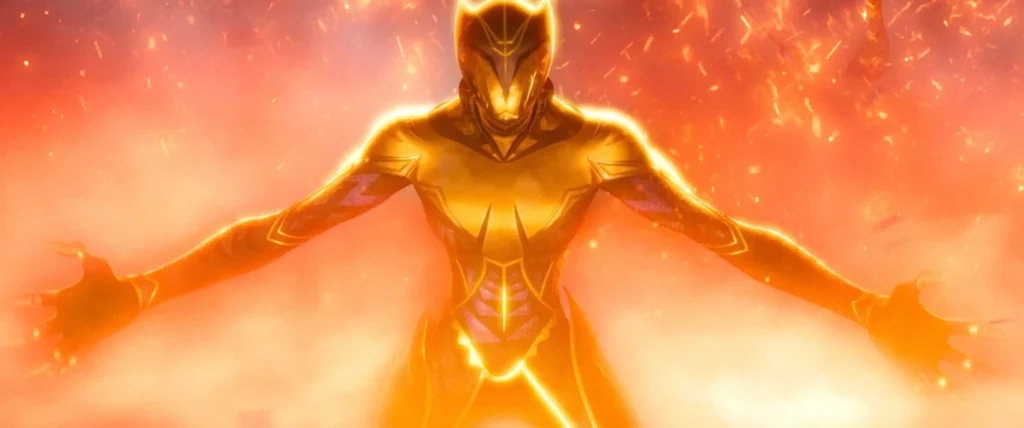
In Crete, 1260 B.C., a modestly sized army of Wakandans led by a masked, vaguely divine warrior-king known as The Lion takes the island by force and ensnares its people, branding the men and teaching the women poetry and music, asking them only to smile in return. (I’m reminded, I think deliberately, of the backlash against Brie Larson’s Captain Marvel, who was apparently too sullen for her own good.) One of the captured women is not a native, though.
In a brief explanatory flashback to six weeks earlier, back in Wakanda, we learn that this woman is Noni, of the merchant tribe, a former Dora Milaje who was expelled from the order on account of refusing to work with the group. Akeya explains who The Lion is — Nkati, a former captain of the Royal Guard who fled the kingdom with dozens of dangerous items and loyal men, using Wakanda’s advanced technology to style himself as a God-king. The fear is that he might assemble an army big enough to threaten Wakanda itself, so Noni is dispatched to deal with him and recover the stolen technology. Her reward will be reinstatement into the Dora Milaje.
From here, “Into the Lion’s Den” is a string of impressively animated action sequences with Noni taking on the Lion’s menagerie of themed goons until an inevitable final confrontation between Noni and Nkati himself. Crucially, though, Nkati reiterates that he left Wakanda because of the nation’s secrecy and lies. He worked within the Hatut Zeraze, or War Dogs, a secret network of spies who travelled the world carrying out the missions that Wakanda would never admit to. But the problem with allowing Wakandans to see the world is that they risk seeing too much of it. Nkati has a point, but the shackles and forced worship are a bit far, and Noni tells him so. She defeats him in combat, albeit losing one eye in the process, but Nkati would rather die than return to what he perceives as slavery, so he activates a self-destruct mechanism in his golden throne (told you he went a bit far with the worship thing).
Noni survives, but is unable to retrieve all of the technology Nkati stole. She’s allowed back into the Dora Milaje, but she refuses — instead, she wants to join the War Dogs and lead the efforts to recover the remaining technology that has been stolen from Wakanda. Akeya welcomes her.
Episode 2, “Legends and Lies”
Episode 2 of Eyes of Wakanda retells the Trojan Horse legend with a twist or two, playing with the fun concept that the Hatut Zeraze were so secretive that they were intimately involved in historical events and the creation of famous legends without anyone realising it. And that sneaky subtext is essential to this story, which pivots on the idea of mistruths being the underpinning of every legend. The only constant is the lies.
Brotherhood and betrayal are essential ideas here, with the protagonist, a Wakandan apparently named Memnon, having embedded himself among the Myrmidons for nine years. In that time, he has befriended Achilles, who trusts him implicitly and considers him a brother. With Achilles on the cusp of sealing his own legend, he has no idea that Memnon’s real mission is to secure the vibranium artifact being worn as a pendant around the neck of Helen of Troy.
When Odysseus devises the plan of sneaking the Myrmidons into the city in the belly of a horse disguised as a peace offering, all of this comes to the fore when Memnon abandons Achilles to pursue his own objective. A vengeful Achilles, devastated by the betrayal, refuses to let Memnon leave with the artifact, and they fight to the death, with Memnon getting the upper hand thanks to Achilles’s only weakness — his heel.
Successful in his mission, if not anything else, Memnon returns to Wakanda, where Noni is now an elderly woman and the director of the Hatut Zeraze. His real name is B’kai, but after so long pretending to be someone else, he can’t adapt to life in the home he fought so hard for. The secrets and lies, it turns out, have a profound cost.
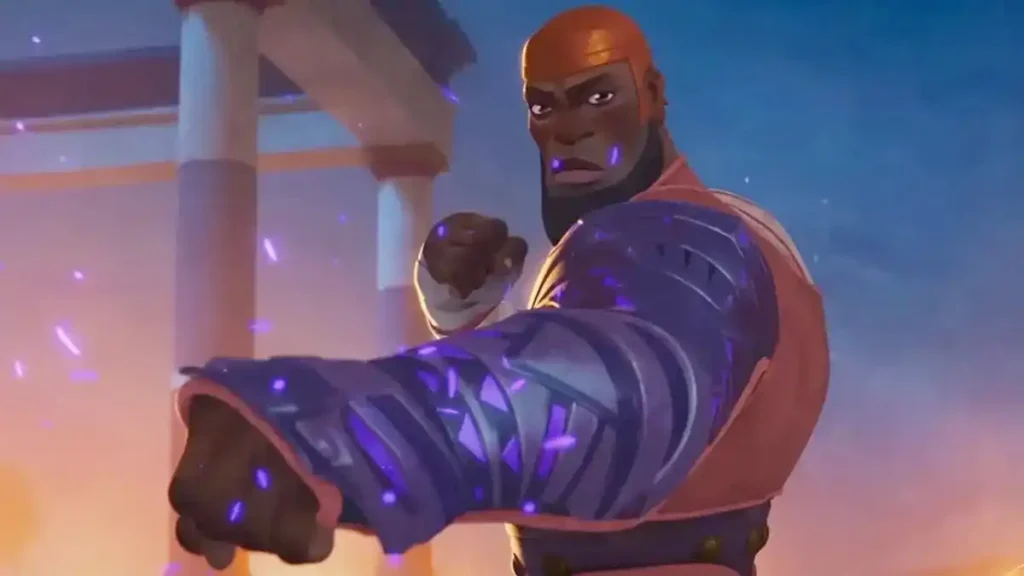
A still depicting Memnon in Eyes of Wakanda | Image via Disney+
Episode 3, “Lost and Found”
Ownership is a complicated concept. A central tenet of Wakandan society is that vibranium is very much their thing, so the centuries-long treasure hunt for the stuff that was smuggled into the wider world has been a pretty unambiguous crusade. Vibranium belongs to Wakanda and thus, even a thousand years later, anything containing vibranium must necessarily also belong to Wakanda. But over such a long period of time, is that necessarily how it works?
This is the argument made by Episode 3 of Eyes of Wakanda, which takes us to China in 1400 A.D. and introduces us to Basha, a cavalier War Dog whose mission to retrieve a sliver of vibranium from a mountain temple takes a turn for the worse when his entitlement earns the wrath of the Immortal Iron Fist, who happens to be the woman who kindly took him in.
The interesting push-pull of this episode is that Basha believes the statue of a dragon with a vibranium tongue is property of Wakanda simply because that’s where the vibranium originally came from, whereas the Iron Fist, whose name is Jorani, believes that in the centuries that have unfolded since the vibranium was lost, the cultural significance that has developed around the statue is more meaningful to her people than the vibranium ever was to the Wakandans, and thus the status belongs to her.
The dilemma works because both sides have a point, and also because it includes a lot of fun action than finally does an Iron Fist justice and boasts a monorail sequence better than the one in the first movie. The trophy room of pilfered vibranium artifacts is also a great location for a fight, showing off tons of creative vibranium weaponry but also raising the uncomfortable question of the Wakandans participating in righteously motivated cultural theft (also look for a Lion mask cameo).
The ending’s a happy-ish one, with Basha pretending to High Councillor Rakim that the whole thing was just a training exercise to test the facility’s readiness to repel a foreign intruder, and Captain Ebo helping Basha smuggle Jorani out of Wakanda. But the joke about the vibranium tongue being pretty easily removed, and thus the entire debacle easily avoided through communication and cooperation, is a deeper idea that functions as a critique of Wakanda’s determined isolationism.
Episode 4, “The Last Panther”
On the subject of that isolationism, the final episode of Eyes of Wakanda explores the idea most adroitly. Since Wakanda keeping to itself also means deliberately ignoring the conflicts and issues blighting the rest of the African continent, that’s easier for some than others. Prince Tafari is one who struggles with the idea, especially when he’s sent on a mission in 1896 to observe a War Dog named Kuda retrieving an artifact from the city of Adwa, Ethiopia, in the midst of Italy’s aggressive colonial expansion, which is reducing Adwa to rubble.
Tafari is eager to please and manages to steal the artifact, an axe, but while he and Kuda are returning to Wakanda with it, they’re ambushed by a robotic Black Panther who turns out to be the Queen of Wakanda 500 years in the future. The reason she’s in the past, though, is because her Wakanda has been utterly destroyed by an alien race known as The Horde. While the nations of Earth fought back against the invasion, Wakanda didn’t, since their laws prohibited cooperation with outsiders. Eventually, the Wakandans were left to fight the Horde alone and were almost entirely destroyed.
In a last-ditch effort, the queen used quantum technology to travel back through time, looking for a link that determined their doomed future, cycling through all of the previous episodes to eventually arrive at the moment that Tafari took the axe. This is a vital hinge point. If the axe is left precisely where Tafari found it, it will kick-start a change of events that will eventually result in Wakanda opening its borders and cooperating with other nations (which, in case you’ve forgotten, is what happens at the end of the first Black Panther movie).
Kuda is sceptical, but Tafari is able to convince him, and together they return the axe while the titular last Panther, 500 years in the future, fights back the Horde to prevent them from passing through the quantum passage. Tafari is successful, which realigns the timelines and ensures that the events of Black Panther take place. Since King T’Challa ultimately ends Wakanda’s isolationism, 500 years in the future, the Horde will be met with a united front that will defeat them.
In a lovely touch, the final scene of Eyes of Wakanda Episode 4 settles on Erik Killmonger. The axe he stole from the museum in Black Panther is the very same one that Prince Tafari replaced.