Summary
Chief of War continues to take its time in “City of Flowers Part II”, but the groundwork is paying off in strong ways in terms of both plot and character.
In another relatively subdued chapter, Chief of War continues to skillfully set the stage for enormous conflicts to come. These range from the macro, such as Kahekili’s pending invasion of Hawai’i, and the micro, such as what Ka’iana will do when he finally makes it home, only to discover his best friend in bed with his wife. Hawai’i’s brewing civil war for the title of God of War would probably fall somewhere in the middle, in terms of scale. If Episode 4 proves nothing else, it’s that there are plenty of fights still to come.
Some are currently ongoing. Kahekili’s campaign to conquer O’ahu, for instance, is almost complete, but it is raising some concerns even among his own men. With the kingdom of Hawai’i having just lost its king, Kahekili thinks now would be a good time to invade and complete what he is framing as the prophesied unification of the islands. One of his troops expresses some understandable concerns that wiping out royal bloodlines doesn’t seem like prophecy or unification, but Kahekili has a ready-made excuse. His theory is that true unification can only happen when just a single bloodline rules all the islands. And, of course, that bloodline will be his. I think the dissenter gets off rather lightly, since I was pretty sure Kahekili was going to kill him.
Hawai’i’s leadership issues form a big part of “City of Flowers Part II”. Keoua, the son of the former king, fully expects to inherit control of everything, so he’s absolutely fuming to discover that Kamehameha has been made God of War, in charge of all military matters. Keoua’s so mad that he knocks one of his own teeth out to symbolize the end of his mourning period — a not uncommon but also not universal practice, I’m led to believe — and promptly declares war on Kamehameha’s side of the kingdom. It’s a bit of an overreaction in my book, but people take lines of succession pretty seriously. Just ask HBO.
Kamehameha is at a bit of a loss, though, and Ka’ahumanu, despite believing herself to be well-positioned as his wife to give him some sage advice, is warned away by both John Young and Moku on the grounds that women shouldn’t have a say. Because she’s a revolutionary, she ignores this advice completely and, in one conversation, is able to coach Kamehameha to a breakthrough. He was sitting around hoping the gods would speak to him; Ka’ahumanu tells him that in their absence, he can make the right decisions on his own. What he decides is not to wage war on Keoua — but if Keoua decides to wage war on him, he’ll make sure he wins. Seems fair enough.
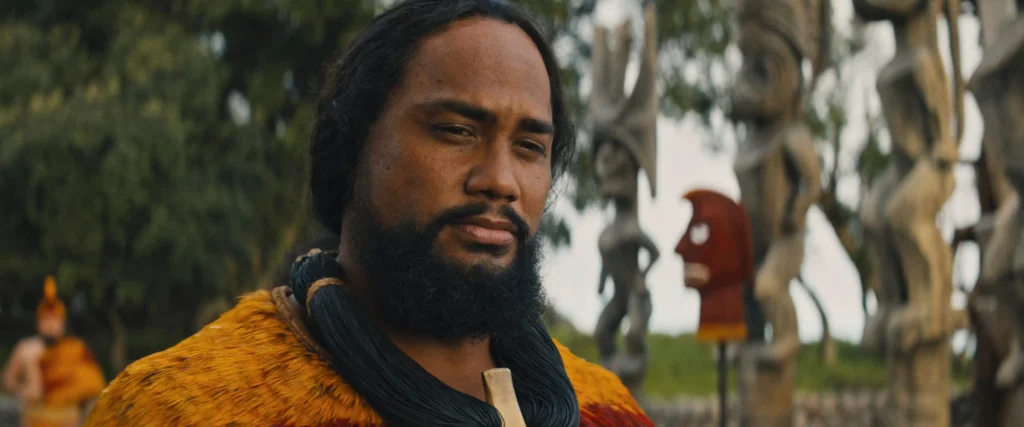
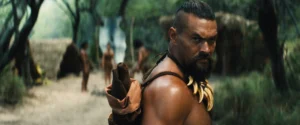
Kaina Makua in Chief of War | Image via Apple TV+
Hawai’i isn’t as idyllic as advertised for anyone, really. It has been a while since Ka’iana left, and some, such as Heke and Namake, are ready to move on. The latter has an ulterior motive, though, since he has pretty serious eyes for Ka’iana’s wife, Kupuohi, which apparently is a long-time thing. Nahi is pretty ticked off about it, perhaps because he would see a union between those two not just as a betrayal but also as confirmation that his brother is never returning. Of course, Ka’iana is returning, not that anyone in Hawai’i is to know. This makes it extremely bad timing when Kupuohi finally succumbs to Namake’s advances, despite earlier rejecting him. I’d hate to be him when Ka’iana gets back.
And Chief of War Episode 4 makes it clear that Ka’iana is coming back, even if he remains in Zamboanga long enough to complete the pretty important side quest of freeing the slave population. This is spurred on by Tony’s disappearance, which Ka’iana refuses to let go, despite Marley trying to send him off in the wrong direction. Once Ka’iana sees women and children locked in cages and batters a Spaniard out of fury, making himself a wanted man, he realizes that Tony is in imminent danger.
It’s Vai who points him in the right direction, albeit reluctantly. Ka’iana’s scenes with Vai are fascinating since she’s the most direct link to his home but has also thrown off most of its trappings, preferring to live among the Paleskins. She points out to Ka’iana that, back on the islands, his chiefly caste wouldn’t have paid any attention to her or her family whatsoever, and in those circumstances, she was better off leaving. Since Ka’iana is learning a lot on his journey, that’s something he’d do well to internalize. If there’s a major change coming to the islands, which we can assume there is based on all this setup, people like Vai will be integral to it.
Ka’iana manages to find Tony in a warehouse full of other slaves, and while freeing him, starts a riot, frees the other prisoners, and kills several Spaniards for good measure. He makes it back to the boat with Tony, so he’s leaving Zamboanga for good, but at least he left in a blaze of glory. Now he’s heading back home. But what will he find when he gets there?
RELATED: