Summary
The ending of Smoke is definitely going to be divisive. Episode 9 leaves a lot unresolved, but it’s a real showcase for Taron Egerton and Jurnee Smollett.
You can tell that the ending of Smoke is going to be one of those that defines how people feel about the show overall. It might retroactively ruin the season for many. If the point of a finale is to provide a concrete resolution, then “Mirror Mirror” fails. But the clue’s in the title. This isn’t a show that has ever been about plot particulars, at least not really, which is why it revealed the identities of both arsonists so early. This is a story about people discovering who they really are, finally looking in the mirror and seeing, perhaps for the first time, what’s staring back at them. It ultimately doesn’t matter whether Dave is convicted of being the D&C arsonist or murdering Detective Burk. What matters is that we see Dave Gudsen for the first time. And that he sees himself.
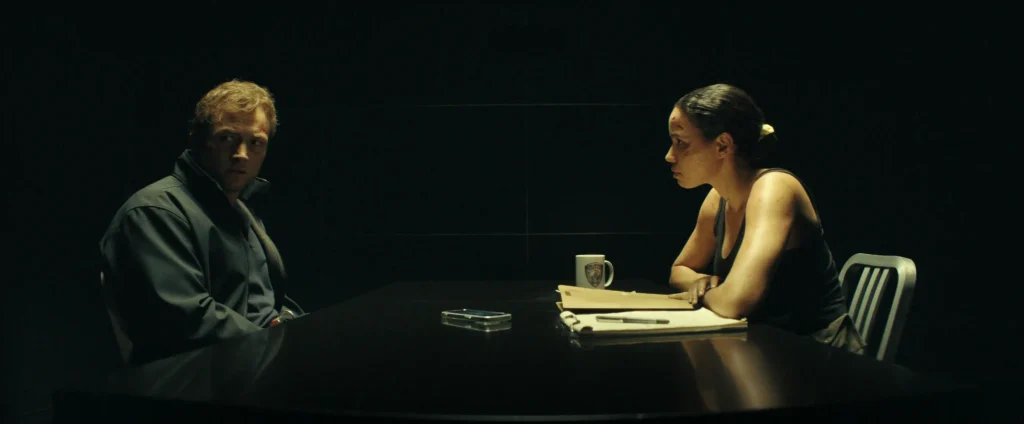
The way this manifests is as an actor’s showcase for Taron Egerton and a less showy but no less brilliant one for Jurnee Smollett. Repeating a trick from the brilliant seventh episode, much of this finale takes place on either side of an interview table, and the game of psychological one-upmanship is riveting but inconclusive in almost every respect. The only thing we know for certain leaving “Mirror Mirror” is that the Dave we know — the Dave he believes himself to be — is not quite the real one, a twist that, to be fair, I predicted way back in the sixth episode. But in the context of this show’s underlying thematic texture, it might be enough.
From the Ashes
A lot of this finale unfolds in the long spectre cast by the death of Steven Burk. This isn’t a surprise, since Michelle suddenly killing him in the penultimate episode also gave her an opportunity to frame Dave. The planted glove containing his DNA does the trick. Even though Ezra and Hudson were both keeping an eye on Dave while he spent the night at Reba’s and thus know he isn’t guilty of this particular crime, everyone’s keen enough to catch him that nobody’s interested in looking into Burk’s death too closely. Except, that is, Captain Pearson (played by a guest-starring Amy Carlson), a close friend and colleague who promises to rain down a fecal storm on whoever was responsible.
When Michelle spots a camera on a neighboring property that may well have caught her leaving the house, she realizes that this might put her in Pearson’s crosshairs, and so puts Benji to the task of covering things up. Benji’s obvious criminality and Michelle’s total lack of interest in policing it are one of many ways in which her morality is reiterated. Remember, she already framed someone this season. She just killed her lover and boss and used the murder as an excuse to frame her partner. Even though Dave is guilty, Michelle is not the good guy here. There are no good guys in Smoke, which is becoming increasingly clear.
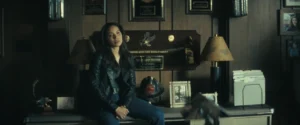
But it’s important to understand this, since it’s integral to understanding how Michelle is just a version of Dave, someone defined by trauma, neglect, and specifically fire, whose neuroses have just manifested in different ways. Dave and Michelle are distinct species of criminal, but they share a common ancestor. This is why so much of the finale, which need I remind you is titled “Mirror Mirror”, involves Dave and Michelle looking directly at each other.
Into the Fire
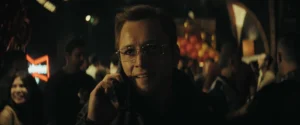
At a loss, especially since Reba won’t provide an alibi for him, Dave returns to work, just like he did in the previous episode. He knows he’s going to be framed, but he also knows that there’s no evidence to implicate him as the D&C arsonist, and certainly none — or so he thinks — to tie him to Burk’s murder. He still believes he can get away with everything; that he should get away with everything. He needs to gloat to make himself feel in control.
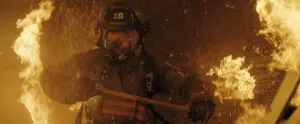
But he also takes the opportunity to try and kill Michelle. When a wildfire breaks out, he and Michelle chase it. This isn’t the job of an arson investigator, but it’s a good opportunity for a chat. Since the previous episode, the only chats that these two are interested in having are ones that give away they’re onto each other. They’re testy, teasing exchanges designed to rile each other and, hopefully, result in something being given away that might be used against them. But Dave becomes increasingly manic, driving the car into the fire at dangerously high speed, unbuckling Michelle’s seatbelt, and deliberately crashing. He’s saved by the airbag, and she’s thrown through the window.
Michelle survives and, in her fury, opens fire on Dave, beats him, arrests him, and quite clearly considers executing him, all in a sequence fringed by flames and possessed of a very obvious, very strange psychosexual undercurrent. One imagines that Dave, in particular, would have hated the side-on shot of Michelle looming over Dave with her gun in his mouth, since the optics are very submissive. Then again, based on how he gets down with Reba, maybe he’d have been fine with the idea.
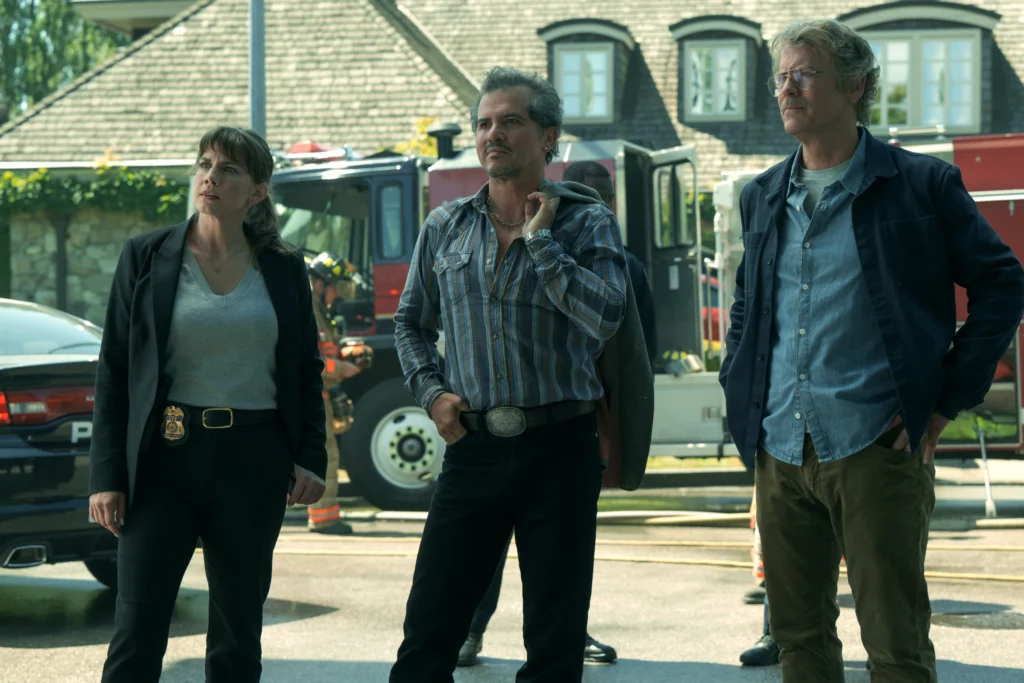
Anna Chlumsky, John Leguizamo and Greg Kinnear in Smoke | Image via Apple TV+
The Real Dave Gudsen
Michelle’s interrogation of Dave is deliberately very reminiscent of Dave’s interrogation of Freddy. But the terms are slightly different. Both are well aware of who they’re dealing with. The tension comes from Dave believing no evidence exists to implicate him, and Michelle having the evidence — including the sealed records from the independent investigation into the hardware store fire, which correlate with details in Dave’s novel — to tie him to the D&C fires and Burk’s murder.
Egerton is unbelievably good here, and he plays Dave’s gradual unravelling expertly. It’s the unravelling which is the point, by the way. Dave believes himself to be the hero of his own story. The character in his book isn’t a version of himself he’d like to be; it’s a projection of the version of himself he believes he is. His entire life is like that. When he looks in the mirror, he sees young, handsome Taron Egerton. He isn’t the D&C arsonist; he’s the hero tracking him down.
This becomes clear as things progress. While this is going on, Ezra and Hudson secure a warrant to search the car Dave crashed on the way back from the arson investigators conference, wherein they find a box containing the D&C arsonist’s trademark attire. Ezra sends Michelle pictures, and when she shows them to Dave, he realizes he has run out of road. But part of that realization is him visualizing himself following the D&C arsonist into a store, ready to catch him. “I’m not that guy,” Dave repeats, as the camera swings around as though it’s going to reveal the face of the arsonist, which in a way it does. But this is an important detail. On some level, Dave’s delusion is so strong that he has convinced himself that he isn’t the arsonist. He’s the hero.
Dave’s “defeat”, so to speak, is the revelation that he’s not young, handsome Taron Egerton. He isn’t the hero. He’s the chubby, balding, limping loser who has wrecked three of his own marriages and countless lives. That flicker he saw of himself in the hospital mirror is who he really is, staring back at him from the two-way glass of the interview room. We might have seen it coming, but it’s still expertly done.
And Everything Else
Also notable in the ending of Smoke is how much is left completely unresolved. We don’t know whether Dave is convicted, either of the D&C crimes or Burk’s murder, and by extension, we don’t know if Michelle’s involvement in the latter ever comes to light. We don’t know why Harvey bothered to spend a long scene in the previous episode revealing how he was embezzling funds from the department, since it doesn’t come up again, and we don’t know what happens to Ezra’s career (or why he was continuously able to work with the police despite not being a police officer.)
We don’t know how, based on Dave’s true appearance, he managed to marry a woman who looks like Reba. We don’t know what’s going to happen with Michelle’s mother, or whether there’ll be any comeback from the lengths Benji went to in order to remove the evidence. We don’t know what the remote-controlled lab fire was all about. There are a ton of unanswered questions, that’s inarguable.
The extent to which you care about that will determine how you feel about this finale, which is about character and thematic resolution and not, evidently, wrapping up every plot point in a neat little bow. Is Apple TV+ angling for a sequel, maybe? I have no idea. I’m not sure a follow-up could ever work as well. But what is here, what is resolved, is still a remarkable feat of acting and a satisfying(ish) payoff to everything that has come before. Almost everything, anyway.