Summary
Alien: Earth shifts focus in Episode 3, exploring more of the Lost Boys and raising some interesting questions about Wendy’s relationship with the Xenomorphs.
“Metamorphosis” is defined as a transformational change, often from an immature form to an adult one, so despite conjuring images of butterflies bursting from chrysalises, as far as Alien: Earth is concerned, it applies less to the Xenomorphs and more to the Lost Boys. Episode 3 hinges on another big question, posed by Morrow to Slightly: “When is a machine not a machine?” The two ideas are obviously related. Boy Kavalier’s synthetic children are designed to grow up quickly, but given their unique fusion of human consciousness and man-made bodies, what will they grow into? And how might it be defined?
This, I’m beginning to suspect, is the point that Noah Hawley and co-writer Bob DeLaurentis are most interested in exploring in this show. You could see it a little in the premiere, where it was clear that the whims of corporate overlords were a more horrifying danger than any alien species. But you might have forgotten during the brilliantly nostalgic second episode, which was set almost entirely aboard the Maginot in a claustrophobic homage to the original movie. Sure, that episode made the point that the Xenomorph might be more of a good guy than usual, but the assumption was that the show was making a point about class. Here, all its points are about existentialism.
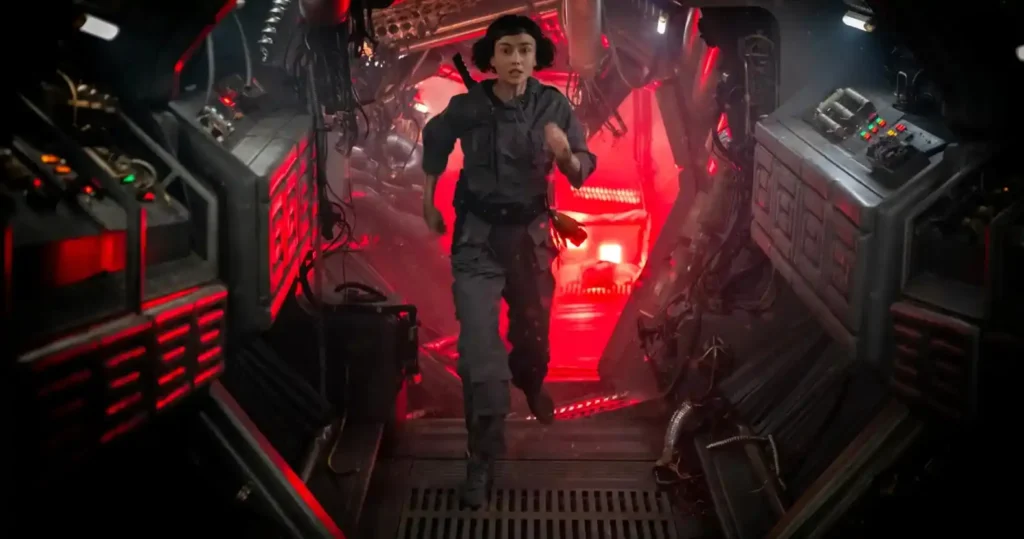
Episode 3 of Alien: Earth shifts away from the Maginot rather quickly, but it does take a moment to snip off that thread and allow a bunch of compelling subplots to grow out of it. First, we have Wendy and Joe’s early encounter with the Xenomorph, which is the only alien action in the entire episode. All that fuss about the Lost Boys’ superhuman abilities counts for little, since the Xeno is able to get the drop on Joe and almost kill him before Wendy intervenes. Even then, while she’s somehow able to behead the creature – it occurs off-screen, behind a metal door that is used brilliantly well in the staging of the scene – she comes out badly damaged.
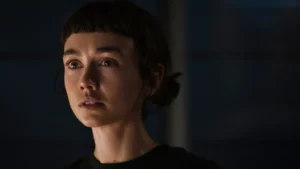
This decision sidelines Wendy and Joe, who occupied the bulk of the focus in the first two episodes, for most of the runtime. The space they leave behind is filled by the other Lost Boys, namely Nibs and Curly, who are more accurately Lost Girls, and Slightly and Smee. Lots of different things are happening here, narratively and thematically. Nibs is becoming disillusioned with the idea of what the kids have sacrificed in exchange for immortality; they get to live forever, but as the toys of a barefoot boy genius whose interest in them is already waning. Curly, though, thinks the opposite, seeing her new abilities and elongated lifespan as an excuse to learn as much as possible in the hopes of one day supplanting not just Wendy as Boy’s favourite but also, potentially, Boy himself. This is an instinct he seems to nurture in a creepily flirtatious way, but he is, ultimately, a child himself. Prodigy or not, just like he can’t see the danger his sudden desire to “own” the Xenomorphs presents, he also can’t see the downside of grooming someone who might ultimately outgrow and outsmart him.
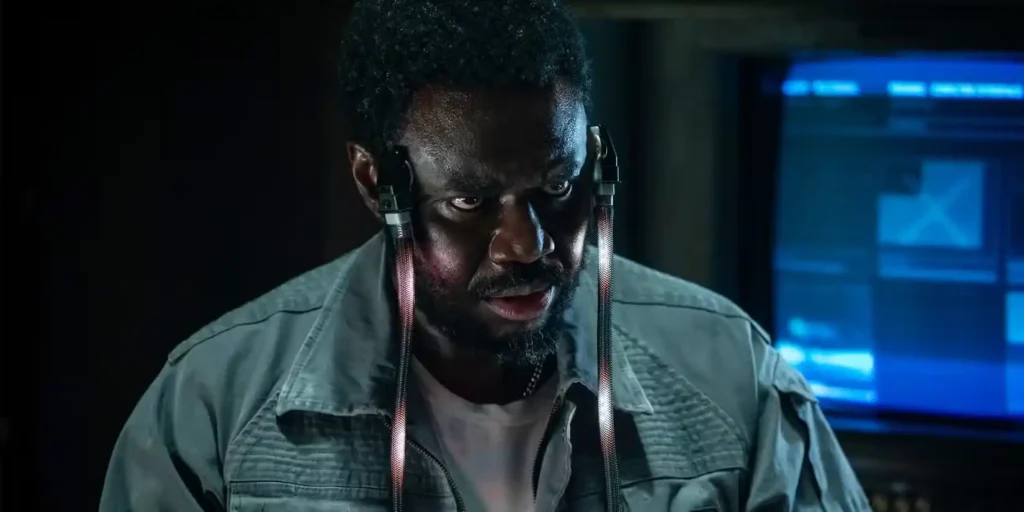
Babou Ceesay in Alien: Earth | Image via FX/Hulu
Sometimes, it’s easy to forget that the Lost Boys are children. But it comes across very strongly through Slightly and Smee, in lots of little ways and some more obvious, comedic ones. The way they sit and talk and play childish games around a Xeno egg; their instinctive need to hide behind Kirsh when they feel threatened. They make a nice counterpoint to Morrow, who discovers them still aboard the Maginot wreckage and is immediately intrigued by their nature. His own is up for some debate. He’s a cyborg who has spent 65 years on a mission to retrieve the Xenomorph samples he has immediately lost control of. Whatever humanity he might have had has been aged out of him, and now the aliens are not just his life’s work, but his sole reason for being.
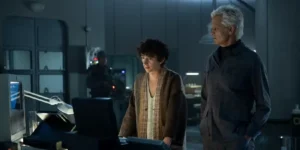
Morrow is the true wild card of Alien: Earth, which comes across in Episode 3. While he’s technically property of Weyland-Yutani, his call to Yutani herself suggests that he isn’t going to necessarily be told what to do. His personal connection to the Xenomorphs, the way they have replaced everything else in his life, is now what motivates him, and he’s determined at all costs to get them back from the Prodigy City lab where Kirsh is presently experimenting on them. To do this, he goes through Slightly, whom he had earlier surreptitiously fitted with a tiny device that later allows him to beam his voice directly into Slightly’s mind. Like Boy and Curly, here’s another instance of a child essentially being groomed, this time as a “friend”, for the nefarious purposes of people who wish them ill. Morrow can recall enough of his humanity to know how to manipulate Slightly, but is too much of a machine to feel bad about it. The whole thing’s a fascinating dynamic.
And this is to say nothing of the more quintessential Alien stuff, questions about which are where this episode leaves things. Kirsh’s experiments turn up the tiny Xeno tadpole thing that lives inside the Facehugger. Once removed, it’s placed in a tank with Joe’s removed lung, where it quickly burrows inside the organic tissue. But while this is happening, Wendy is staggering through the halls in agony, being tormented by snatches of the experiments. Somehow, she’s connected to the Xenomorphs on a biological level. Did that happen when she fought the Xenomorph, or is there some other, more nefarious explanation? Either way, it’s a compelling enough question to tide us over until next week.
RELATED: