Summary
Beyond the Bar is as functional as ever in Episode 8, but it’s also becoming a little predictable and formulaic in its structure.
Is someone working on Beyond the Bar reading these recaps? It feels like it sometimes. Only yesterday, I was complaining that the office politics of this show threaten to become a little overwhelming, and in Episode 8, a lot of that stuff is dealt with out of the gate. You can still quibble a little about what Yullim’s sexist toxicity really says about the underpinnings of the drama, since it’s kind of hard to root for favourable outcomes for this firm when you know what’s going on behind closed doors, but whatever. As I’ve reiterated over the weeks, this is a drama about the law and how the law affects Hyo-min and Seok-hoon specifically, and as long as that angle is covered, which it continues to be, then I don’t think there’s a great deal of room for complaint in this regard.
But I also hinted at Beyond the Bar becoming just a mite too formulaic, and I reckon that comes across here more than usual. It isn’t a bad episode, not by any stretch. The difficulty of the domestic abuse case at its core helps to develop Hyo-min as a character and Seok-hoon as her mentor, since it’s his advice specifically that helps her to achieve a positive outcome. But I found my attention wavering just a fraction, and if you asked me to highlight a really standout moment or idea from this episode, I’d struggle. Take that as you will.
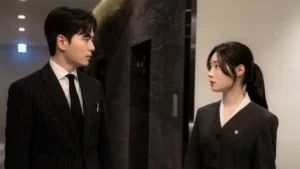
Roughly half of this episode is devoted to Seok-hoon attempting to clear his name after the allegations stemming from Na-yeon’s sweeping structural changes, and while this is functional and necessary, it mostly serves to underscore the abhorrent internal culture fostered by the senior advisors. It also helps to retroactively recontextualise some of the things we’ve seen involving Hye-jin, who has been suffering from terrible workplace abuse and harassment at the hands of Hong Do-yun, a truly nasty piece of work, and this is probably what works best about the entire endeavour. We already know that Seok-hoon is smart and always a couple of steps ahead, so that side of things isn’t especially compelling.
Meanwhile, Hyo-min’s case involves a news anchor, Han Seol-yeon, supposedly having assaulted her husband. However, she can’t remember the event, having dosed up on prescription psychiatric medication and simply woken up at the police station. But the evidence is, apparently, pretty substantial, enough so that the only reasonable path of argument is for diminished capacity on account of the drug-addled stupor.
For what it’s worth, Seol-yeon is “guilty”, but that’s the point – her attacking her husband occurred in the very specific context of him having abused her for years, so he technically deserved it. That isn’t a strong legal argument, though, which understandably causes Hyo-min some problems, but it’s enjoyably meaty thematic territory, especially given how Beyond the Bar Episode 8 chooses to handle it. Seol-yeon has a really interesting arc, wherein she begins to associate her medication as a source of liberating superpowers, and her assault as freedom from her oppression. Again, I wouldn’t be keen on the prospect of trying to argue this in court, but it’s a fascinating and, on some level, very understandable idea.
What trips Hyo-min up, legally speaking, is that Seol-yeon voluntarily took the medication with the intention of rising up against her husband thanks to it; that kind of invalidates the logical capacity defence. Here’s where Seok-hoon comes in, advising Hyo-min to use a loophole to argue that Seol-yeon wasn’t of sound mind when she took the medication in the first place. It gets Hyo-min the win she’s looking for and allows Seol-yeon to avoid a prison sentence, even if it’s a bit ethically dodgy.
And this is where I think Beyond the Bar Episode 8 feels a tad weaker than usual, since it has already reached this same conclusion multiple times throughout the season. I’m getting just a wee bit tired of Hyo-min having a tough case, discussing it with Seok-hoon over a hot drink, and then magically arriving at a solution. It’s perfectly fine and functional storytelling, but it’s being used a fair bit now in largely the same way, and I’d appreciate it a lot if we got a curveball soon just to liven things up.
Maybe next time.
RELATED: