Summary
Alien: Earth is arguably at its best in Episode 5, a flashback that smartly evokes the original movie with some new twists and surprises.
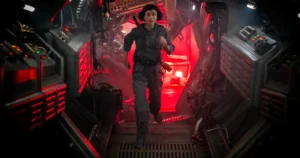
I’ve never been more thankful for a flashback episode. Usually, such things are the lowest common denominator of flat-pack TV storytelling, but after whatever was going on in the previous episode, I’m just thankful for a reprieve from Boy Kavalier. Episode 5 allows Alien: Earth to essentially redo the original movie with some neat twists and turns, evoking the same retro-future aesthetic of the Nostromo, all clunking green text and eminently pushable buttons, but seeding its sterile corridors with newer nasties. It’s also framed a bit like a murder mystery, mostly just for fun.
What we’re seeing is the downfall of the USCSS Maginot, the ill-fated vessel that Morrow and the Xenomorphs crash-landed on. I’m not sure we needed to see any of this – I praised the premiere at the time for not showing any of it – but I’m glad we did, especially in the context of the season overall. Alien: Earth has a lot of good ideas, but I’m increasingly beginning to feel like what I mostly want from it is exactly the kind of throwback Alien experience that “In Space, No One…” so capably provides.
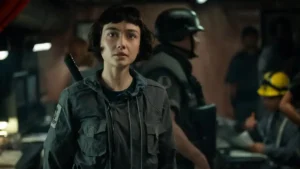
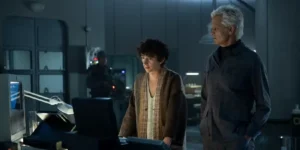
Anyway, needless to say, the hour is framed almost entirely in Morrow’s perspective. Seventeen days before the Maginot’s scheduled arrival on Earth, he was awoken from cryosleep to be informed that the captain is dead, having been latched onto by a facehugger and then broiled in its acidic blood during attempts to remove it. This is a problem for self-explanatory reasons, but also because the specimens escaped due to a fire that was set by a mysterious saboteur. Morrow’s mission, straight from Yutani, is to ensure the safe transport of the cargo, and the crew is very much expendable, so he’s to pull double-duty in figuring out who’s skulking around the vents and making sure they don’t do it again while also keeping an eye out for any more escaped specimens.
In the captain’s absence, Executive Officer Zoya Zaveri assumes command, but she’s instructed by Mother – the ominous computer aboard all Alien ships – to prioritise the cargo over the crew, lest Morrow usurp her. The point is pretty clear. Morrow is the quintessential outsider, the not-entirely-human agent of the entirely inhuman interface that insistently types the demands of corporate overlords to the crew. He’s Mother’s son. And this, understandably, makes it difficult for him to conduct an official investigation.
This is my favourite aspect of Alien: Earth Episode 5. It plays with the usual trappings of a mystery, but all the gossip and clues Morrow uncovers about his fellow crewmates are instead put to use in forcing them to give up the information he needs because they won’t play ball any other way. It’s an extremely pragmatic and unfeeling approach, which is its own kind of characterisation, since there’s something pragmatic and unfeeling about how Morrow is manipulating Slightly in the present day. This isn’t just an explanation of what happened, but how and why it happened, so we can understand how it’s repeating itself on Earth, just in a slightly different way.
It only makes sense, then, that the ship’s saboteur, Petrovich, is working on behalf of Boy Kavalier. Who else? Swayed by the promise of a new hybrid body and disillusioned by Weyland-Yutani’s alien-first approach to workplace safety, he was a willing agent. In some ways, he’s the antithesis of Morrow, who’s unflinchingly loyal and mission-oriented. But “In Space, No One…” even does something interesting with that, explaining Morrow’s manner not as programming or an innately defective moral character, but instead an outgrowth of trauma, having lost his daughter in a house fire when she was 19.
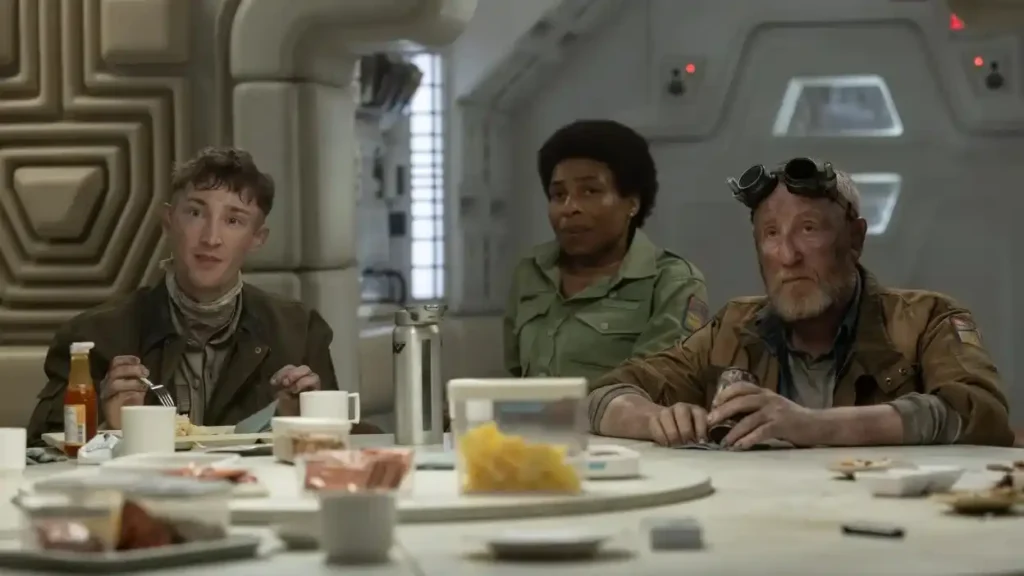
This makes Morrow more sympathetic, obviously, but also more frightening, since understanding how much he has lost means we also understand how little he has to lose. Babou Ceesay’s acting and some neat visual storytelling do a lot of heavy lifting here, but it’s the script that truly impresses. The way the crew of the Maginot is presented is sensational, immediately communicating everything we need to know about them, their responsibilities, and their personalities, so their deaths hit just hard enough despite us knowing for certain that they’re coming.
And Alien: Earth Episode 5 is another one that you shouldn’t eat or drink while watching, since its devotion to truly gross-out creature design and creepy-crawly imagery is impressive. There’s a bunch of truly nasty stuff in this, and some fine Xenomorph shenanigans towards the end that make it one of the better chapters in the season overall, even if it’s the least consequential plot-wise. The Maginot’s crew are fully-realised human beings from the outset, and their inevitably messy demises are a reminder of what’s at stake in this cold, corporatised, unfeeling vision of the future.
RELATED: