Summary
The Paper works as a spin-off from The Office, but it also stands on its own as a well-intentioned celebration of local journalism.
It says a lot that even in 2025, twenty years after it first debuted, simply being a spin-off of The Office is enough to constitute an entire marketing campaign. That isn’t bad going for an inferior version of the British original – a hill I’m prepared to die on – and The Paper, from Greg Daniels and following the same documentary crew that filmed the staff of Dunder Mifflin, milks the connection for all its worth. Fear not – the ten-episode series, which is streaming on Peacock, is a very worthy successor.
The time that has elapsed since that show, not to mention its astronomical popularity, creates an interesting vibe around this return to the same mockumentary format. Back in the day, part of the appeal – of the British version, primarily – was that audiences genuinely couldn’t tell if it was real or not. These days, the style, which has kept The Office in syndication since it ended in 2013, is not only familiar but has formed a rubric for countless imitators since, so the specific filmmaking grammar – the looks to shaky handheld camera, the cutaways, the slow pans to reaction shots – feels comfortingly familiar. The Paper undeniably feels like The Office. But it also feels like something else.
It’s called The Paper, by the way, because it’s about a newspaper, The Toledo Truth Teller. But it’s also called that as a nod to the Ohio-based company, Enervate, that apparently acquired Dunder Mifflin as part of its diverse paper portfolio, and then subsequently shuttered it. By the time the same documentary crew returns for a twenty-year-later catch-up session with the original cast, they find the world has moved on, the only legacy of Dunder Mifflin being Oscar Martinez (Oscar Nuñez, The Lost City, Solar Opposites), who is now The Truth Teller’s chief accountant and wants nothing to do with being filmed again. He has no choice in the matter, though, since the release he signed back in 2005 gave the documentary crew the right to use his likeness in perpetuity.
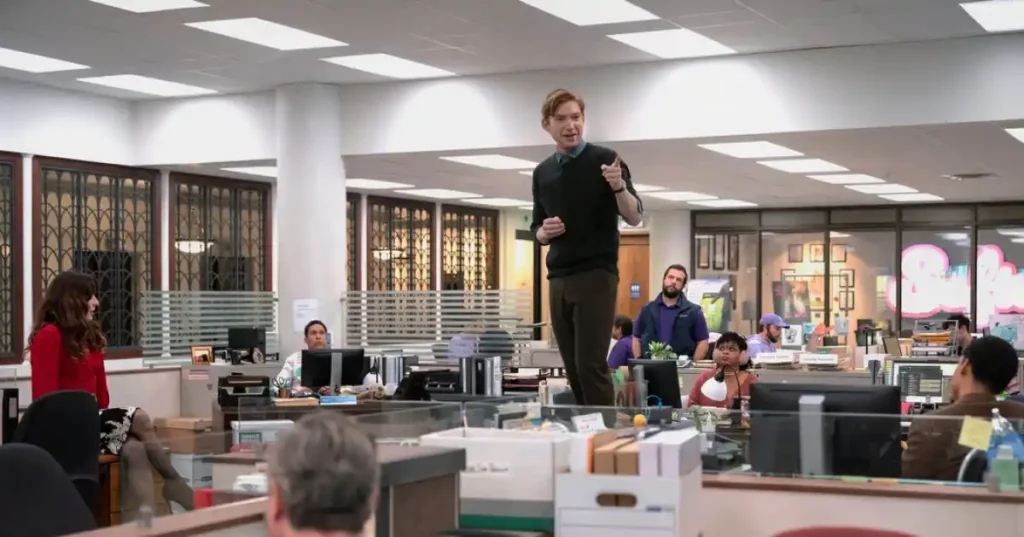
So, it looks like The Office, and has some direct connections, but The Paper is a show with more obvious narrative structure and momentum, and a bit more on its mind about the topics of local journalism and community spirit that it clearly holds quite dear. The plot is kick-started by the arrival of Ned Sampson (Domhnall Gleeson, Echo Valley, Fountain of Youth), a new hire sent by Enervate to serve as the editor-in-chief of a rag that has devolved into publishing nothing but wire service stories, sports scores, and, most importantly, ads.
The paper’s managing editor, Esmeralda (Sabrina Impacciatore, 7 Women and a Murder, The White Lotus), would like things to stay as they are, as would the money men, including Ken (Tim Key, After Life), an extremely Brent-like corporate strategist who is loathe to drum up the funding for Ned’s highfalutin ideas of bringing back real local journalism and abolishing celebrity clickbait. But some in the office, including ex-Army copy-paste specialist Mare (Chelsea Frei, Dollface), ad salesman Detrick (Melvin Gregg, High Flying Bird), circulation chief Nicole (Ramona Young, Never Have I Ever), and accountant Adelola (Gbemisola Ikumelo, A League of Their Own, Sex Education), become swayed by the idea of chasing real stories, and before long Ned has a team of reporters to play with.
The fact that none of these characters are easily comparable to ones in The Office says a lot about The Paper. Sure, there are some who qualify as caricatures, including Travis (Eric Rahill), who works in the same office but for Enervate’s toilet paper department and just wants to try out journalism as a lark, but the show’s critique of ordinary people trying to cash in on the reality TV boom, which constituted half the cast in both versions of The Office, is mostly reserved for management. The boots-on-the-ground team is mostly put to work in a well-intentioned narrative arc about the value of local journalism and honest reporting in an age where such things have been literally and figuratively sidelined.
To this end, the ten episodes of Season 1 regularly employ black-and-white flashbacks taken from an old documentary of the paper’s 1970s peak to create a then-and-now vibe, as Ned tries to recreate the halycon days of broadsheet journalism before it went online and descended into a quagmire of clickbait-driven digital advertising. There’s a real earnestness to these underpinnings that helps what might have otherwise been a funny but anodyne knock-off to feel distinct. Being a spin-off from The Office will get people in the door, but The Paper can stand on its own.