Summary
The Resurrected delivers a predictably downbeat ending. Revenge is achieved in a sense, but the cost is high, and a last-minute stinger implies it might not have been worth it in the first place.
The Resurrected is an exercise in endurance from beginning to end, but the ending itself is particularly guilty of compounding one awful revelation on top of another. There was, ultimately, no chance of a “happy” conclusion to a story about resurrecting a dead criminal to torture him for kicks and then use him to extort his wealthy family for civil settlement money, but even by those standards, Episode 9, “Judgement Night”, seems designed as a string of answers to the same question: “What’s the worst thing that can possibly happen here?”
I don’t just mean “worst” in the sense of “most horrific”, but more “most morally unconscionable” and “most damaging for a grieving mother to learn about her comatose daughter” – that kind of thing. Don’t get me wrong, there are still plenty of people getting shot, stabbed, tortured, and having their heads stoved in, but just like the basis of the revenge story is underpinned by the complexity of emotions being experienced by the grieving mothers who desire it, the payoff is in how deeply costly that revenge ends up being for everyone when the bill comes due.
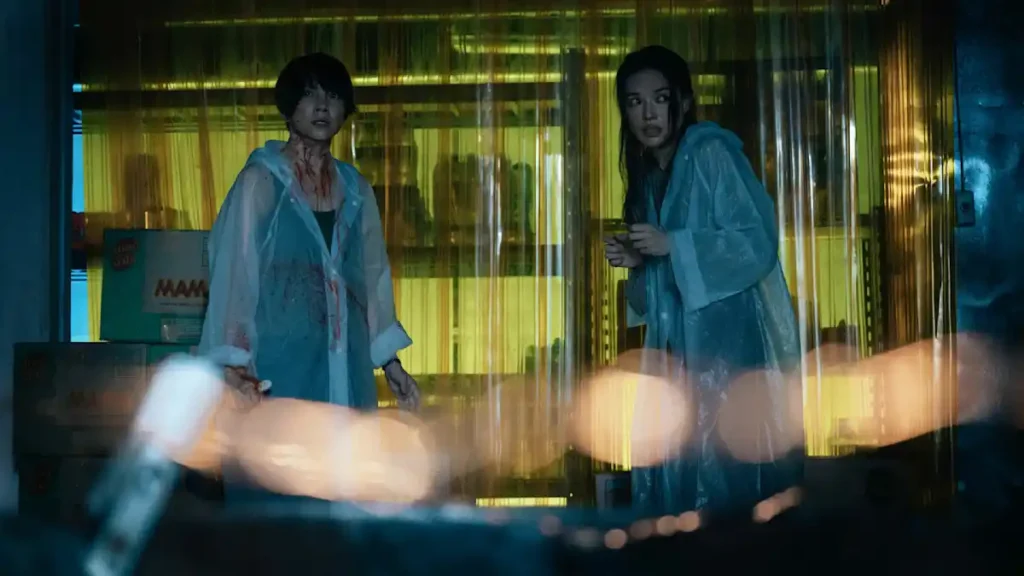
Having abandoned horror-adjacency and entered straight-up action-thriller territory, the finale finds a different show from the one it began as, but nonetheless one still rooted in the relationship between Hui-chun and Chao Ching. Now ostensibly enemies thanks to recent revelations, one of the big hooks here is whether they can get on the same page to enact their vengeance. But there’s a deeper, more insidious question to consider, one which recasts a victim as someone perhaps not worth all this trouble in the first place.
Hui-Chun and Chao Ching Against Each Other
By the time the ending of The Resurrected rolls around, Hui-chun and Chao Ching are on opposite sides. Both have been morally compromised by their own deeds, driven half-mad by grief, and turned against each other by the deft manipulations of Shih-kai. The clincher was that it was Jin Jin, Hui-chun’s comatose daughter, who sold out An Chi and Hsin-yi, resulting in the latter’s death. Kai claims they were in a relationship and working together, with her using her popular YouTube channel to lure girls into his scam.
This idea is still lingering over events in the finale. Despite a crypto wallet of payoff money being the MacGuffin that everyone is fighting over, financial remuneration having been posited as a kind of worthwhile cause after the idea of torturing Kai until he eventually disappeared began to feel hollow and pointless, the real crux of the drama is whether Hui-chun and Chao Ching will kill each other.
And they almost do. Hui-chun even goes so far as shooting Chao Ching – or so it seems, anyway. This development compels Kai to reveal that none of the girls ever turned against each other. He was tipped off by someone else. He deliberately manipulated everyone to turn them against each other, but, in a stinger, Ching pops up, perfectly well. The shot was fake. Kai’s final realisation, as he begins to disappear at the end of his seven-day resurrection, is that he has been outwitted.
Mommy Issues
In turning Kai against his own family and former associates, Ching and Hui-chun did, in a roundabout way, get their revenge. The entire operation was exposed, politicians were paid off, deals were torpedoed, and carnage ensued. There’s a victory of a sort.
One of the most noteworthy ways in which this manifests is Kai killing Chia-feng. Smug since the very beginning, watching him die at his execution, Kai’s “mother” gets his just desserts in a nasty way, shot and stabbed and shot again. It’s a cold and unceremonious ending, but a deserved one.
This degree of chaos and bloodshed is perhaps a consolation for Ching and Hui-chun not ending up with the crypto wallet. Money was never the point in the first place, even when they thought it was. Defrauding Chia-feng, who had lived in the lap of luxury even while they suffered, felt symbolically right, but unleashing Kai upon her and allowing her own chickens to come home to roost is revenge in a much more complete sense.
Jin Jin Was The Villain All Along
While the revelation that Jin Jin had sold the other girls out was a deception, the ending of The Resurrected confirms that she was more sinister than anyone else seemed to realise. She was openly conspiring with Yang to unseat Kai and take over the entire operation herself. The season even ends with her opening her eyes, framed in an unambiguously sinister way. Who’s the real winner here?
The cruel thing is that this development completely undermines Hui-chun and Ching’s entire quest, certainly the former. Their desires were rooted in revenge for innocent lives lost, for young girls – their young girls – being exploited. The idea that Jin Jin was complicit on some level, that all this has been done in her name despite her having been cut from the same cloth, completely undermines Hui-chun’s sacrifices.
This is what I meant about how miserable the climax really is. The point of revenge stories is always that revenge is ultimately hollow; that an eye for an eye leaves the whole world blind, and all of that. But the idea of revenge on false pretences, of so much suffering to avenge someone who was undeserving of it, is more awful still. And it’s only really the audience who know that truth and have to live with it. Thanks for watching.