Summary
The ending of Peacemaker Season 2 doesn’t provide much payoff, but it does open plenty of doors for the rest of the DCU, figuratively and literally.
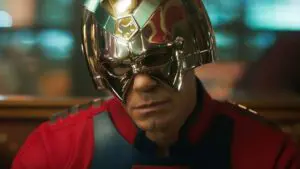
In many ways, the ending of Peacemaker Season 2 is exactly the opposite of what audiences have come to expect from the finale of a superhero show. It’s pretty low-key. It’s mostly driven by small, intimate character moments, and is largely about what the entirety of this season has been about – Chris Smith struggling to feel accepted in his own reality. But Episode 8 also has a DCU world-building mandate, a responsibility to set up the near-future of James Gunn’s multimedia reboot project. And you can kind of feel these dual purposes chafing against each other a bit in “Full Nelson”.
If I were to recount what happens in this episode in the traditional chronological sense, there’d be big chunks wherein very little of note occurs. You can summarise it really easily (and I will). But the point is bigger implications about the franchise’s future, namely in the form of Checkmate, a S.H.I.E.L.D.-style DC covert ops agency, and Salvation, a meta-human prison planet that seems to have been slightly tweaked from a spin-off from Final Crisis titled Salvation Run.
This stuff is inevitably going to matter. It might not matter in the form of a strict Peacemaker sequel, since I think we’re past that point, but these ideas and characters will pop up again in other corners of the DCU without question. You can’t give a finale too much praise for that alone, but it’s important to mention, especially in this kind of storytelling. And, to be fair, the emotional arcs at play here do make sense and feel satisfying, even if they ultimately lack payoff.
Chris Finds His Place
Speaking of those arcs, the most important is obviously Chris’s, which he has intimately connected to his romantic connection to Emilia Harcourt. There’s a good bit in this finale after he has been tricked into reuniting with the 11th Street Kids, where he lays out why he believes he’s cursed, and the argument is pretty compelling. He killed Rick Flag Jr in The Suicide Squad. In Season 1, we learned he had killed his beloved brother, and he later killed his father. When he visited an idyllic alternate dimension, he killed himself, and his actions led to the death of his father again. You can see his point.
This is why, after emerging from the Nazi dimension, Chris surrendered himself and the Quantum Unfolding Chamber to Rick Flag Sr and A.R.G.U.S. It’s why he deliberately avoided reuniting with his friends, and why they had to go out of their way to coax him back. Chris has to understand that he isn’t a bad guy, that he belongs here, that his friends genuinely care about him, and that, most importantly of all, Harcourt is as into him as he is into her.
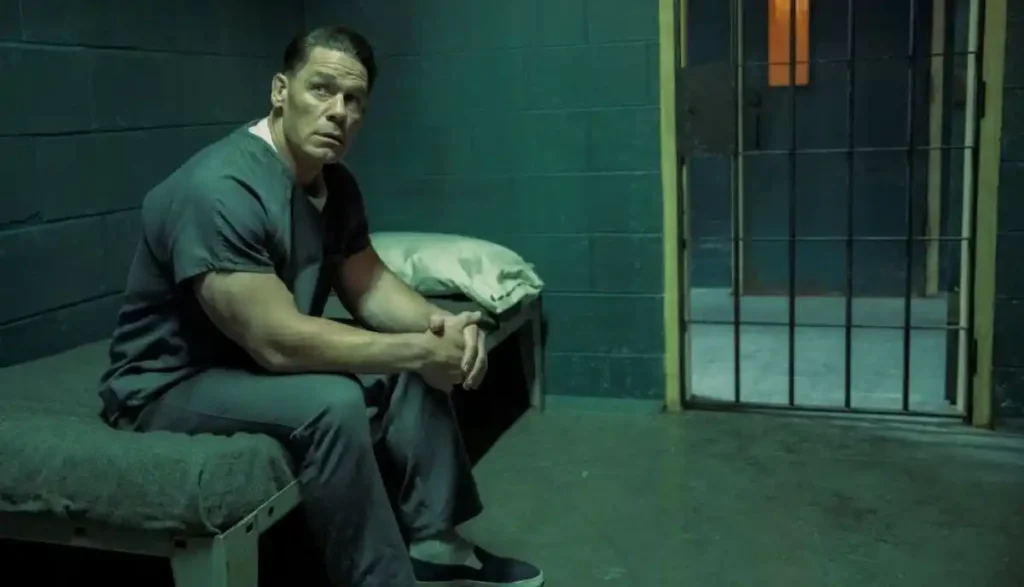
Flashbacks to the rescue, in that regard. But the payoff of Chris’s fist-pumping reaction when Harcourt finally reveals she feels the same way is what we were looking for from this finale. It’s why the ending stings so much. Just as things are starting to look up for Peacemaker, A.R.G.U.S. agents snatch him up and deliver him to Flag, who has falsified a signature confirming him as the first prisoner of his new meta-human prison. Chris ends Season 2 as the first and only human resident of Salvation.
Salvation
The reason Rick Flag wanted the Quantum Unfolding Chamber turns out to be his desire for an off-books meta-human prison that he eventually dubs “Salvation”. In this finale, he has A.R.G.U.S. investigate the various worlds contained inside the chamber – leading to some fun, silly scenes with hostile native fauna – until he finds one that can sustain human life. It’s here that Chris is sent.
It’s a familiar concept for comic book fans, the planet Salvation having featured in the aforementioned Salvation Run, where Amanda Waller and the Suicide Squad sent various DC villains through a Boom Tube. This seems conceptually similar, and the snarling animal sounds Chris hears at the end of the episode suggest similar plans for building a kind of contained conflict for control of the planet. It probably won’t be DeSaad and the New Gods of Apokolips, but it might be, since we’re going to have to work our way to introducing Darkseid eventually.
Either way, we’re very likely to return here in the future of the DCU, with Peacemaker’s close connections with the latest Superman having already been established through that Lex Luthor cameo.
Checkmate
On the other side of the aisle, the ending of Peacemaker Season 2 is also notable for the formation of Checkmate, an ad hoc intelligence agency comprising the 11th Street Kids and, somewhat unexpectedly but very excitingly, Sasha Bordeaux and Langston Fleury. I’m particularly excited about Fleury’s involvement in anything in the future, since his banter with Economos and, in this episode, Vigilante, is just brilliant.
This take on Checkmate seems to be an inversion of its typical comics incarnation, but it’s likely that certain elements will remain in check (such as connections to Max Lord and Batman). It’s a way to keep the 11th Street Kids sans Chris Smith involved in wider DC goings-on, potentially connecting them to other corners of the continuity in an organic way. And it also helps to officially position A.R.G.U.S., at least under Rick Flag Sr’s leadership, as a genuine antagonist faction.
I’m not sure how well all of this speaks to the quality of Peacemaker’s finale in and of itself, but as is lamentable but unavoidable about comic book storytelling in general, no single episode of any show ever really exists in and of itself, and it’d be weird to try and judge it as such. I think this season has largely been quite flawed, reiterative, and badly paced, but it really came together in its later episodes, and this climax opens plenty of interesting doors for the rest of the franchise to step through. On that level, if no other, it should be considered a success.