The latest in an increasingly long list of Netflix animations adapting recognisable video game IP, Splinter Cell: Deathwatch joins stuff like Castlevania, Tekken, Onimusha, and Devil May Cry in the storied “better than I thought it’d be” streaming canon. But it also comes with a few more expectations than usual. Ubisoft has inexplicably left the Splinter Cell franchise alone since 2013’s Splinter Cell: Blacklist, despite numerous rumours of sequels and remakes in the interim, making Deathwatch the first official release for over a decade. And it’s canon, building on the events and characters in the games, with only a few creative liberties having been taken to smooth the transition to television.
For long-time Splinter Cell fans – and given how long it has been since the last one, that’s basically the only kind of fan there is these days – this is kind of a big deal. We’re finally catching up with Sam Fisher, not in the form of a cameo in some other misguided Ubisoft project – RIP xDefiant, we hardly knew you – but in his official, original form. The storyline of this series isn’t a new take that exists in some weird pocket dimension, but a continuation of the narrative threaded through all the games, particularly Chaos Theory. It’s a proper trans-media sequel.
I thought it might be useful, then, after having watched all eight episodes, to lay out most of the Easter eggs and big connections between the Netflix series and the games. Some are minor, some are major, some are more or less effective than others, but there are enough of them for Deathwatch to feel like it exists within the storied franchise.
Splinter Cell: Deathwatch Is Canon
As mentioned above, a Ubisoft spokesperson told IGN that the Netflix series is canon to the games, despite some creative liberties having been taken to make certain story elements more amenable to a television format. I can confirm that this is mostly true. The show’s narrative involves Diana Shetland, the daughter of Sam Fisher’s friend-turned-rival Douglas Shetland, who appeared in Pandora Tomorrow and more notably in Chaos Theory, and includes several flashbacks clarifying Fisher’s relationship with Doug, which is similar in its broad strokes but slightly different in its details.
In the games, Doug was an old war buddy and friend of Fisher’s who was honorably discharged from the military after being scapegoated for a friendly fire incident in Bagram, Afghanistan. He subsequently sued the U.S. military and used the proceeds to found Displace International, an extremely successful private military corporation (PMC) that seemed legit, but was really being used to clandestinely bring about major regime change by engineering the East Asian Crisis that backdrops Chaos Theory.
In the show, Doug was responsible for going off the rails in Bagram, resulting in the deaths of Navy SEAL personnel. Sam subsequently testified in a military tribunal, which resulted in Doug being dishonorably discharged. While it isn’t clear how he would then have had the capital to found Displace, he seems to have done so anyway. In both Chaos Theory and the show, Sam ultimately killed Doug in largely the same way; the flashback in the show is almost word-for-word the same as the one in the game. This also canonises the ending where Fisher shot Shetland (in the game, you can choose not to shoot him, at which point he attacks, and Sam is forced to stab him).
Deathwatch Takes Place After Splinter Cell: Blacklist
Despite being most intimately tied to Chaos Theory, Deathwatch takes place way after the most recent game in the series, Blacklist. By this point, Sam has sequestered himself in the Polish countryside and has retired, grown out a man bun, and mostly raises animals with his dog, Kaiju. Anna Grimsdottir, meanwhile, continues to run Fourth Echelon with a new character named Jo.
The presence of Fourth Echelon confirms that Blacklist happened in the show’s canon. In that game, Fourth Echelon was established by U.S. President Caldwell as a top-secret black ops outfit to hunt down and eliminate a group called The Engineers. Fourth Echelon at the time comprised Fisher, Grim, a tech specialist named Charlie Cole, CIA operative Isaac Briggs, and black market arms dealer Andriy Kobin. Fisher and Grim had previously worked for Third Echelon, a top-secret branch of the NSA that was dissolved following the events of Splinter Cell: Conviction, wherein its director, Tom Reed, attempted to frame Fisher for the assassination of President Caldwell in order to prove the need for Third Echelon’s presence in the global espionage game.
A still from Splinter Cell: Deathwatch Cr. COURTESY OF NETFLIX © 2024
Deathwatch also confirms that Black Arrow, a PMC owned by Lucius Galliard and used by Reed to carry out his attempted coup, was a subsidiary of Displace International. Initially, it was canon that Black Arrow was “built on the wreckage” of the disgraced Displace and was subsequently bought by Galliard. Here, it’s strongly implied that Black Arrow is the PMC wing of Displace, and that despite having publicly claimed to have shuttered it, Diana Shetland is still using its operatives behind the scenes.
Easter Eggs Aplenty
As well as these more explicit narrative connections, Deathwatch is also full of small details that tie it to the world of the games. This isn’t intended as a comprehensive list of Easter eggs, since there are many and I haven’t played the games recently enough to catch them all, but there’s still plenty I personally took notice of.
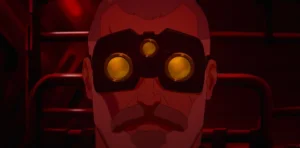
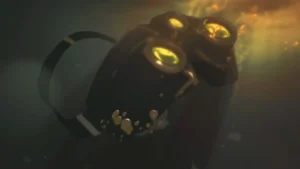
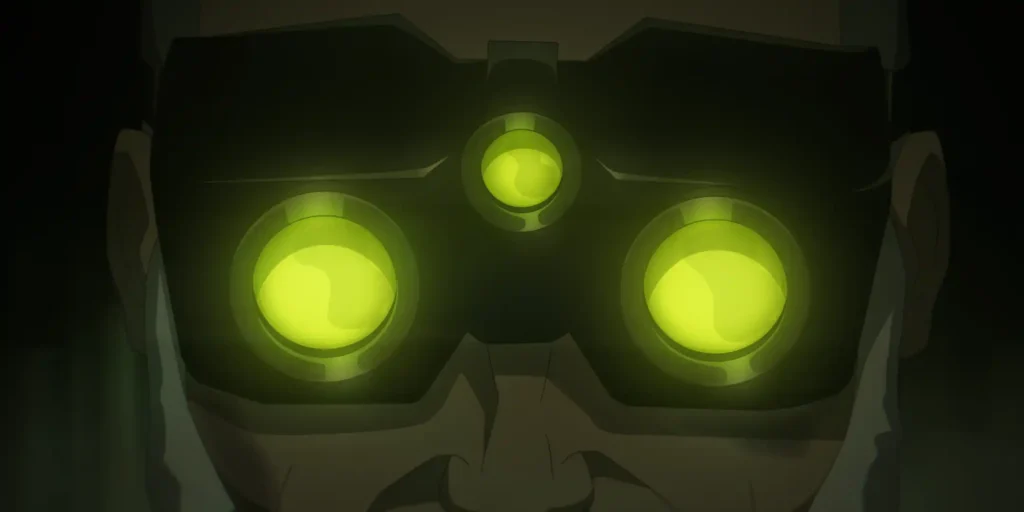
The most obvious one is the presence of the iconic trifocal multi-vision goggles, which make the exact same sound when turned on as they do in the games. Another is the wrist-mounted OPSAT (which stands for operational satellite uplink, by the way), which looks, functions, and again sounds the same.
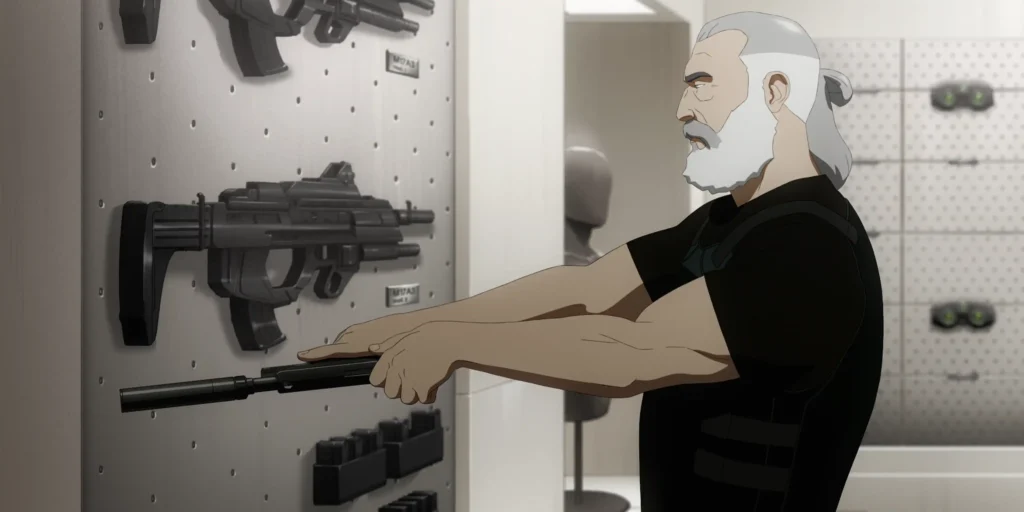
Some stuff is more subtle. In the games, plot exposition was often relayed through broadcasts by the World News Media network, a fictional broadcasting company that is briefly seen here as Sam watches a news broadcast. He also takes Zinnia McKenna, a new Splinter Cell character created for the show, to a safehouse of his in Gdansk, Poland, where his SC-20K rifle — pictured at the top of this article — is clearly visible. Unfortunately, he never uses it throughout the show. Maybe in Season 2.
RELATED: