Summary
Like all anthologies, Star Wars: Visions remains a mixed bag in Season 3, but one episode is a real masterpiece, and several others are well worth the price of admission.
There’s a very compelling argument to be made that, at least under Disney, Star Wars: Visions is the most interesting and perhaps even important project in the franchise. Being divorced from the broader canon allows storytellers from all over the world to offer their unique take on a galaxy far, far away, bringing striking visual styles and bold interpretations of long-standing ideas to the forefront of digestible collections. Season 3 operates in the same way, with another nine animated shorts offering brief snapshots of creativity, freed from the obligations of continuity minutiae.
It doesn’t always work like this, though, obviously. All anthologies tend to have their fair share of duds, and Visions has a few, including a handful in this third volume. But while its worst shorts are merely tepid, too-familiar takes on old ideas that don’t differentiate themselves enough visually or conceptually, its highlights are worth the price of admission on their own. Season 3 has a bunch of very good episodes, and one I’d quite happily consider a masterpiece of visual Star Wars storytelling.
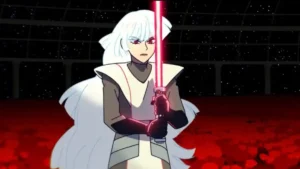
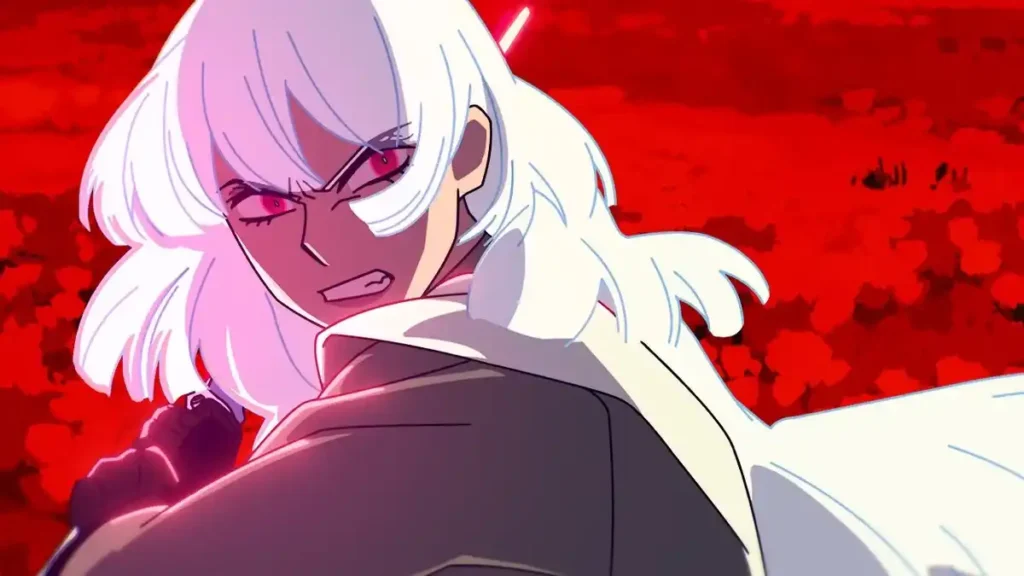
What this season does do, which sets it slightly apart from the previous two, is meddle in more explicit continuity. Several of the shorts here are connected to ones in previous volumes, including the opener, “The Duel: Payback”, a return to the Kurosawa-inspired samurai stylings of the first ever Visions episode, “The Duel”. Kamikaze Douga, now with help from Anima, revisits the Ronin with even more style and panache, and it’s a great example of why returning to the well is sometimes a good idea.
Less so in an episode like “The Ninth Jedi: Child of Hope”, though, a follow-on to “The Ninth Jedi” that awkwardly feels like the middle chapter of a story that doesn’t work without the explanatory context of the original and won’t end until a concluding chapter is created in a subsequent project. It’s a misfire not because it isn’t any good – none of these shorts qualify as “bad” in any traditional sense of the term – but because its style of storytelling is ill-fitting to a largely standalone collection.
“The Lost Ones”, a sequel to “The Village Bride”, fares better on the strength of its vaguer connective tissue, but that does raise the question of why bother to create a sequel in the first place just for that tangential value. On balance, I prefer the stories that are completely isolated, rather than backdoor pilots for ongoing miniseries, much like how the Ronin became a character in a tie-in novel and two one-shot comics instead of remaining an inscrutable, enigmatic knight-errant in that original depiction.
Then again, sometimes Star Wars: Visions Season 3 feels at its least provocative and exciting in these stories. Stuff like “The Song of Four Wings”, “The Bounty Hunters”, and “The Smuggler” are all very typical Star Wars stories that don’t stand out visually or narratively. They’re very good versions of familiar ideas, using the typical building blocks to craft fun stories with engaging characters, but they’re almost too Star Wars. Luckily, the show has a real knack for droid and creature designs, with the cute Woopas and lonely droid Teto being real standouts in that regard, and often there’ll be a standout action sequence or inventive flourish that keeps things lively.
“The Song of Four Wings” is also interesting in how it skews towards a younger audience, with a later episode, “Yuko’s Treasure”, taking this idea a step further by aiming directly at young kiddies in its animation and content. I’m always impressed by how adaptable the Star Wars universe can be in this regard, and it’s refreshing that Visions, as a projec,t is widely accessible, which is a claim that even a truly great show like Andor can’t make for itself.
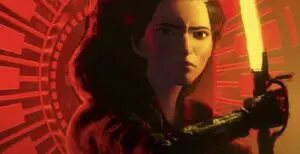
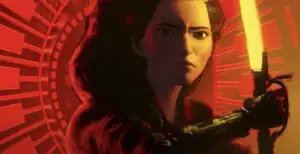
This volume of Visions saves the best for last, though. “The Bird of Paradise” boasts standout CGI animation that gives it a totally different look and feel from the other shorts, and it’s also a more intimate, introspective story revolving largely around a single character. But “Black” is equivocally a visual masterpiece, a nightmarish descent into the mind of an Imperial Stormtrooper that is, at least to me, the best single work ever committed to this series. If you only watch one episode of Visions, make it this one.
But don’t be put off by the rest of it either. A very good voice cast for the English dub brings a lot of these stories to vivid life, and so many of them are great fun that it’s well worth the time investment, especially considering that no short runs over 20 minutes and the whole thing can be gobbled down without any effort. Many fans are quick to disparage Visions for existing outside of the established continuity, but I still have a lot of affection for it as a reminder of just how much is artistically possible in the Star Wars franchise, and there’s a fair amount here worth a very close look for fans of animation and visual storytelling in general.