Summary
Liam Hemsworth is the least of the problems in The Witcher Season 4, which is hampered by wild inconsistency and baffling story choices much more than its casting.
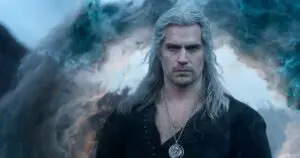
Let’s just get the elephant in the room out of the way – Liam Hemsworth is fine. Sure, he’s visibly doing an impression of Henry Cavill, which is sometimes convincing and sometimes less so, but it’s generally a good enough imitation that, if you squint a bit, you probably won’t tell the difference. Ultimately, though, it’s beside the point. Hemsworth has joined The Witcher at the right time, since Season 4 is when the general roadmap of Andrzej Sapkowski’s stories dovetails with the inconsistent changes in Netflix’s “Witcherverse”, meaning that at this point the whole thing is very much an ensemble and Geralt of Rivia is just one piece of a much larger puzzle.
Whether you like that or not is up to you, but it’s where we are, and it absolves Hemsworth of a lot of responsibility for a casting switch that was by no means his fault. Whatever problems there are with Geralt in this season, they’re not problems with Hemsworth’s take on him, but part of a wider issue of general inconsistency in writing, performances, and storytelling that sometimes lets The Witcher feel like a true fantasy epic and sometimes make it feel like something cobbled together on the fly by people with no idea what they’re doing.
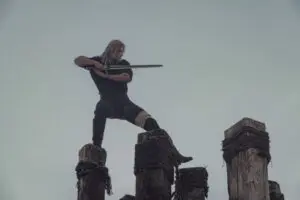
You can tell right from the jump. The opening of Episode 1 is a hilarious “previously on” montage with Hemsworth recast in Geralt’s key moments, the show desperately straining to prove that he can do everything he’s being asked to do just fine, thank you very much. The clunkiness extends into everything, as the plot widens following the events of the Season 3 finale to follow multiple point-of-view characters on several fronts, not all of whom seem to be operating with the same degree of concern for the wider plot. It’s extremely bizarre how the good stuff – and, don’t get me wrong, there is good stuff here – is wedged so closely to the terrible stuff; how they can often be ping-ponged between in the confines of a single scene or sequence. Sometimes the world feels rotten and real; sometimes it feels like a soundstage. Sometimes the visual effects are eerily, convincingly lifelike; sometimes they look like PS2-era computer graphics. Sometimes the core cast remember they’re on a world-saving, Continent-spanning quest; sometimes they seem to forget entirely.
You get the idea. Part of this is a structural issue. Geralt, Jaskier (Joey Batey), and Milva (Meng’er Zhang) are travelling together to Nilfgaard, where they believe Ciri (Freya Allen) is being held captive by her father, Emperor Emhyr (Bart Edwards). As we know, though, thanks to a convoluted set of circumstances facilitated by evil mage Vilgefortz (Mahesh Jadu), the “Ciri” in Nilfgaard is really Teryn (Frances Pooley), a brainwashed half-elf replacement. This means that Geralt and his gang, which quickly comes to include dwarf Zoltan Chivay (Danny Woodburn) and intractable barber-surgeon herbalist Regis (Laurence Fishburne), are heading in the wrong direction.
The real fight is being conducted by Yennefer (Anya Chalotra), who is portalling around the Continent on a recruitment drive to build an army of powerful magical allies who can stand against Vilgefortz and his remaining loyalists. Hiding out at Montecalvo, this subplot brings key players like Triss (Anna Shaffer), Fringilla (Mimî M Khayisa), Philippa (Cassie Clare), and Francesca (Mecia Simson) all to the same place, but that choice divorces them from the wider political goings-on occurring in other areas. The Witcher Season 4 does this consistently, keeping its key characters siloed in separate locations and storylines, giving the whole narrative an oddly disconnected feel.
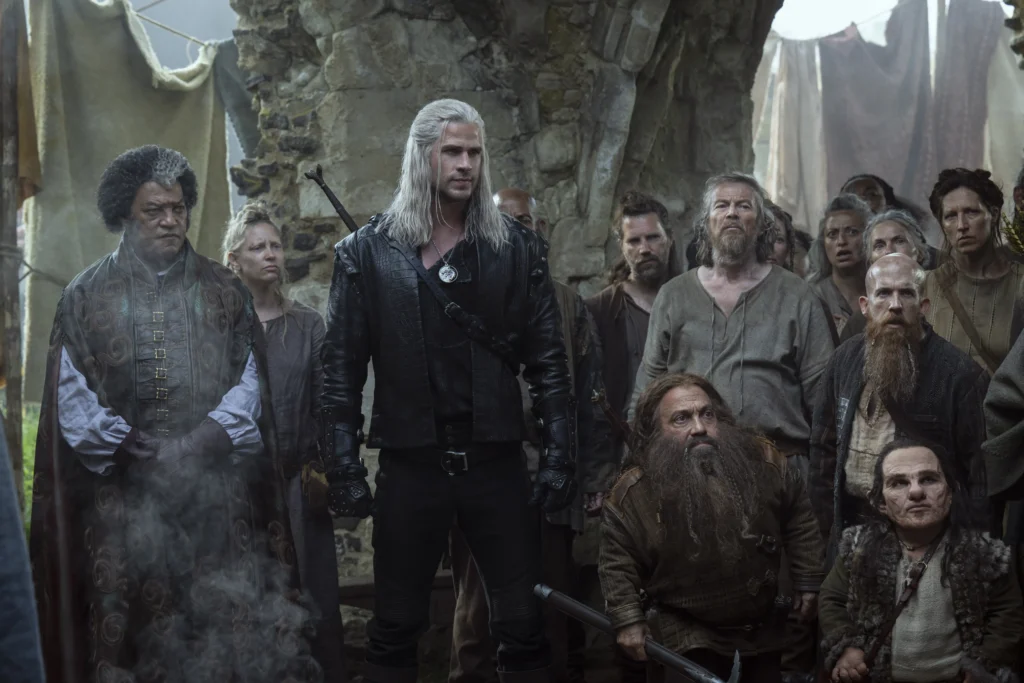
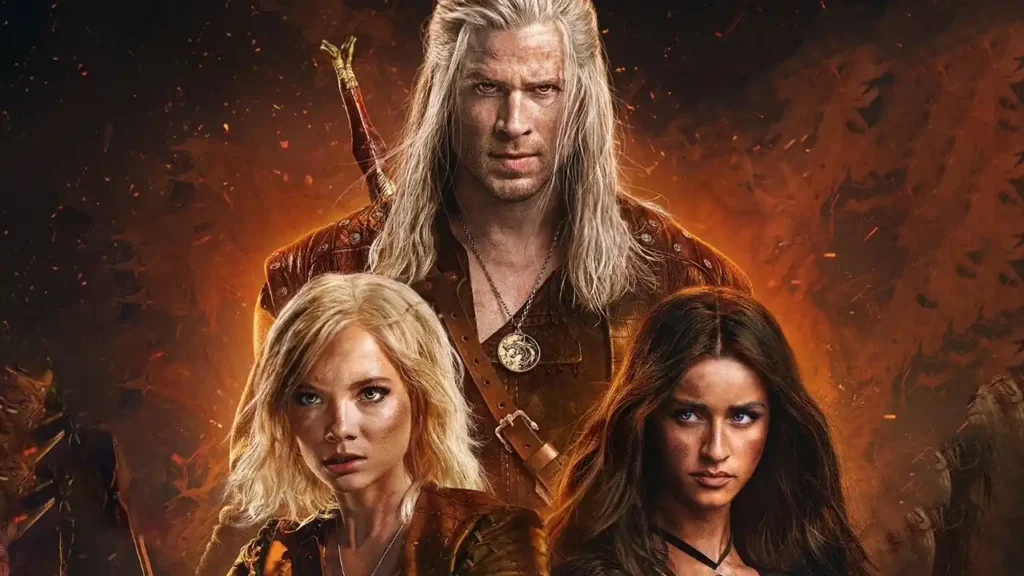
A group still from The Witcher Season 4 | Image via Netflix
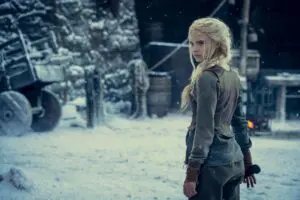
Even the real Ciri is well out of the way, although to be fair, her storyline with a group of Robin Hood-style bandits known as the Rats is probably the highlight. Freya Allen emerges as a surprising MVP whose circumstances have delivered her to a major evolutionary crossroads. She’s the only character who is intermittently unrecognisable for good reasons; her experiences have calloused her and turned her surprisingly ruthless, which makes her an interesting foil for the best new villain, Leo Bonhart (Sharlto Copley), a beloved bad guy in the books who doesn’t have a great deal to do here but whose presence is undeniably felt.
Even here, some of the writing is clunky and not all the performances work, at least not all of the time. But Season 4 of The Witcher seems to be largely about making the best of it, finding the highlights – a fun monster design or action sequence here, a sincere line reading there – amongst a churning sea of illogical narrative decisions, contrivances, and canonical adjustments. A certain subsection of die-hard fans will hate this season, although to be fair, given the previous outings, I’m not sure why they’d still be watching.
For those more familiar with or comfortable in the Netflix adaptation of this world, the problems are less egregious but still bothersome. It’s difficult to excuse the flip-flopping between sincerity and baffling disinterest that creeps into almost all of the performances, or the flattening of multiple character arcs thanks to a wonky story structure that gives interesting new characters, like Emhyr’s spymaster Skellen (James Purefoy), little of direct consequence to do. But there’s also some evolution in Ciri and Geralt that is enjoyable; the hardening of the former and the softening of the latter, though they’re kept apart for so long that it’s sometimes easy to forget they’re pining for each other. And the action choreography remains pretty top-notch, although it’s designed to be cool and show-offy more than dramatically involving.
It’s all quite predictable, ultimately. We all know this isn’t where the series was necessarily heading when it was originally conceived, and now, thanks to a litany of controversies and changes, it’s limping to a pre-determined finish with as much grace as it can still muster. A lot of the potential was squandered a couple of seasons ago, and in ill-advised spin-offs designed to flesh out a world that nobody seemed as interested in as Netflix expected. It’s a shame, but it is what it is. I still found plenty to enjoy, but mileage will vary considerably, and it remains impossible not to wonder what this show might have been in different circumstances.
RELATED: