
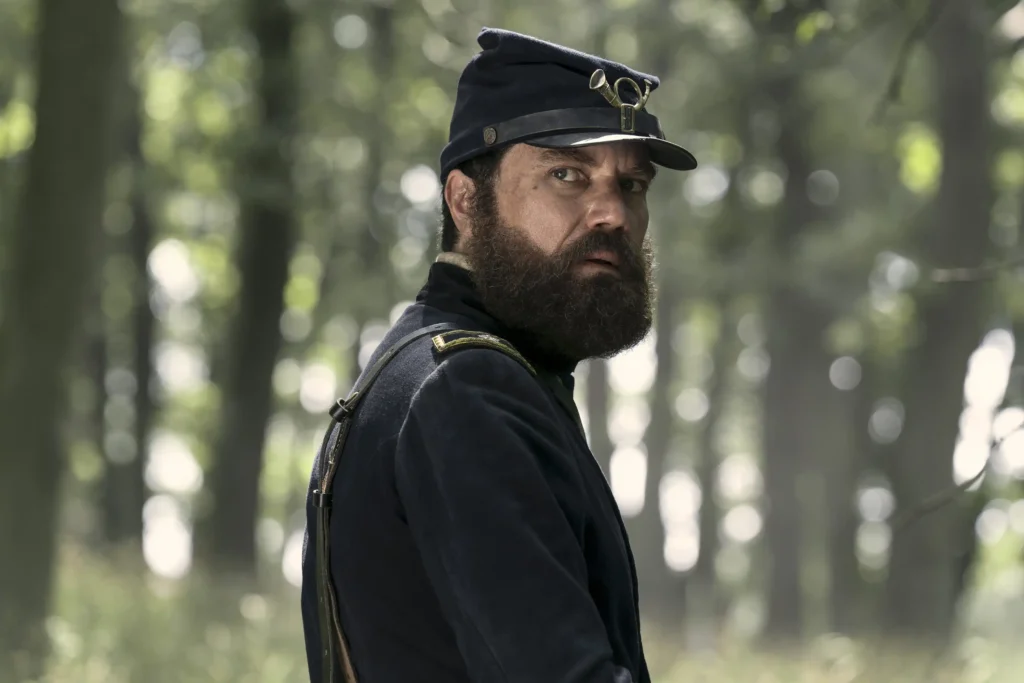
On July 2, 1881, U.S. President James Garfield was shot by Charles Guiteau in the Baltimore and Potomac Railroad Station in Washington, DC, having been in the White House only 120 days. Of this, at least, there can be no doubt. But as the ending of Death by Lightning proves, the shooting isn’t the half of it. Guiteau, a mentally ill office seeker who had convinced himself that he was responsible for Garfield’s election, was a symptom of a deep-rooted cancer metastasising through the republic’s entire political machinery. He fired the bullet, but what made it fatal, both literally and metaphorically, was a widespread resistance to the very change that Garfield was fighting for.
And on some level, Garfield never intended to fight for it, at least not from the highest office in the land. But some things happen by accident, or destiny if you’re that way inclined, and both Garfield and Guiteau were meant for the positions they ultimately occupied; a martyr in the case of the former, and a curious brain in a jar, in the case of the latter. Their knottily intertwined stories are compelling because they happened – the Netflix series, from Mike Makowsky, is based on Candice Millard’s Destiny of the Republic: A Tale of Madness, Medicine and the Murder of a President – but also because they continue to happen, just to slightly different people under slightly different circumstances.
The march of progress never ends, though. The present wends this way and that into an uncertain future, history trailing in its wake, doomed to be repeated if it isn’t learned from.
The Man Who Became President By Accident
While Garfield’s presidency was short-lived, the more remarkable thing about it is that it happened by accident. His nomination as the Republican candidate was almost entirely against his will. At the Republican National Convention, his intention was to endorse Treasury Secretary John Sherman. But his oratory was so fierce and passionate that an immediate swelling of support from within the party pushed him to the top of the ticket, ahead of the favourite, former President Ulysses S. Grant, and James Blaine.
At the time, the party was cleaved into two warring factions: The Stalwarts, represented primarily by Senator Roscoe Conkling and his right-hand man (and future president himself) Chester Arthur, and the Half-Breeds, represented by Garfield and Blaine. Key battlegrounds included civil rights reforms, about which Garfield was passionate, marking him as something of a progressive for the time (albeit at a time when the right to own another human being was still something of a partisan issue; to many, the idea of former slaves having the same rights as white Americans was unconscionable).
As his running mate, Garfield chose Arthur, a drunkard who had habitually benefitted from the rigged system that senators like Conkling wanted to uphold and was utterly unsuited to the Vice-Presidency – at least initially.
The Man Who Nobody Wanted
Charles Guiteau’s life was one of rejection. He was rejected by his father. He was rejected, somewhat improbably, by the Oneida Community, a free-love utopian religious sex-sect where he couldn’t even get laid. His speeches were rejected, his grand idea for a paper called The Daily Theocrat was nixed, and nobody, including Garfield’s administration or the Republican party in general, wanted to give him a job.
The problem with Guiteau is that he believed he was entitled to all of these things. His desperate need for approval and acceptance leads him into politics, and he ends up endorsing Garfield simply because he gets the nomination – the speech he wrote was originally about Grant, and he simply changed the name. But what he interprets as his long-term devotion to Garfield’s presidency morphs in his own mind into him being instrumental in his election. And because he believes that, he perceives being rejected by Garfield’s administration as a deep personal betrayal.
In reality, Garfield only met Guiteau once in passing. In Death by Lightning, that encounter is fleshed out a bit, but boils down, essentially, to Guiteau asking Garfield how to become great like him, and Garfield responding that he’s not especially great himself and it all happened by accident anyway. He’s a bit more eloquent than that, obviously, but the gist is the same. And that sentiment is anathema to Guiteau’s idealised vision of Garfield as a common man who grew into the embodiment of the American dream.
The Man Who Survived Being Shot (For A While)
On account of his constant rejection and what essentially amounts to a ban from the White House – at the time, office seekers would line up for hours a day to ask the president for positions, and Guiteau believed he was entitled to a consulship somewhere on account of the speech he wrote about someone else and only delivered once – Guiteau resolved to kill Garfield. Shooting him proved surprisingly easy, but it took him quite some time to actually die.
Guiteau shot Garfield at Washington’s Baltimore and Potomac Railroad Station, right in front of his family. The show’s title is ironic, since it’s taken from something Garfield says to his wife, Crete, when he refuses to employ private security: “Assassination can be no more guarded against than death by lightning. And it’s best not to worry too much about either one.”
The bullet missed all of Garfield’s vital organs and his spine and lodged neatly just behind his pancreas. It wasn’t a fatal shot. Garfield’s eventual death from infection was slow and painful, entirely needlessly. He could have quite easily survived.
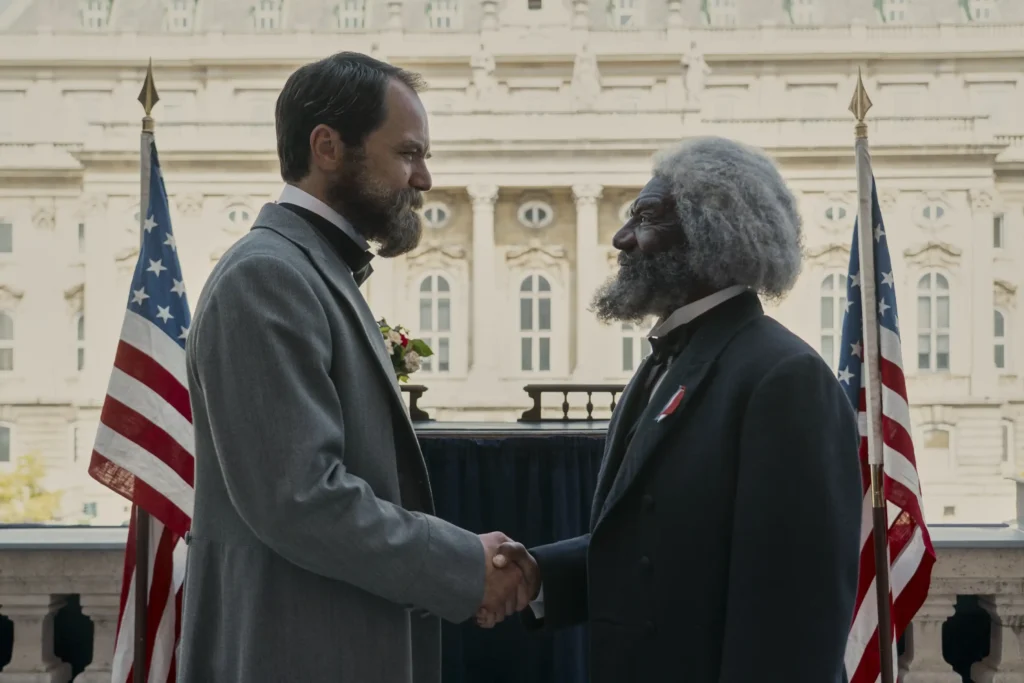
(L to R) Michael Shannon as James Garfield, Vondie Curtis-Hall as Frederick Douglass in episode 102 of Death by Lightning. Cr. Larry Horricks/Netflix © 2025
The Man Who Was Killed By Ignorance
Garfield was tended to by two doctors. One of them, Dr. Bliss, had served in the Civil War and was adamantly opposed to new medical research coming out of Europe that argued in favour of antiseptic treatment to prevent infection. The other, Dr. Purvis, who became the first Black doctor to treat an American president, argued that Bliss’s refusal to sterilise his equipment was unnecessarily risky.
Bliss won out, and continued to dig around in Garfield’s wounds until he came down with a severe infection that ultimately killed him. The bullet might have been the proximate cause, but it was ignorance and a refusal to embrace progress that ultimately claimed his life.
After his death, Garfield was replaced by the most unlikely candidate – Chester Arthur, who had spent most of Garfield’s time in office conspiring behind his back with Conkling, only to be repeatedly given another chance by Garfield, who saw something of himself in the man’s earlier efforts as a reform lawyer before being ensnared by the corrupt spoils system. Having grown a conscience as a witness to Garfield’s tragic story, Arthur served a single term in the White House, but spent his time there passing the crucial civil rights reforms that Garfield had intended to.
The Man Who Won’t Be Remembered (Until Now)
All Charles Guiteau wanted was to be important. To be needed. When it became obvious that he never would be in his current guise, he instead tried to become infamous. In this, he also failed, though one supposes the popularity of this series might reverse his fortunes somewhat.
Death by Lightning ends with Lucretia visiting Guiteau in prison just prior to his execution and clarifying that she will ensure he never achieves the celebrity status he covets. He killed Garfield too early in his term for the event to sustain public interest. Eventually, both he and Garfield will become footnotes in history. Only, Garfield has others, like Arthur, to continue the work he started. But Guiteau has nobody. He’ll die in anonymity and be forgotten.
Even to the end, he doesn’t believe it. As the hangman’s noose is slipped around his neck, he recites a bizarre poem he has written that he expects to be received as a fine piece of oratory, like the one that won Garfield the Republican nomination in the first place. Nobody in the audience cares. And with this realisation the last thing on his mind, Guiteau is executed.