
Summary
Marines provides unprecedented access to an expeditionary unit forward-deployed in the Pacific, but its function may be more as a recruitment tool than illuminating entertainment.
There’s a very specific tension to Netflix’s four-part docuseries Marines, and it’s the promise – not a suggestion, the outright guarantee – of war. Nobody’s entirely sure where it’s coming from. It could be China, acting aggressively in the Pacific as a show of force. It could be the Russia/Ukraine conflict spilling over across the rest of Europe, and indeed the world. It could be Iran or its various proxies in the Middle East, or a nuclear North Korea. But it’s coming, or at least the men and women of the 31st Marine Expeditionary Unit believe so, and they’d probably be the ones to know.
It’s an odd vibe for a documentary, especially one with its fair share of lighthearted moments and coming-of-age themes. The idiosyncrasies are, I think, intentional. There’s unavoidably a high-school feel to young men and women sharing close quarters, being ordered around, and fretting about exams, but in this case, the high school is a state-of-the-art U.S. warship, and the qualifications being sought determine who is ready to conduct complex operations across any potential battlefield, against any possible enemy. The consequence for failure, even in the training phase, can be death.
It can be difficult to square the underpinning stakes with the on-screen action, especially when there’s an occasional feeling that at least some of the subjects are being made fun of. The long-held cliché about front-line grunts being idiots is brought up by two best-friend bros who do little to disprove the notion, and later, someone else can’t remember the point he was making about why Marines are smart. A similar thing crops up a few times when young trainees are quizzed about their motivations for joining the Marine Corps, with an incredulous voice clarifying, “So, you’ve dreamed about killing people since you were a kid?”
This, coming from Amblin Documentary, is perhaps a little surprising given Amblin’s history with deeply respectful portrayals of America’s armed forces, including iconic ones in Saving Private Ryan, Band of Brothers, and Apple TV+’s recent Masters of the Air. None of this is to say that Marines is disrespectful or even skeptical of its subject, but director Chelsea Yarnell is willing to at least acknowledge some of the contradictions and weirdnesses at its core.
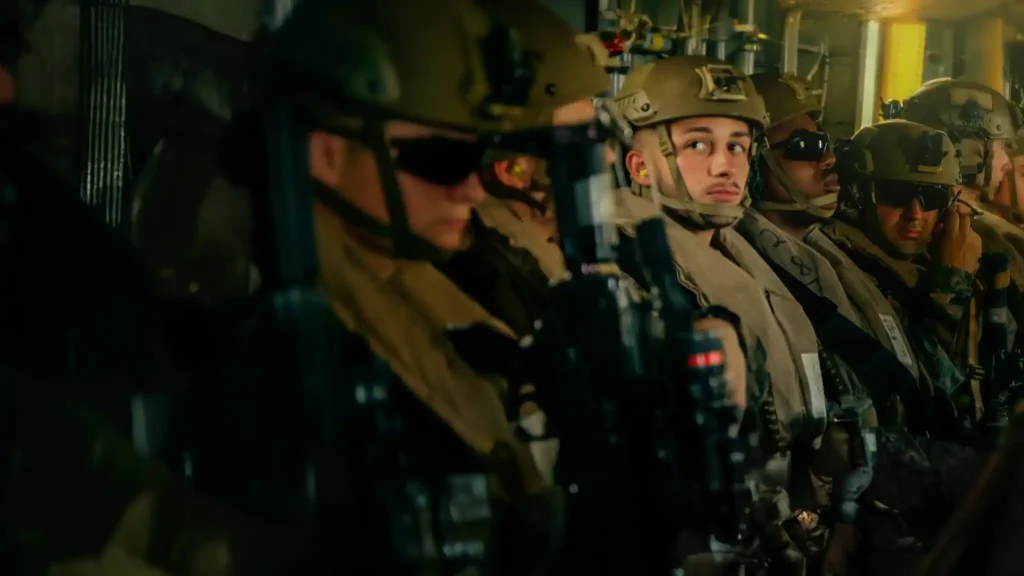
Four episodes, each under an hour, feels about right for this. CERTEX – certification exercises – create the season’s shape, with demandingly lifelike training operations forming each episode’s centre while various very real interpersonal stories and geopolitical conditions crop up around that dramatic nucleus. The entire breadth of the 31st MEU is accounted for, with gunners and scout-snipers, pilots and officers all fulfilling the role of talking heads. There are arguably too many to keep track of, especially since the series rattles through them at quite a pace, but the unprecedented level of access is appreciated nonetheless, and it always feels like the audience is becoming privy to an insulated culture with its own very distinct rules and codes of conduct.
With its release timed to coincide with the 250th anniversary of the U.S. Marine Corps’ founding in 1775, there’s doubtlessly a promotional element to Marines that constitutes something of a recruitment drive. While it isn’t all sunshine and rainbows and makes time for the rigorous physical pressures and subtler psychological ones that young service members navigate away from home and in combustible conditions, it’s reiterated near-constantly that the Marines fulfil a vital role in geopolitics and regional peacekeeping. The 31st MEU’s constant commitment to readiness – it’s the only continuously forward-deployed of seven such units – is also returned to continuously, a through-line that returns us to the endless threat, discussed at the top, of all-out war. There’s little doubt that the Marines are ready for such an eventuality. Some are even eagerly anticipating it. Maybe, perhaps based on how successful this docuseries ends up being, there’ll be many more ready to join the fight, which is perhaps the most unsavoury takeaway of what is otherwise an impressive and illuminating documentary.