Summary
“Everybody Dance Now” benefits from sidelining Kim Kardashian and instead focusing on Niecy Nash’s Emerald. The writing is still often dreadful, but the storytelling has some value.
The vitriolic criticism of Ryan Murphy’s All’s Fair has been more predictable than warranted. Don’t get me wrong, the premiere was woeful, and set a terrible standard for the rest of the season. But the smart casting of serious actors like Glenn Close helped to buoy the story as it progressed, and the third episode made what were, for my money anyway, some interesting story choices. Episode 4, “Everybody Dance Now”, makes a few more, but it’s primarily interesting for other reasons. And highly flawed for the usual ones.
This is, essentially, an anti-procedural. The way most procedurals work is by focusing on a case of the week and allowing wider plot and character arcs to develop in the margins. But All’s Fair reverses that structure, keeping the ongoing, character-driven storytelling front and centre, and using the one-off cases to inform the core dynamics. It’s odd, and doesn’t always create the best pacing, but it still kind of works in the weird, heightened way that this show is clearly intended to.
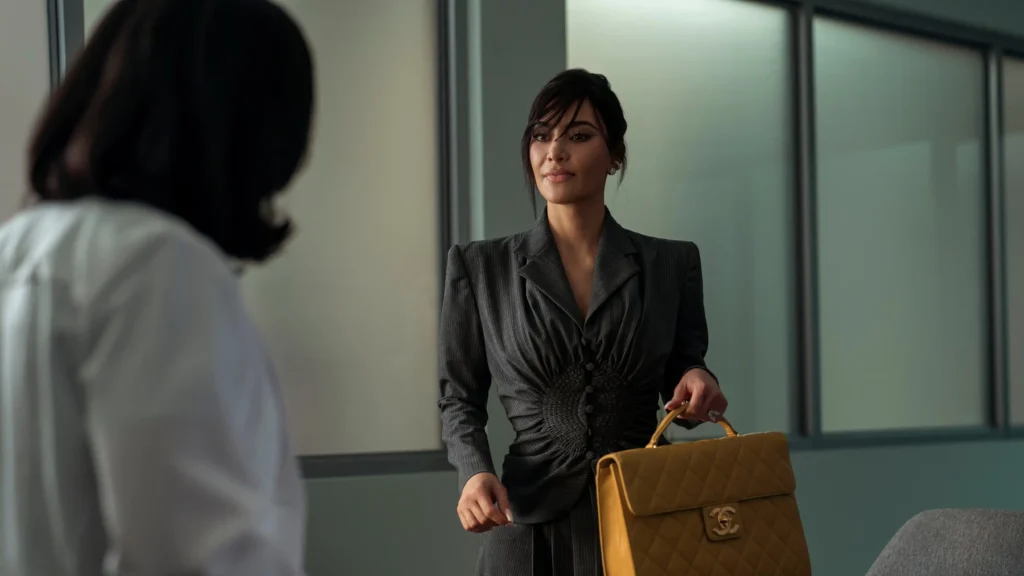
Thankfully, the weakest element – the fact that Kim Kardashian couldn’t act her way out of a wet paper bag – is mostly sidestepped in “Everybody Dance Now”, since the focus shifts from Allura to Emerald, though there are a few tactical reminders that Allura is now pregnant (maybe) with illegally-implanted embryos fertilised by her soon-to-be-ex-husband.
Emerald’s arc is an outgrowth of her story thus far. Her single-motherhood has been a point of pride for her throughout, but years of celibacy and careerism seem about to come to an end when she finally agrees to attend a singles party. She dresses up for the occasion. She puts herself out there. And within the span of one night, she’s drugged and potentially sexually assaulted – it’s never quite made clear exactly what happened – by a mysterious man with seemingly no connection to her. After, she’s tormented by the same fellow with lewd images of herself in highly compromising positions.
There are shades of a whodunit in All’s Fair Episode 4, but it doesn’t really play out like that. Instead, the focus is on how Emerald deals with the situation, in terms of immediately going to the authorities, explaining what happened to her kids, and coming to terms with the idea that, legally speaking, the man may never be brought to justice. Niecy Nash is excellent in this episode, particularly at a crucial hinge point when it becomes obvious that she’s not dealing with it as well as she thought she was.
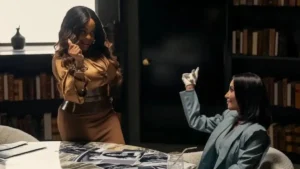
That hinge occurs on account of the case of the week, which finds Jennifer Jason Leigh as a woman trying to divorce her bitter ex-husband on account of his wanting kids that she never intended to provide. Naturally, Carrington is representing the husband, and gleefully reveals that the client had an abortion that she never told her husband about, which might constitute emotional cruelty. You don’t need me to tell you that this whole subplot exists for two reasons only: To reinforce Emerald’s sense of powerlessness, especially regarding men’s cruelty towards women, and to have Allura chew over the ethics of treating human life like personal property.
Sarah Paulson is a scene-stealer once again – she has some zingers in this episode – even though she’s forced to accept defeat when the husband gets his new girlfriend pregnant and decides to drop the proceedings. But the implications of this case are far from over. For one thing, it shakes the dynamics in the office, since Dina believes that Emerald’s attacker may have targeted her as revenge against Dina, which Emerald finds difficult to square. And then there’s a small matter that Emerald’s attacker ends up dead. For now, his death has been ruled a suicide, but homicide hasn’t been ruled out, and between the women at the law firm and Emerald’s three grown-up sons, all of whom knew about the attack, there is no shortage of potential suspects. I highly doubt we’ve heard the last of this.