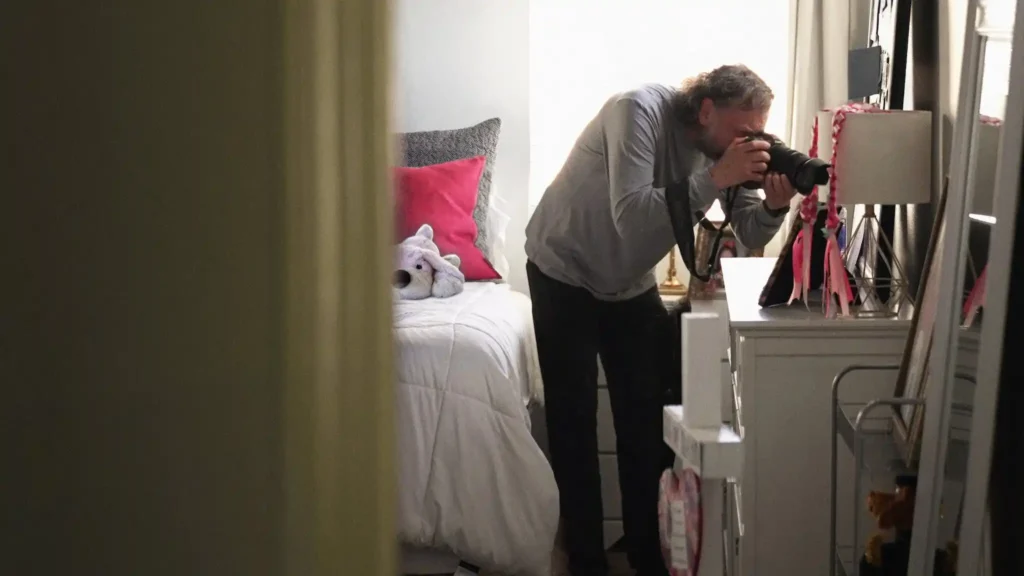
When I sat down to review All the Empty Rooms, it took me only a few seconds of the 35-minute runtime to realise it was pointless doing so. How could you possibly pass some sort of faux-objective judgment on this? Oscar-nominated Joshua Seftel’s short film chronicling CBS News correspondent Steve Hartman and photographer Lou Bopp’s seven-year mission to memorialise the empty, untouched bedrooms of children killed in school shootings is a remarkable work of rawest emotion, of lives captured in still images and unfinished drawings, in collections of toys and outfits never worn, standing sentry in still closets. A star rating wouldn’t do it justice.
The first film to be sold out of this year’s Telluride Film Festival, Netflix acquired the film for what will doubtlessly be an awards push, but unlike with something like Train Dreams, that seems beside the point. I can’t think of a better, more mainstream home for this witheringly powerful work of documentary filmmaking, itself a cogent reminder of the steep price paid for the right of the American citizen to bear arms. But while the film unavoidably addresses this deeper underlying subject, both in the form of on-screen statistics – such as the number of annual deaths rising from 17 to 132 in the few years since Hartman began documenting the tragedies – and in devastated parents wondering aloud both why and how a thing like this can happen, and happen so frequently, it doesn’t seek to preach and lecture. It allows its careful, quiet, mournful compositions and the interviews with the parents of children who lost their lives to speak for themselves.
It’s fitting that Hartman, once known as a ceaselessly upbeat figure in the often cynical world of broadcast journalism, decided enough was enough. There are only so many school shootings that can occur before attempts to see the silver lining ring out as being deeply disingenuous. A subject so serious had no use for Hartman’s once-trademark optimism. Instead, he began to rigorously document each tragedy’s victims, contacting their parents for permission to immortalise their bedrooms as shrines to their avoidable absence. All the Empty Rooms is structured around the final three he has yet to visit: The bedrooms of Hallie Scruggs and Jackie Cazares, both nine years of age, and 15-year-old Gracie Muehlberger.
The film’s focus never veers from the victims. Their parents fondly recall their brief lives, their interests and passions, and hopes and dreams, while Bopp’s photographs contextualise their recollections through leftover possessions, each a tiny insight into a life cut short. The shooters are never mentioned; their potential motives are unaddressed. They get enough column inches as it is, while the victims are reduced to impersonal statistics, to be wielded with faux-sincerity by anti-gun advocates, or to be dismissed as a worthwhile sacrifice by those who believe individual liberties must remain unassailable. Here, there is only the victims and the terrible absence they have left behind.
Hartman and Bopp are not simply observers. They are, as parents, as deeply invested as anyone, so sure of the value of what they’re doing that the idea of not doing it has become incomprehensible. Not sharing it, too, would represent unconscionable cowardice, to allow these rooms to remain untouched in secret, unnoticed by everyone other than the parents who occasionally visit them to mourn their lost children. The effect of being allowed into these private spaces is deeply intimate and personal. All the Empty Rooms is inarguably a tearjerker, but it’s also a searingly important work highlighting the deeply human cost of America’s intertwined mental health and firearm crises, and it should be watched by as many people as possible.