

Viewers love real estate reality TV both because it’s typically packed with drama and surprises, and because it portrays situations they can imagine themselves in during their own real estate transactions.
But is what you see on TV an accurate representation of how the industry really works?
Experienced real estate professionals say no, and that it gives viewers a distorted perspective of the industry. This distortion, they argue, can cause buyers and sellers to make poor choices that adversely impact a transaction, and the impact is even more significant for real estate professionals who get into the industry for the wrong reasons, driven by what they see in these shows.
Derek Carlson, president and managing broker with Realty ONE Group MVP, is one of these experts. He runs a team of over 1,200 agents, was listed as one of the top 10 brokerages in the U.S., and has generated well over $15 billion in sales and closed over 50,000 properties, so he’s seen more than his share of transactions.
He explains what he sees real estate reality TV consistently gets wrong, saying,
“When you have a hit show about an industry, it typically expands the consumer side, causing people to want to buy the product, but I feel that real estate is the opposite. When a real estate show goes viral, it doesn’t create more buyers—it creates more new, inexperienced Realtors and investors. This means more people jump into real estate without understanding the expertise, discipline, and knowledge the profession requires.”
He says that hurts everyone.
Shows like Buying Beverly Hills, Selling Sunset, and Owning Manhattan depict the consumer side of the real estate industry, where buyers and sellers work with Realtors throughout their transactions, whether buying or selling a personal home. On the other hand, shows like Zombie House Flipping, Stay Here, and Flip or Flop depict the investor’s side of the industry, where viewers watch the journey of buying, renovating, and selling a property as an income-producing asset.
While there are dozens of similar shows, each with a slightly different angle, they all follow the same format: Hype up the exciting parts of the industry, add lots of extra drama, and cut out everything else.
So in this article, we’re going to break down what’s wrong with real estate reality TV from the perspective of one of the top brokers in the industry.

‘Buying Beverly Hills’ (Photo: Netflix)
It makes viewers believe every transaction should be dramatic
The typical real estate transaction is already difficult enough, so there’s no reason to add any more chaos to the equation. Yet producers still can’t seem to help themselves.
Carlson says, “Reality TV thrives on drama, but in real life, great Realtors eliminate drama. We solve problems before they escalate. While it’s not as exciting, a smooth transaction is a sign of strong preparation, communication, and expertise. This is not something you’ll ever see celebrated on television.”
Carlson believes these shows drive people to expect drama, and when they don’t encounter it naturally, they often create it, whether consciously or unconsciously.
Unfortunately, real estate-themed reality TV gives people the idea that the entire process should be filled with drama. Huge arguments, last-minute surprises that force everyone to scramble, and intense negotiations may make great television, but they generally make a real estate transaction more complicated than it needs to be.
“About 11 years ago, I tried out for a reality TV show. In our sizzle reels, all they cared about was more drama, and they explicitly asked us to create fake scenarios to provide that. We weren’t able to give them the level of drama they were looking for, so they didn’t bring us in for the show,” he explains.
What makes this even more problematic is that unnecessary drama can cause an otherwise good deal to fall through, leaving both the buyer and the seller in a worse position than they started. Reality TV is directly causing this.
“At the end of the day, my mission to provide a smooth real estate transaction for our clients is directly at odds with a TV producer’s mission to provide entertainment that keeps their audience glued to the screen.”
It distorts the true timeline of a transaction
When you’re buying or selling an asset that, for most people, is the largest investment they’ll ever make, you would logically assume it should take a while.
The truth is that it’s a complicated process because there are a lot of moving parts, including processes that all parties are legally required to follow, extensive documentation requirements, and multiple people involved—all with different personalities. As a result, the timeline can range from a few weeks if you’re dealing with experienced professionals and everything goes smoothly, to months or longer if you are dealing with inexperienced professionals or things go wrong.
“On TV, a multimillion-dollar deal unfolds in eight minutes. In reality, a transaction is a detailed legal, financial, and logistical process. It involves inspections, title work, appraisals, lending timelines, negotiations, insurance, HOAs, and dozens of checkpoints. Reality TV compresses weeks of work into a montage, making the public believe everything should happen overnight,” Carlson explains.
This often encourages buyers and sellers to push real estate professionals to move faster, which isn’t really possible without cutting corners, and when that happens, people face significantly more financial risk.
It creates the illusion that there’s a secret trick to saving every deal
If you’ve ever watched one of these shows, you know the routine—everything is finally lined up and the deal is just about to close, and then, right before the commercial break, either the buyer or the seller throw a monkeywrench into the works that threatens to destroy the deal.
When the show opens back up, and with the backdrop of serious faces and dramatic music, the hero of the show saves the day with some convincing “silver bullet” negotiation strategy that magically brings both parties back to the same perspective, and the deal closes without further incident.
In the real world, this sometimes works, but more often, the deal blows up on the spot.
Carlson says. “There’s no magic line that suddenly gets a deal across the finish line. There is discipline, market knowledge, strategy, and experience. Sometimes the best win is protecting your client by walking away. Reality TV makes it look like every deal should be forced to close. Real professionals know the difference between pushing and protecting.”
Experts like Carlson warn that forcing a deal is a bad choice because ultimately, it’s a mathematical formula that either works or doesn’t, so making too many concessions to get it to the finish line can transform it from a great investment into a poor one.
Not every deal will work, no matter what you may say or offer, and viewers have to understand that that’s a completely normal outcome in this industry. Sometimes, it’s best to walk away from a deal.
It gives consumers unrealistic pricing expectations
Understandably, most people don’t spend their days tracking home prices, so their only exposure to this critical data point comes from what they see in the media. This includes traditional media outlets like Yahoo Finance, Benzinga, and Newsmax, as well as real estate-themed reality TV.
For more than a decade, Americans have been bombarded by a never-ending barrage of stories about how home prices have continued to skyrocket, making it seem like there’s no way to lose in real estate. They’ve also seen an endless stream of real estate shows on TV carrying the same message.
This ignores a key reality that home prices do not always go up—in fact, in many areas of the country, prices have been going down for quite some time now.
Carlson explains, “Shows use pricing for shock value. Real pricing comes from comps, supply and demand, market conditions, and economic indicators. When clients step into the real market with a TV mindset, disappointment always follows. They expect instant offers, bidding wars, or price jumps that don’t match today’s reality.”
Experts say that sellers with unrealistic pricing expectations often fail to sell their home at the best price and as quickly as they could because they go into the transaction with pricing in mind that simply doesn’t exist today.
One agent I spoke with, who asked to remain anonymous, shared a story where a seller kept rejecting offers that were priced based on today’s market conditions. His response was as brief as it was absurd:
“I’m looking for offers more in line with what I was getting three years ago.”
This seller wanted offers from the peak of home prices three years ago—something that no longer exists today.
The consensus among financial experts is that the market entered a correction phase several years ago, which means that prices have gone down in most areas to compensate for affordability, interest rates, and demand. But because that message isn’t quite as sexy as the constant upward trajectory in home prices that the media has portrayed, a majority of people still don’t realize that today’s market is very different from what we’ve seen over the past decade.

‘Owning Manhattan’ (Photo: Netflix)
It oversimplifies the entire transaction
For most people, buying or selling a home will be the most complicated transaction they’ll ever take part in, and the most surprising part is that they only see a fraction of the work that goes on behind the scenes.
That’s because a good agent will insulate their client from most of it.
As a result, most people think it’s far simpler than it really is. Nowhere is this more evident than in conversations about the real estate industry, and more specifically, conversations about real estate agents. People are especially harsh on social media, where they feel more comfortable lobbing criticism and insults from behind the relative safety of a computer screen.
The general consensus is that agents don’t do much work for the fees they collect. This is driven by the fact that clients don’t see all the work an agent puts in behind the scenes. They’ll typically just see the agent while looking at a property and maybe again at the closing, and they don’t see much real work during either, so they assume that’s all an agent does.
Reality TV magnifies this distorted perception by cutting out 90% of the real work from their shows.
Carlson explains, “Behind the scenes, agents handle title issues, permit research, inspection negotiations, insurance hurdles, lending delays, appraisal disputes, compliance, and so much more. The truth is, real estate is one of the most complex consumer transactions in America. On TV, they compress it into a tidy plotline with pretty homes and quick decisions. That’s not how it works in the real world.”
It’s understandable because there’s nothing exciting about paperwork, so this part of the transaction ends up on the cutting room floor, but it’s a foundational part of the industry.
Unfortunately, when someone comes into a transaction thinking it’s a simple process, they tend to have unrealistic expectations that can derail an otherwise viable deal.
It gives new agents dangerous expectations
More new agents have entered the real estate industry over the last ten years than at any other time in history, driven largely by the promise of tons of easy money.
It’s easy to see how they might think this way.
With a combination of home prices having consistently risen at a meteoric rate, interest rates at historic lows, and easy credit availability over the last decade, a career in real estate seems like Easy Street to outsiders. Especially when you consider that most Americans have watched the bidding wars unfold on a majority of listings for quite some time.
In many cases, an agent simply had to list a property, sit back and wait for the highest offer to come in, and then collect their commission check for an easy five or six-figure payday.
Carlson says, “This is where reality TV does the most damage. New agents watch these shows and believe that deals close quickly, success comes fast, negotiations are wrapped up in minutes, luxury listings are easy to land, and clients will just fall in your lap. None of this is true.” He goes on to say, “Success in real estate is built on years of consistency, lead generation, late nights, early mornings, and a high level of professionalism. TV creates an illusion of easy money, which is why many new agents burn out when they hit the real world.”
He warns that this doesn’t just affect agents, though. “Churn in real estate is higher than in other industries, and this means that most agents lack the depth of a truly experienced professional. Unfortunately, the standard broker model doesn’t support much training or mentorship. New agents are usually just thrown into the deep end to figure things out on their own, and that means they learn at the client’s expense.”
Carlson explains that because most agents don’t close many transactions early in their careers, they don’t develop the broad knowledge necessary to be a truly valuable resource in a transaction. This hurts their clients.
It also limits their career because they tend to put themselves into a tiny box when it comes to their understanding of evaluating and closing a deal.
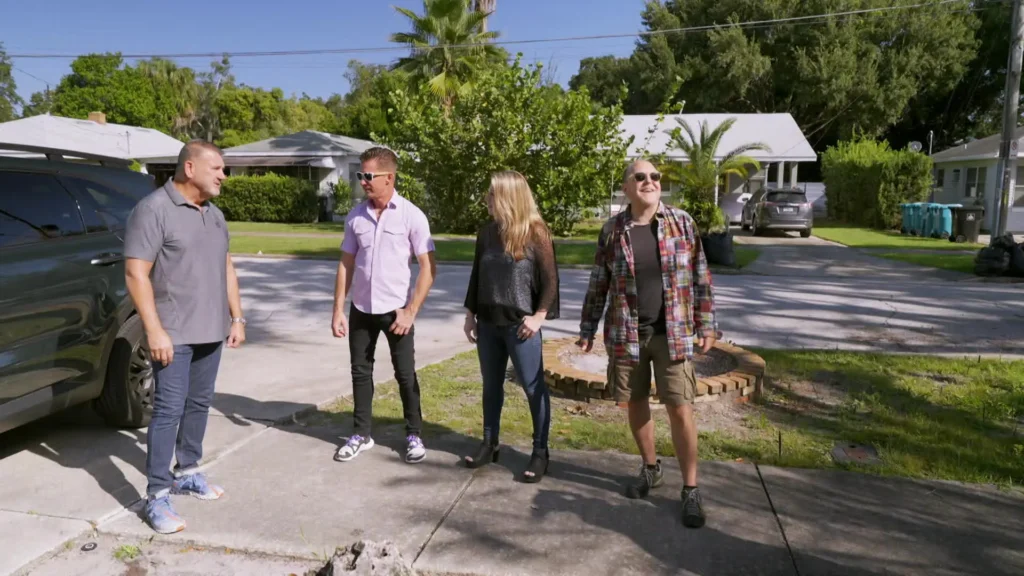
‘Zombie House Flipping’ (Photo: A+E Networks)
Much of it is staged, scripted, or manipulated
Carlson says that while these shows are usually entertaining in an over-the-top kind of way, they aren’t based in reality, despite what the name implies.
He explains, “People forget this part. Scenes are staged. Homes are preselected. Negotiations are reenacted. Timelines are rearranged. Emotions are exaggerated. It’s entertainment, not education. When the public confuses the two, expectations fall out of alignment with how the industry actually works.”
And that’s really the best way to watch these shows. Carlson and other experts share the same sentiment—real estate reality TV is not education, it’s entertainment, and as long as you treat it as such, it won’t cause problems in your transactions.