Summary
Spartacus: House of Ashur doesn’t miss a beat in returning to the outlandish extremes of the original series, with Episodes 1 and 2 easily passing the vibe check.
Spartacus: House of Ashur is a story about second chances. For one thing, it’s a return to Starz’s beloved, ridiculous historical epic, one of the shows on which the platform built its reputation for blood by the bucket-load and boobs by the barrel. But it also represents a second chance for Ashur himself, the Syrian turncoat who betrayed Spartacus and his allies and paid for it with his head, which is conspicuously reattached in this spin-off. It at once feels of a piece with Gods of the Arena, Blood and Sand, Vengeance, and War of the Damned, all of which are referred back to here in Episodes 1 and 2, despite the events of the premiere taking place in what is ostensibly an alternate universe.
The particulars of that alternate universe are, thankfully, only very lightly explained. After his death in the main series, Ashur is condemned to the underworld and is met by a cameoing Lucy Lawless as Lucretia, the wife of his old master, Batiatus. In a pretty simplistic what-if scenario, we’re given a general outline of this new continuity, in which Ashur survived, threw the spear that felled Spartacus, earning him favour with Marcus Licinius Crassus, and went on to assume control of the former House of Batiatus, now the eponymous House of Ashur.
That’s it, really. We don’t spend much time in the underworld; there isn’t a great deal of mythologising, it’s simply a matter of getting on with things and establishing the new status quo, which works just fine. The better question is why Ashur, of all characters, but “Dominus” and “Forsaken” answer that pretty adroitly. Sure, this is a gladiator story, as the early seasons of Spartacus were, but it’s also a story about an underdog trying to navigate a cutthroat political climate, and who better to be the point man for that story than the most scheming and immoral member of the original cast?
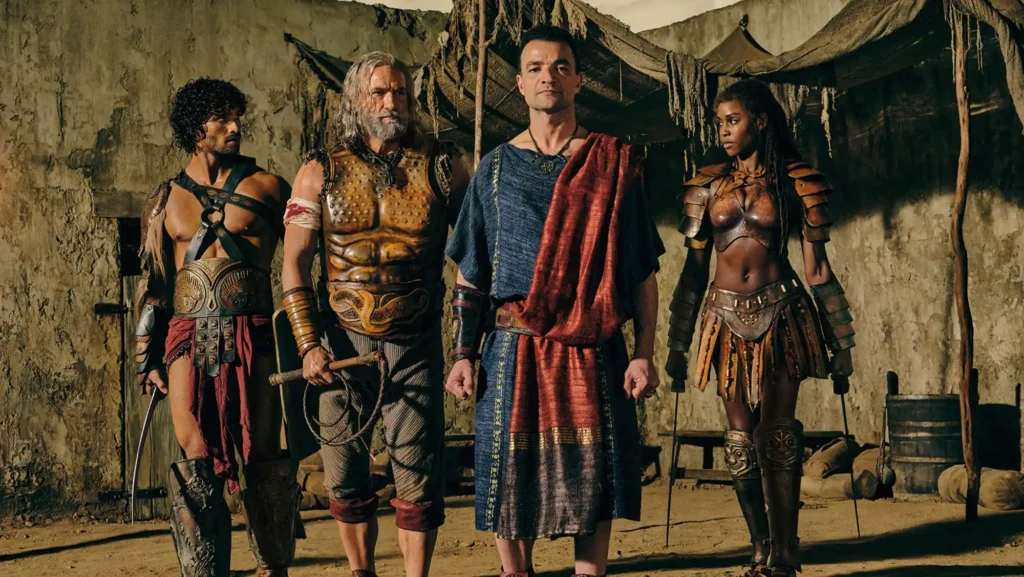
Episode 1, then, is about establishing where Ashur currently sits, which is pretty low down on the pecking order, despite his “heroism” in helping to put down Spartacus’s rebellion. He’s insulated, somewhat, thanks to his relationship with Crassus, but his Syrian heritage and lack of personal glory in the arena mean that he has precious few allies. The most notable is his doctore, Korris, but even their dynamic is pretty fractious. Ashur’s political power is determined by the success of his gladiators, but his ludus is churning out consistently subpar fighters. It also doesn’t help that the most promising among them is killed by Ashur himself to prove a point, although I’ll grant you it’s a fair point – by his own admission, he was one of the most weaselly of the original cast, so if he can defeat all of the gladiators handily, they’ve got a pretty serious problem.
“Dominus” builds to a funny reversal of expectations when the one half-decent gladiator Ashur is grooming ends up being messily felled by a comedy trio of little people, only worsening Ashur’s high-society ridicule. But it also alerts him to the changing tastes of the baying crowds, who are no longer satisfied with gladiators who all look and fight the same. A marketer at heart, Ashur realises he needs novelty, and he finds it at the slave market in an unexpected form – a woman.
In Episode 2 of Spartacus: House of Ashur, that woman is given the name Achillia and welcomed into the ludus as a trainee, with Ashur pinning his hopes of fame and fortune on her shoulders. She’s a capable fighter who might become a great one if only the other gladiators can stop themselves from assaulting her at every opportunity. In a rigorously class-stratified culture, the very idea of a woman fighting for her freedom on the sands is too radical for many to parse. What makes Achillia compelling to Ashur is exactly what is liable to get her killed long before she’s able to compete in the arena.
“Forsaken” can get a little wearing in the endless stream of unpleasantries that Achillia is subjected to, but it’s all in favour of her ultimately winning the respect of Korris by drawing his blood during a duel – something that none of the other more experienced male fighters have ever been able to do. That Korris challenged Achillia on account of her ripping off the genitalia of a gladiator who just tried to force himself on her isn’t something he’s liable to apologise for, but the penis prosthesis flopping around on the sand is probably apology enough. House of Ashur doesn’t miss a beat in continuing the vibe, visuals, and quasi-Shakespearean dialogue of the original series, and that includes its penchant for absurdly over-the-top violence and practical effects.
It works. The worry with any spin-off is that it’ll feel like a pale imitation, but Spartacus was always a show prone to reinvention, sometimes in unavoidably tragic circumstances. Ashur’s return feels right because he hasn’t changed; his second coming is just another opportunity to cause even more trouble, in much the same way as he always did, just from a slightly different position. The vibe-check is passed, and Achillia provides not just a compelling screen presence but also a viable avenue for exploring this universe at a fresh remove. What more could anyone have wanted?
RELATED: