Summary
City of Shadows is workmanlike genre entertainment, offering plenty of turns but no real surprises overall. But it’s undeniably well produced and performed, and slips down in an easy binge.
Slipping right into the storied streaming canon about maverick detectives with haunted backstories solving major crimes in European cities, City of Shadows is the latest deeply self-serious serial killer thriller to grace the Netflix thumbnails. And it’s fine! It’s about what you’d expect – lots of sweeping shots of Barcelona’s architecture, lots of pensive staring into the middle distance, a few murders, a touch of conspiracy, and a bedraggled-looking detective being Big Sad virtually all of the time.
First impressions aren’t great, granted. The opening scene is the plot’s inciting incident, the grisly murder of a prominent businessman who is burned alive while being displayed outside the famous La Pedrera, or Casa Milà, one of a number of buildings conceived by Catalan architect and designer Antoni Gaudí. And in terms of visual effects, it looks like something out of Jason and the Argonauts. My hackles were immediately raised, but fear not – the show only rarely indulges in this kind of VFX tinkering again in its six-episode season.
Besides, the point is the murder, and its historical and cultural underpinnings, since pretty quickly the Gaudi connection gives way to a full conspiracy-tinged cat-and-mouse chase involving Masonic lodges and all kinds of secret society stuff. Its similarity to so many other crime shows notwithstanding, City of Shadows is in many ways Catalonia’s answer to a Dan Brown thriller, feeling particularly reminiscent of Angels & Demons, at least to me, though with Vatican City understandably swapped out with Barcelona and Tom Hanks replaced by Burning Body’s Isak Férriz (and also seen in Infiesto).
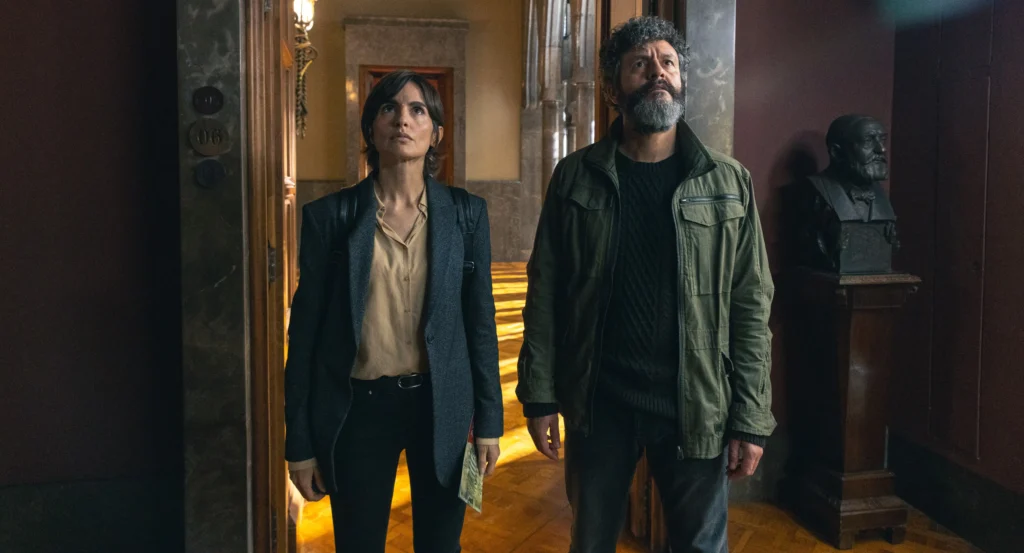
Férriz plays Inspector Milo Malart, a somewhat disgraced cop sitting on the shelf on account of smacking a colleague in the mush, who is nonetheless brought back into the fold to investigate the high-profile crime, which predictably ends up being just the first of several similar killings. Milo is teamed up with Deputy Inspector Rebeca Garrido (Verónica Echegui, Book of Love), and of course, they’re both answerable to the very guy that Milo was suspended for punching. Milo also has some longstanding personal issues, including the death of a niece, and he occasionally has to attend workplace-mandated therapy appointments like he’s starring in The Agency or something.
Tragically, Echegui passed away in August of this year at the age of 42, and the episodes are lovingly dedicated to her. Her performance is very good; she makes a nice counterpoint to Férriz’s frazzled energy, although the institutional antagonism feels a bit forced, given how obvious it is right from the jump how connected everything is. But part of the joy of shows like this is watching no-nonsense cops rail against their superiors, and City of Shadows is nothing if not devoted to being almost exactly the kind of show it ends up being.
But all these Spanish stars aside, the most notable character here is Barcelona itself, and in much the same way as the aforementioned Angels & Demons essentially functioned as a tourist’s guide to the local culture and history, so too does this fulfil a similar function for Spain. It was filmed on location and feels lived-in as a result, which informs a lot of the crimes and, of course, the motives underpinning them. It also deploys a lot of what seems very much like archive footage of real moments in local history. That strong sense of place is integral to the show’s identity.
Well-produced, paced, and performed, City of Shadows has the usual seal of quality of Spanish Netflix productions and the typical touchstones of the genre, which helps to keep it engaging, if not necessarily to stand out. The script from director Jorge Torregrossa, alongside Carlos López and Clara Esparrach, yields a few twists but no real surprises, if you get what I mean, and crime connoisseurs will see most of it coming. But it’s very competent binge-ready entertainment and, given it’s based on a tetralogy of novels by Aro Sáinz de la Maza, there’s plenty more to adapt if the usual crowd takes a liking to it.
RELATED: