
Summary
Elway resists the usual temptation of framing a sports doc around scandal, and instead delivers a straightforward and inspiring narrative about how a born winner became a legend.
I spent most of my time with Elway, Netflix’s definitive profile of Hall of Fame NFL quarterback John Elway, waiting for bad news. As an Englishman, perhaps I’ve been conditioned by stuff like Untold, which tends to target controversy, as in Shooting Guards and The Fall of Favre. But whatever the reason, I’m always expecting a pretty straight-up career chronicle to eventually get into the sordid stuff. The great strength of Ken Rodgers and Chris Weaver’s film is that it never does.
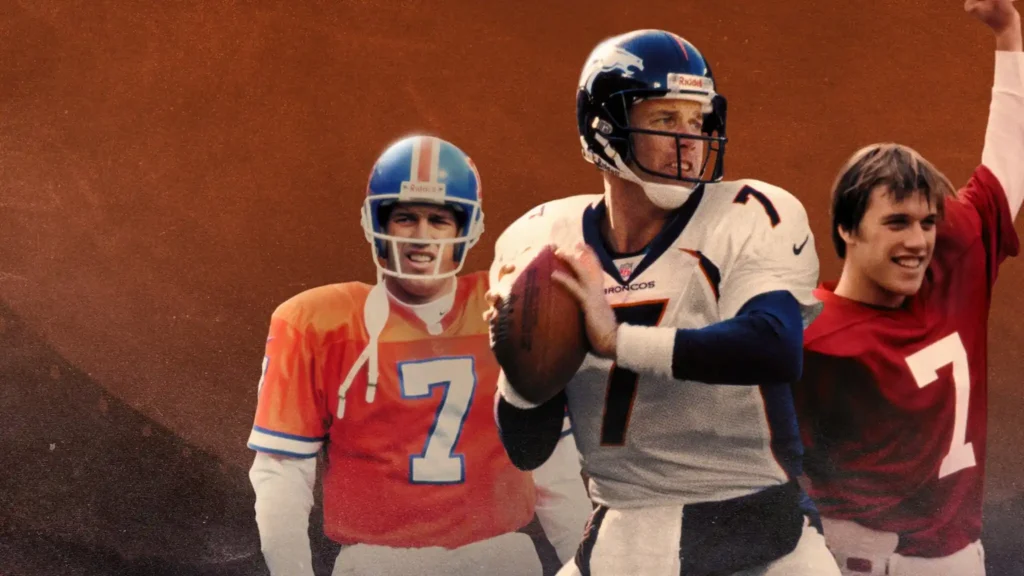
The narrative line is clean. Tracing John Elway’s career from Stanford through sixteen seasons at the Denver Broncos, we understand in the most easily digestible terms what the stakes are. Elway was a remarkable talent who helped to shape the modern understanding of what an NFL quarterback could be. He endured unprecedented levels of public scrutiny and was almost cowed by accusations that he’d never be coronated as an all-time great without winning a Super Bowl, and then obsessively continued playing through the twilight of his career, even as his body and relationships fell apart, until he eventually won two.
I’ve long held the belief that high-level sport is the best storytelling medium in existence, and what I like about Elway is that it believes this too. There’s no room for fanfare. There isn’t the gloss of a Last Chance U, or even an SEC Football: Any Given Saturday here. The movie provides a deeply personal angle – Elway himself stewards us through his own career with embellishments from teammates, coaches, and relatives – but is content for the story being told to be the story as it happened. It recognises that Elway’s career in and of itself can easily fill a feature runtime.
The arc is familiar. Elway’s talent earned him a ton of scrutiny, which created immense pressure, and his consistent failures at the final hurdles left him at a crossroads: He either retired, content to be a guy who almost made it, or he kept going, whatever the cost, until he eventually fulfilled his lifelong ambition. Needless to say, he chose the latter.
The downside of the movie is that it values this narrative arc above everything else. It doesn’t want to linger in the weeds because it’s less interested in being a comprehensive accounting of Elway’s life and career than it is in propping him up as an avatar of quintessential any-means-necessary do-or-die American sporting heroism. As well as this works – and, trust me, it works well – one can’t help but lament the story left in the margins about the true cost of the pressure placed on Elway’s shoulders, and the lengths he eventually had to go to in order to reach a point where he felt like he could stop.
The losses – professional, including several Super Bowl near-misses, and personal, including a marital and physical breakdown and, post-retirement, a string of bereavements – are acknowledged but not dwelled upon. Elway’s very obvious emotion comes through in his reminiscences over how things went wrong, but he’s at his most obviously moved rewatching his eventual Super Bowl victory. This isn’t intended as a sneaky commentary on how Elway approached his life and career, but it could quite easily be read as one. There’s never a doubt what the movie’s focus – and indeed its climax, even for a total rookie like me – is going to be.
In some ways, all of this might be seen as something like America’s Team: The Gambler and His Cowboys, an attempt to carefully solidify and reiterate a legacy rather than challenge and interrogate it. But I think that’s a cynical way to read Elway, however obvious and deliberate the framing might be. There’s a real earnestness at the movie’s core, a sense of appreciation for its subject’s place in football history and the importance of his achievements. Granted, this approach does prohibit it from achieving any kind of all-time-great status, something that perhaps feels ill-fitting for a documentary about John Elway. But it’s the rare documentary that allows success, and success alone, to be its guiding light. And there’s something oddly inspiring about that.