Summary
Fallout Season 2 is very much in side quest mode in “The Golden Rule”, but things are still fun enough to not mind.
It’s probably fitting that Fallout, of all shows, devotes some time to side quests. There’s an argument to be made that this isn’t the best way to structure a television series, and that Season 2 is already moving a little bit slower than it should be, but there’s a very valid counter-argument that Episode 2, “The Golden Rule”, is fun enough for it not to matter. I don’t think this argument will hold up throughout an entire season, of course, but we’ll cross that bridge when we come to it.
Curiously, though, it’s only really Lucy and the Ghoul’s subplot – built on an argument that their wildly differing approaches to wasteland survival aren’t entirely compatible – that feels least illuminating, in part because it’s reiterative. Everything else, from Maximus navigating the Brotherhood of Steel to Norm’s efforts in Vault 31 and Hank’s deeply unethical technological trials at Vault-Tec’s old headquarters, at least feels as if they’re continuing existing threads, even if they’re ping-ponging around.
Maximus didn’t crop up in the season premiere, so it’s nice to see him here. The episode even starts with a flashback to his backstory, with Shady Sands being ruthlessly nuked on Hank’s indifferent orders, leaving Maximus the only survivor of the colony with no real idea of what happened or why. But that lack of certainty and understanding is what made the Brotherhood of Steel seem so initially compelling, even though it’s a thoroughly psychotic organisation.
Personally, I find the Brotherhood very funny. The multi-chapter meeting in this episode is brilliant stuff – “That was one squire, and he was well within his rights!” – but it’s funny because it’s nuts, seeing these cosplaying idiots hopelessly bicker over cold fusion, war with the Commonwealth, and various matters of even less importance. Maximus’s arc in “The Golden Rule” is about realising for himself that the Brotherhood isn’t what he had idealised it to be.
This takes a heavy-handed form in Maximus having to fight and kill a much bigger Knight in the pit-fighting celebration thrown to celebrate everyone rallying around Elder Quintus to war with the Commonwealth over limitless energy. But it’s threaded throughout the entire hour if you’re looking for it. This subplot also excuses the introduction of Kumail Nanjiani’s imperious Paladin Harkness, who arrives towards the end of Fallout Season 2, Episode 2, to lend a bit of gravitas to proceedings.
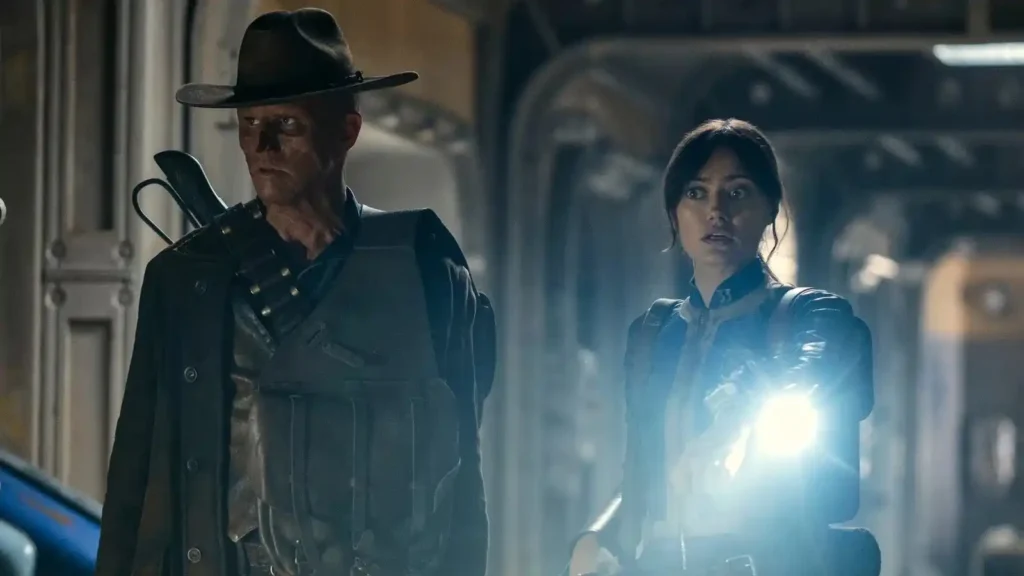
Lucy and the Ghoul, meanwhile, are not getting on, and largely for the same reasons as usual. The Ghoul is well practised at ignoring the plights of those suffering in the wasteland – “People have been screaming for two hundred f*cking years” – while Lucy is too pathologically peppy – “Did it ever occur to you that if you helped them they would stop?” – to ignore a single cry for help. But that cry for help is emanating from a woman dressed in a tunic, which the Ghoul clearly recognises as membership of Caesar’s Legion, but instead of just saying that outright, he acts all coy and psychopathic, I think just to annoy Lucy.
After a fun fight with some mutant scorpions, Lucy and the Ghoul part ways (again). She leaves him badly injured to take the woman she has just rescued back to her home, but immediately finds herself surrounded by men in Roman Empire attire. In a roundabout way, the Ghoul was right, but the fact that this is happening entirely because he didn’t explain his line of thinking or warn Lucy about the Legion feels a touch too artificial for my taste. A side quest is fine, but a side quest for the sake of it is another thing entirely.
In Vault 31, Norm manipulates the newly awakened Dwellers to help him escape the place, and at Vault-Tec’s old headquarters, Hank continues to test the brain-computer interface, first on lab rats and then on humans. The human stuff constitutes pretty biting anti-capitalist satire of a kind that really helps to situate us in the universe of the Fallout games – one of the guys he wakes up is some rich dude who bought himself a premium doomsday survival experience but left his family to die – similar to how the endlessly stellar production design does. People have been needlessly snooty about the introduction of Robert House, as I expected they would as soon as we entered New Vegas territory, but I’m not sure that most of the criticism feels especially genuine – this still feels very much like the games to me.
RELATED: