Summary
Spartacus: House of Ashur finally provides a proper return to the arena in “Goddess of Death”, and it’s a worthwhile payoff to all the build-up and maneuvering thus far.
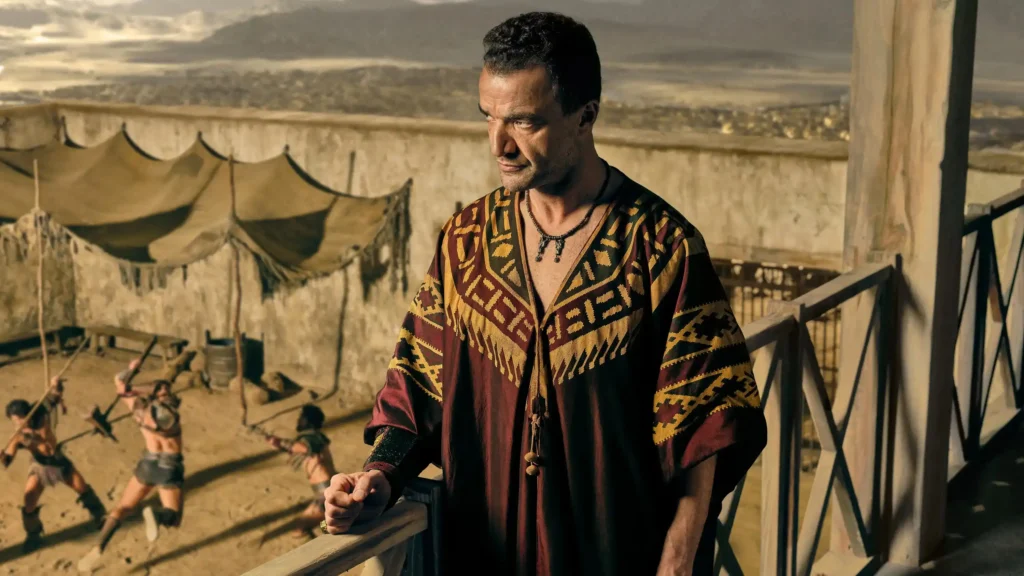
It might have taken until Episode 5 for Spartacus: House of Ashur to properly return to the sands of the arena, but “Goddess of Death” was worth the wait. It isn’t just that we finally get some gladiatorial action. This hour is also rich with knotty political maneuvering and soapy character drama, proudly living up to the idea of Starz’s Spartacus as a ludicrous, quasi-Shakespearean bloodbath of epic proportions. All that silly dialogue, exaggerated sexuality, and practical gore work best in this kind of context, with all the fanfare and pageantry.
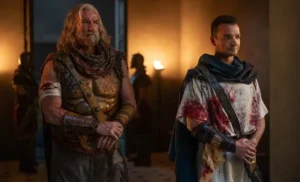
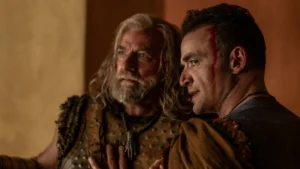
Caesar’s presence helps. After his surprising arrival at the end of the previous episode, Caesar and his wife, Cornelia, are now staying in Ashur’s villa, making their presence felt by wildly disrespecting everyone there. Caesar is a fantastic character for precisely the reason that Ashur is, simply in reverse. Ashur’s a shrewd negotiator trying to attain position by cosying up to power, while Caesar is a shrewd negotiator trying to maintain position by lauding the power he already has over those who don’t. Both are deplorable, but Caesar is monstrous, as proved when he forces himself on Hilara just as an affront to Ashur. But when he moves in political circles, entreating with Gabinius and Cossutia, he’s the consummate charmer, the smart negotiator. Jackson Gallagher — taking over the role from Todd Lasance — is very good in every mode. I hope the ire about the recasting doesn’t obscure that, but I won’t hold my breath.
Caesar, it’s quickly revealed, was responsible for the “Cilician pirates” attacking Cossutia and Viridia, with the blessing of Crassus and — we later learn — help from Opiter. The whole point was to give Ashur — and thus Crassus — a position at the games that it didn’t seem like he would be able to achieve on his own, which is in itself part of a long con to sway Gabinius away from Pompey and into allegiance with Crassus. To that end, Caesar also pitches Gabinius on co-hosting the games and putting the House of Ashur’s “champion” in the primus (the main event, basically).
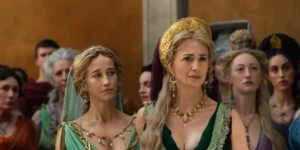
It’s probably quite telling of how this setting works that Caesar is able to accomplish in five minutes what Ashur has been toiling at unsuccessfully all season, which doesn’t go unnoticed by Ashur himself. But he’s in a tricky position, and so much can go wrong so easily that he has no choice but to play ball. All hopes rest on Achillia, who has been named champion and dubbed the titular “Goddess of Death”. It’s a risky political ploy that continuously threatens to backfire, especially when her introduction goes down like a lead balloon in front of Gabinius and all the other senators and WAGs.
But the will of the people is fickle, and everyone knows that all it takes is Achillia finding success in the arena to sway the crowd. Ashur’s idea of cementing a woman as the champion of his house will either backfire considerably or prove to be a masterstroke, and Spartacus: House of Ashur Episode 5 mines as much tension as possible from this idea. It’s building to a big action climax at the games themselves, of course, but it’s also excusing a lot of character drama in the meantime as the circumstances force everyone to choose sides, form their own allegiances, and work on private plans.
Tarchon, for instance, feigns support of Achillia, rallying the other gladiators to do the same, in the hopes of generating her as much prestige as possible so that he can kill her and become a vaunted champion himself. Caesar is clearly working to his own self-advancement, while his presence corrupts things in Ashur’s house, causing Messia to continuously remind Hilara of how shoddily he treats her (she’s right, but she clearly has her own agenda after having been romantically rebuffed by Hilara twice). Opiter still has a thing for Korris, but Proculus sees them getting it on and is sure to use that information down the line. And Achillia and Celadus develop a romantic connection on the night before the games, which may or may not continue, and, if it does, is sure to cause even more problems between Celadus and Tarchon.
In all this, Ashur’s surprising ally turns out to be Cossutia’s daughter, Viridia. She’s still grateful for Ashur saving her life, of course, but it’s more than that. She sees the appeal of Achillia as an impactful political stunt; she immediately intuits that Caesar is reaping the benefits of Ashur’s efforts — he even starts calling the ludus “The House of Caesar”, at one point — and there’s unmistakably a bit of sexual chemistry here, which certainly doesn’t go unnoticed by Hilara. Viridia even attends the games, which she isn’t typically inclined to do, and ends up enjoying them enough that it’s fair to say her distaste for the whole thing is probably a bit of a put-on.
“Goddess of Death” culminates with two battles in the arena. One finds Tarchon and Celadus going up against another pairing and just about making it through, though admittedly no thanks to Tarchon and his glory-hound approach, and the other sees Achillia revealed in the primus to a lot of heckling to take on the Brothers Ferox, with whom she has been bickering all episode.
But Gabinius pulls the rug at the last minute and has Achillia fight a gigantic dude instead, clearly in the hopes of killing her off to spite Ashur for blindsiding him in the first place. For once, though, something goes Ashur’s way. Achillia is victorious, albeit at the small cost of what I assume to be a severe concussion and one of her sword hands being cleaved almost in two. Still, a win’s a win, even if you collapse after achieving it. It’s about time Ashur got one. But given how things are going, I don’t see too many more in his future.
RELATED: