Summary
Stranger Things Season 5 has a lot of work to do in Volume 2, and not all of it is done as artfully as it could be. But when it’s firing on all cylinders, this show is impossible not to like.
I’ve realised against my better – and indeed professional – judgement that I’ll forgive Stranger Things for just about anything, so long as the core remains intact. And Season 5 has tested this theory, let me tell you. In Volume 2 alone, there’s an episode that feels so slavishly devoted to formula that you can see the seams bulging, and there’s another episode about a melting building that looks like something sprung to life from PS2-era computer graphics. But it’s hard to mind. The characters remain so fun to be around, and the action – when it comes – is so lively and engaging that the show is virtually impossible to dislike.
This is perhaps just as well, since Netflix isn’t doing it any favours. The streaming giant’s insistence on dividing each season of its major IP into “volumes” with random numbers of invariably overblown episodes is incredibly taxing from a critical perspective, because it means I’m having to judge a chunk of a show that doesn’t work without the four episodes preceding it and can’t really be judged holistically until the release of the supersize finale. But I’ll do my best either way.
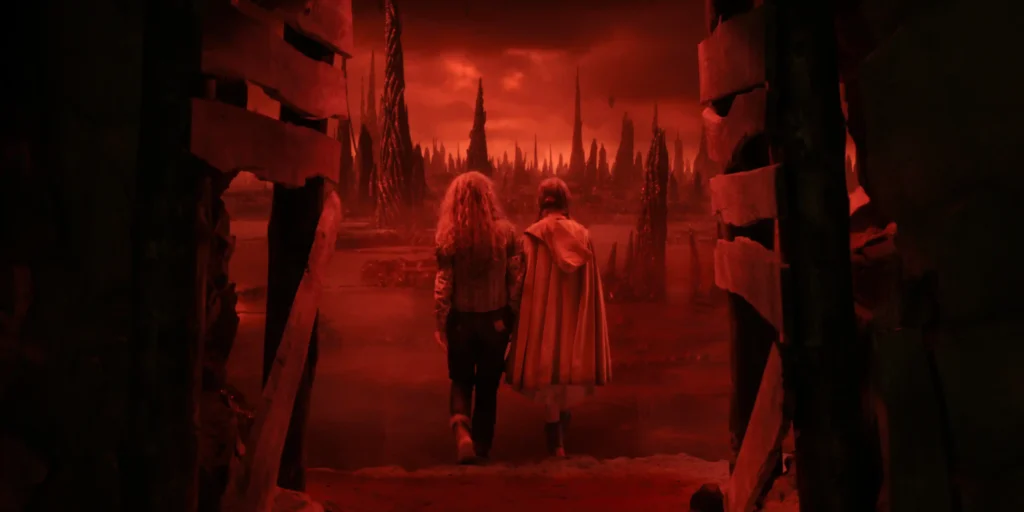
In large part, you can characterise Episodes 5, 6, and 7 as the “what’s really going on” episodes. It’s here we get some concrete answers about what both the military and Vecna are really up to, which is nice, especially regarding the latter, since the former remains frustratingly disconnected from the main arc and is damagingly behind the curve. We finally know what the Upside Down is, what Vecna is trying to do, and how to stop it. That’s a pretty impressive feat given how much of the additional lore has been freestyled by the Duffer Brothers, but it does mean that a good chunk of Volume 2 is devoted to explaining it.
And yet the explanations are still pretty winning on the strength of the cast. This has always been the secret weapon of Stranger Things, and it remains as true now, even though all of them are adults instead of the charming nippers they started as, as it did way back in the halcyon days of 2016. We’ve known these characters a long time. We’ve watched them grow up, find each other, and find themselves. Even the silliest moments in these three episodes are threaded with genuinely affecting character drama. Jonathan and Nancy having a relationship crisis surrounded by the goo from Mighty Morphin Power Rangers: The Movie somehow still works. It’s miraculous.
The action works the same way. Sure, there’s much too long between set-pieces, and a judicious edit would trim a lot of the superfluous stuff away, and in an ideal world, at least a couple of the less-important characters would have been killed off. But then the show puts together a peerless set-piece – there’s a superb one at the end of Episode 6 – that is orchestrated so well and involves everyone so meaningfully that you see the logic behind keeping everyone alive. Even the one-note supporting cast is liable to offer a great one-liner or individual moment given the opportunity. It’s rare for a show so long in the tooth to still be capable of being so good.
This is why I’m so forgiving of Stranger Things Season 5, Volume 2. It has its work cut out juggling so many subplots and character arcs, setting things up for a major climax, and still delivering memorable moments on its own terms, and despite everything, it still manages all three. And it does it all while refusing to skimp on the elements that made it successful in the first place – that sense of nostalgia, that operatic emotion, that achingly earnest affection for its characters and their individual plights. A lot has been made of Will’s coming out scene in Episode 7, but away from the snarky confines of social media, it’s a deeply felt moment that’ll mean a lot to many. At its best, Stranger Things continues to deliver those in spades.
The big question is whether or not it’ll stick the landing. There’s still, admittedly, a tremendous amount to do and resolve, so much that two-plus hours might not even be enough. But Volume 2 has laid all the right groundwork, if nothing else, and I get the sense that if any show can wrap all this up satisfactorily, it’s this one. We don’t have to wait long to find out.
RELATED: