Summary
Land of Sin is the quintessential Nordic noir, embodying all of the visual and thematic signifiers that have made the genre so compelling and immovable in the current TV landscape.
Nordic noir is one of the few genres of television that really prizes cliché. You almost don’t want a Scandinavian crime thriller to try anything new. You want the tortured protagonist, whose unaddressed personal trauma invariably bleeds into the case they’re investigating (since they are, always, a maverick police officer); you want the wide-eyed new partner to the surly lead, who prefers to work alone; you want the rugged, chilly landscape, full of picturesque natural beauty and working-class locals who don’t like outsiders; and you want a death, or several, and all the implications it has for the local area’s politic, culture, and relationships. You want Land of Sin.
Land of Sin is the kind of Nordic noir that helped to formalise the hallmarks of the genre. It has every visual and thematic element you’d expect and no real desire to explore any that you don’t. It’s the anti-trailblazer, the kind of show that exists precisely to be the thing its target audience is expecting, in exactly the way they’re comfortable with. And that’s reassuring, since discomfort within the material itself is one of the hallmarks. Nobody is happy in shows like this, neither at the beginning nor, more often than not, at the end.
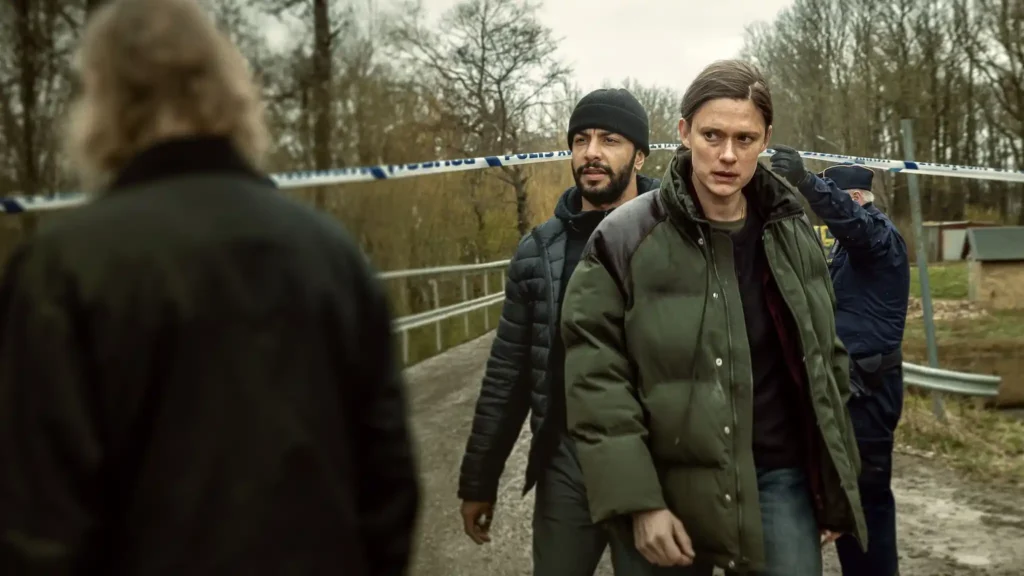
Our troubled protagonist of the moment is Dani Anttila (Krista Kosonen), a brusque single mother who is called to the coastal Bjäre peninsula to investigate the disappearance of troublesome youth Silas (Alexander Persson), the scion of a rowdy farming family known for their distrust of the establishment, familiarity with social services, and fondness for drink and violence. Dani is personally connected to Silas, who has a relationship with her own troubled drug addict son, Oliver (Ceasar Matijasevic), so when his disappearance quickly reveals itself to be a murder, her guilt compels her to dig into the case against the wishes of Silas’s family, including his uncle, Elis (Peter Gantman).
Dani is assisted by a new partner, Malik (Mohammed Nour Oklah), a rookie in her eyes but a capable and battle-tested investigator in his own right who provides a decent foil to Dani’s maverick insularity. A ticking clock quickly emerges in the form of Elis’s one-week deadline; if the police don’t turn up anything meaningful in that time, then the locals will take over and get to the bottom of things in their own way. But the more Dani digs, the closer she gets to her own most closely-guarded fears and secrets.
See what I mean? Dani is a Nordic noir protagonist in the classically damaged and abrasive mould. She’s a no-nonsense, unselfconscious avatar of get-sh*t-done femininity. She doesn’t have a sense of humour, has no tolerance for fools, doesn’t scare easily, and is silently raging at the state of the world and her personal life 100% of the time. She’s complimented by Malik, who isn’t cartoonishly different in that odd-couple way, but exists apart enough from Dani that he can feasibly call her out on her worst behaviours and help her peel back the layers of a knotty mystery carved deep into the rural countryside.
The countryside means hostile blue-collar locals, a favourite of Scandi television, and Land of Sin doesn’t disappoint in this regard either. But these people aren’t depicted as cartoonish stereotypes. It would have been too easy to depict someone like Elis, or Silas’s ailing father Ivar (Mats Mårtensson), as moustache-twirling evildoers, but it isn’t that simple. Just like how Dani isn’t strictly a good guy, these folks aren’t inherently bad; they have instead lived a very specific, humble life, and have largely good reasons for mistrusting the institutions that look on them with derision. They’re flawed, not monstrous, which is an important distinction that television often forgets to make. Creator and director Peter Grönlund relishes context and understands that hostility doesn’t foment in a vacuum.
It’s about survival, and not just individual life-or-death survival, but the survival of traditions, of culture, of families, of inherited plots of land and guarded secrets. Land of Sin is about life on the literal and psychological edge; scraping out an existence in the margins, by any means necessary, without oversight or interference. Dani’s an imposter not because she doesn’t embody the same values, but because she’s a limb of the machine that grinds nonconformists in its gears. But there is such a thing as too little accountability, however viable the justifications might be, and Dani is also the avatar of moral order that keeps a society in check. It’s a fascinating and very specific push and pull that gives Land of Sin some real texture, even as it works through the twists and turns of what is, ultimately, another murder-mystery.
There’s nothing here you won’t have seen before, which is entirely the point. But the chilly economy of the storytelling, the strong cinematography and performances, and the rich sense of place more than make up for the absence of any real surprises (beyond those, of course, turned up by the story itself). It’s unrelentingly bleak, but not so much so that it’s off-putting. On the contrary, it’s building to a note of bittersweet redemption rather than a death knell, which is a fine payoff. At just five episodes, it’s well worth a look for fans of the genre.
RELATED: