Summary
Fallout Season 2 effectively develops some moral complexity in “The Other Player”, but it’s a relatively tame episode to arrive at this point in the season.
I’m not sure about “The Other Player”, truth be told. One has to wonder whether Fallout Season 2 really needs an episode like this so late in its run, one that takes a notable present-day pacing hit to better flesh out some wider world-building details. This is especially true since Episode 6 is coming right after a pretty major falling out between Lucy and the Ghoul, resulting in the former being kidnapped by her demented father. And yet the focus here is pretty squarely on Barb, about whom there’s clearly more than initially met the eye. A new character and a last-minute reunion help to liven things up, but I’d still argue something feels just a touch off here.
Then again, it’s very on-brand to see executives dispassionately quibbling about the best approach to apocalyptic logistics, so there’s that. Sometimes it’s just a case of the needs of the franchise outweighing the needs of a television story, and there may be some of that here. Either way, let’s get on with breaking it all down as much as we can.
Playing God
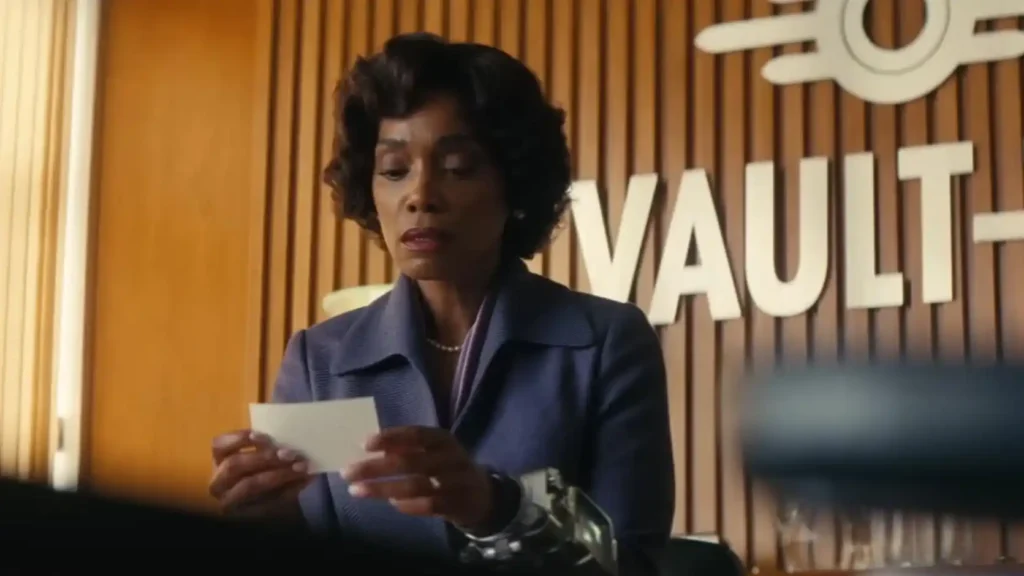
As if making a mission statement, “The Other Player” opens with a flashback in which Barb is shown a string of presentations laying out various options and decision-making opportunities for how best to manage the end of the world. How will Vault-Tec’s wealthy clientele best make their way to their Vaults? Which of the Vaults will run out of water? Quite how much damage will multiple nuclear weapons of a particular yield do?
It’s grim stuff, and only gets less cheery when the body-double Robert House presents Barb with a Rob-Co device that is clearly the precursor to whatever present-day Hank is trying to build with the brain-computer interface. The technology is a mind-control device that essentially turns human beings into automatons, and Vault-Tec has paid Rob-Co for it in exchange for cold fusion. What better way to keep dwellers on the straight and narrow than having their behaviour be completely programmable?
It’s a lot for Barb to think about. Is there a right or a wrong decision to make in the management of the world’s end? If you’re among the few people who know what’s coming, are you obligated to prevent it from happening, or try your best to adapt to what seems like an inevitability?
Like For Like
When we last saw the Ghoul, he was impaled on a pole outside a hotel, and he remains there for a good chunk of “The Other Player”. On the cusp of turning into an actual ghoul, he almost summons the energy to free himself by thinking of his still-living daughter, but his best efforts only leave him sliding back down to the bottom.
Luckily, the Ghoul is rescued by a giant creature who eventually reveals itself to be a supermutant (Ron Perlman is playing him in a pretty delightful casting choice). The supermutant heals the Ghoul’s wounds with uranium, but he nonetheless rejects the idea of team-up, despite the supermutant’s claims of their kinship as abominations and a coming war that they’ll need to fight. The Ghoul has, pretty understandably, had quite enough of the idea of war.
Cue more flashbacks.
Marital Strife
Despite the Ghoul’s presentation as a pretty amoral dude, Cooper Howard was much more of a straight arrow, and it was really Barb who was intrinsically compromised, which Fallout Season 2, Episode 6 does a pretty good job of spelling out. In multiple flashbacks, Cooper and Barb argue about the latter’s complicity in coming events, and Barb’s reasoning isn’t great. Sure, protecting Janey is of paramount importance, but killing millions to do it? Even that’s a stretch.
Barb has her reasons. Parental instinct is one, and fear is another, since as Siggi reminds her, she’s a small part of a big, lumbering machine, and if she doesn’t want to play ball, she can be easily replaced. And being replaced means that she and her family will no longer be safe from what’s coming. This is what leads Barb to that meeting we saw in Season 1, wherein she told the heads of the most powerful corporations that they have to drop the bombs themselves to guarantee the desired outcomes. It’s an inevitability thing. If something’s going to happen anyway, you have to figure out how to adapt.
But this still isn’t easy for Cooper to swallow. It feels too much like passivity, like accepting the easier, less frightening outcome. So, he resolves to do something himself, which involves luring Hank to his room, getting him drunk, and drugging his drink. When he opens the case he’s handcuffed to, though, it contains just an injector. Barb arrives and uses the injector to withdraw the cold fusion from Hank’s neck, where it was apparently being kept the whole time.
Home Sweet Home
The big cliffhanger of the previous episode was Lucy being snatched by Hank, and she wakes up here in “The Other Player” in a simulacrum of her home in the vault, though admittedly with some major differences, such as mind-controlled members of Caesar’s Legion happily trudging about the place.
There’s definitely an argument to be made about mind-control being a good productivity driver. Hank has the place humming along thanks to happy brainwashed workers churning out more brain-computer interfaces, having presumably perfected the device on the snake oil salesman. But it’s a pretty weak facsimile of normality, which is clearly what Hank is going for. He’s cooking away in the vault and tries to bond with Lucy over literary discussions – All Quiet on the Western Front, in this case – but she’s not really buying it, even if she shows a flicker of agreement with the idea that humanity kind of thrives on people fighting each other over nothing.
At the first opportunity, Lucy holds Hank at knife-point, though he suggests that she handcuff him and volunteers himself as a hostage, all the better to back up his claim that everything he has been doing has been for her benefit, and thus he isn’t a threat to her. He uses his diligent workers to prove the same point. Some were murderers, some were gang members. Now they’re all friends. Even when Lucy opens the doors and tells them they’re free, they stay put, apparently happy with their lot. Of course, contentment isn’t the same thing as programming, but Hank’s point is that there isn’t a particularly substantial difference. To prove it, he allows Lucy’s idea of leaving two new arrivals to their own devices to backfire, with a member of Caesar’s Legion and Biff from the NCR trying to kill each other until Lucy dutifully presses the mind-control button and turns them both into immediate BFFs.
Maybe Hank has a point after all. As with Barb’s subplot, it’s all about practicality.
Reunions
Towards the end of Fallout Season 2, Episode 6, we check back in with Maximus and Thaddeus for the first time since Episode 4. They’re now roaming the desert, debating who to sell the cold fusion to; Thaddeus would rather sell it to the highest bidder, while Maximus wants to hand it off to someone good, which is a rare thing to find in the wasteland. Lucy would have been the likeliest candidate, but she’s otherwise occupied, so it’s a stalemate for now.
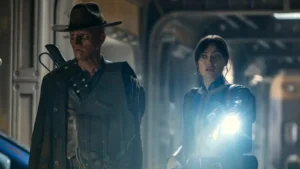
Eventually, Max and Thaddeus are woken up by Dogmeat, who’s still carrying the Ghoul’s hat. He leads the two of them to the Ghoul, who isn’t exactly glad to see them, but he’s certainly looking better than the last time we saw him, so that’ll have to do.
“The Other Player” certainly leaves things in an interesting place; the balance of power between Lucy and Hank has switched, Max and Thaddeus have rendezvoused with the Ghoul, and the moral underpinnings of the backstory are becoming a bit more enjoyably chewy. But I still think it’s a fairly tame episode to arrive in the back half of the season, as things need to be heating up.
RELATED: