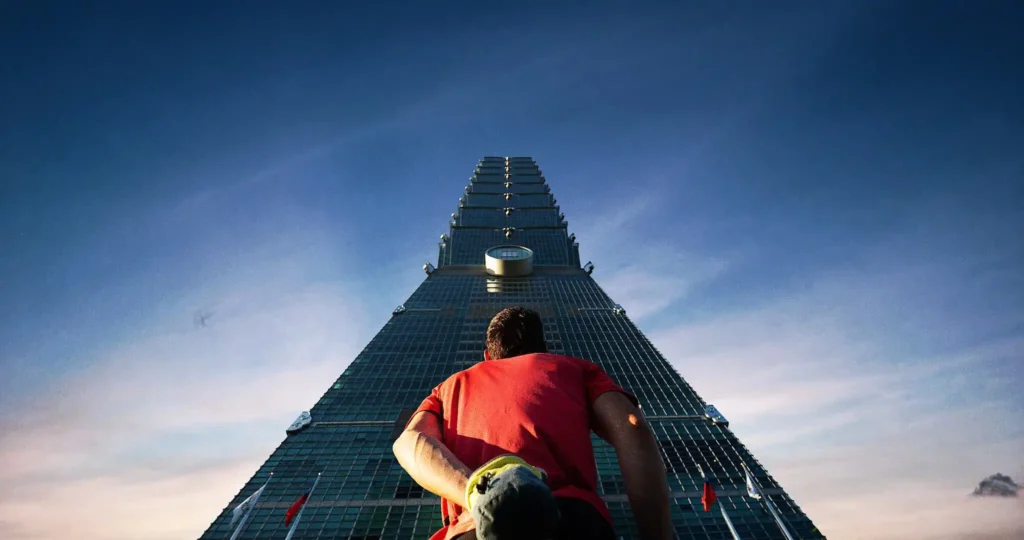
Let’s be frank here: Anyone who tunes into Skyscraper Live is doing so for one reason and one reason only, which is to see if Alex Honnold dies. That’s the key appeal, if we’re being totally honest. Free soloing – climbing very high things without ropes, a harness, or any kind of safety equipment at all – isn’t a spectator sport. There are only two potential outcomes. One is success, and the other is a very messy death.
Everyone kind of expects Honnold to succeed, for several reasons. He has been training for months to climb this specific edifice, the 1667-foot tall skyscraper Taipei 101, the tallest building in Taiwan and the eleventh tallest in the world. This is after an entire career of free soloing. He’s about as good at climbing as anyone else is at any other thing. And there’s also a latent sense of disbelief that Netflix would be so boldly associated with anything that might go so badly wrong. So, people are expecting success. But make no mistake, they’re watching out of morbid curiosity, just in case of failure.
Given this, in an uncomfortably bizarre turn of events, it will almost constitute a disappointment, dramatically speaking, if Honnold survives. And that’s not an entertainment climate I’m enthusiastic about.
By the time you read this, Honnold will have completed the climb or died in the attempt. But his individual success or failure isn’t really the point I’m making. On a broader level, the entire thing speaks to something ghoulish about Netflix’s evolving approach to live programming. As a streaming service, it’s pretty unrivalled in terms of the depth and breadth of its library, but live sports and sports-adjacent spectacle is new territory. Some of the acquisitions are uncontroversial; Christmas Day NFL games, the MLB Home Run Derby, the 2027 FIFA Women’s World Cup. But some have a touch of the carnival freak show about them. Jake Paul fought a geriatric Mike Tyson on Netflix, and then paid his penance by playing the nail in a hammering by Anthony Joshua that no sane athletic commission would have ever sanctioned.
Alex Honnold potentially splattering all over the streets of Taipei is an outgrowth of that impulse to court viewers by presenting something without any margin for error. This isn’t a new phenomenon. Evel Knievel made a career out of trying to kill himself in front of an audience, and almost succeeded multiple times. At first glance the appeal is novelty. Spectacle. But what’s really being sold is the risk itself. Nobody I’ve spoken to seems entirely sure about how many safety measures have been taken here. Nobody quite knows how transparent Netflix has been about the potential dangers, or the steps that might have been taken to alleviate them. The ambiguity builds interest, and the peril sells. It’s the can’t-miss appeal of live sports tinged with the morbid curiosity around potential calamity.
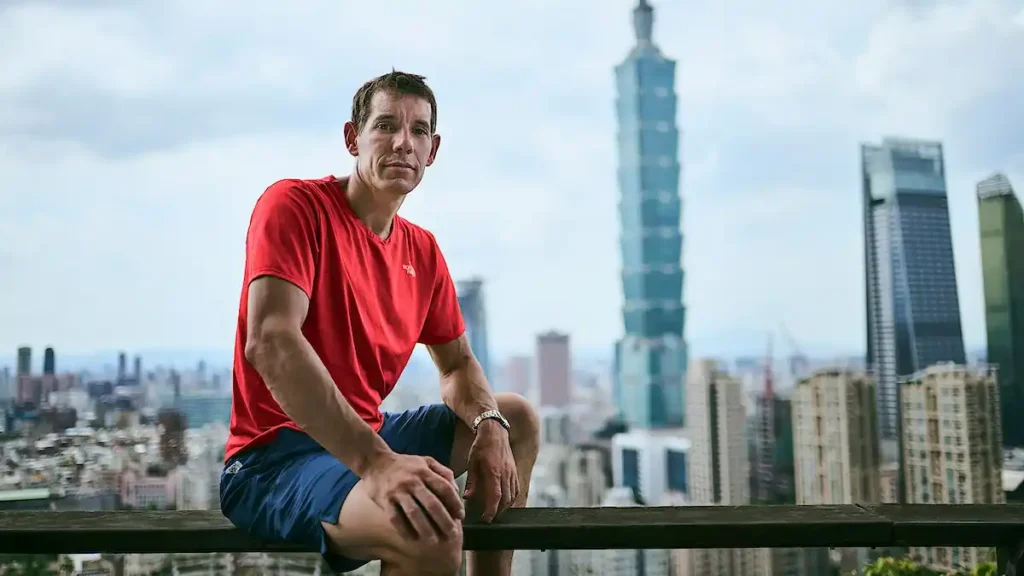
Alex Honnold | Image via Netflix
The broadcast will come complete with a “viewer discretion is advised” warning and run on a 10-second delay, so if Honnold falls the stream can be killed before he is. Fair enough. That seems like crossing the T’s and dotting the I’s, and the veneer of sporting legitimacy – an on-air panel, including an ESPN anchor, and live betting markets – creates the illusion of an upstanding event. There’s a key issue with that, though. This isn’t really sport, is it?
I’m not saying climbing isn’t a sport. But free-solo climbing is particularly dangerous; lots of people have died doing it. When I settle down to watch football, I’m not doing so with the expectation of anyone keeling over. The appeal isn’t potential death. Sport thrives on unexpected outcomes and dramatic swerves, not mortal danger. Watching a husband and father clamber up a skyscraper without a harness is voyeurism. The instinct to tune in is the same one that compels you to turn your head when driving past a nasty-looking car accident. But I wouldn’t pay a subscription for that, since that’d make me a lunatic.
The normalisation of something like Skyscraper Live – and it is, by sheer virtue of airing on the world’s most popular streaming platform, definitionally normalised – feels like a bedfellow of the increasing prevalence of live-streaming everything, a practice with so many copious downsides you don’t need me to reproduce examples of it going wrong. The whole thing’s a bit grim, but it also reeks of commercial artifice. Skyscrapers are, at least according to most professional climbers, relatively easy to climb. They offer recurring segments and regular natural rest points. It isn’t easy, obviously; it still requires extreme skill and endurance. But the chances of a failure are, by free-solo standards, low. And yet the chances of failure are the driving impulse behind the entire event, otherwise why bother to broadcast it live?
It’s not a quandary I relish. It makes me feel grubby. The 24-hour news cycle is full of morbid stuff, of course, and you can’t move on social media without seeing something scarring, but, again, you don’t pay for those things. Being informed of awful stuff happening is important. Going out of your way to see awful stuff happening is something akin to mental illness. And yet we’ll all tune in, won’t we? Some of us will do so out of what we pretend is professional obligation, some of us will do so because of FOMO, but we all will. And Netflix knows it.