Summary
Fallout Season 2 continues to suffer from its own scattershot structure in “The Handoff”, but it does leave all the various moving parts in interesting places.
The more I think about Fallout Season 2, the more I think I understand why it can’t quite reach the heights it’s capable of reaching, even when it’s pretty good. And no, it’s nothing at all to do with video game canonicity or “wokeism” or any of the other ridiculous accusations that detractors have levelled at it. It’s much duller than that, but also more important, and you can see it really clearly in Episode 7, “The Handoff”. It’s the structure.
Fallout has a large ensemble and is juggling multiple characters and storylines all the time. This isn’t unusual or anything, but the issue with it here is that it prevents proper individualised focus on people and events that need more examination to make their implications really sing. Fallout’s underlying “war never changes” subtext is a bigger idea than that one-line summary suggests, and there’s something about developing everything in increments, past and present, across multiple viewpoints, that doesn’t do it any justice.
Steph Is Canadian
Case in point: Steph. “The Handoff” is building to her pending nuptials, and the late-stage payoff of her being chased through the Vault halls by an angry mob who’re furious that she’s… Canadian?
We knew this anyway, but an explanatory flashback clarifies. Steph grew up with her mother in the “Uranium City Internment Camp”, part of what is cheerfully dubbed as “The Big 51” since, in the show, like the games, Canada was annexed by an expansionist pre-War United States and its citizens kept in line through judicious use of Power Armor-embellished force. So it’s kind of a big deal that Steph is Canadian.
The flashback is a nice reminder that the United States are not the good guys in this story. The idea that the moral bankruptcy of the state is a recent development is nonsense. Natasha Henstridge, guest-starring as Steph’s mother for a brief stint before she’s fatally wounded, reminds Steph that the only way she’s going to survive is by considering the people she’s ingratiating herself with not as human beings, but as Americans. Her cutthroat survival instincts have been nurtured since childhood, coloured by trauma.
It’s all good stuff and helps to contextualise the breakdown of the marriage ceremony, but it’s also all occurring too quickly, given how interesting the lore implications are and how useful the characterisation is for Steph. Most shows would give her an entire episode. This one can barely spare much time at all.
Daddy-Daughter Time
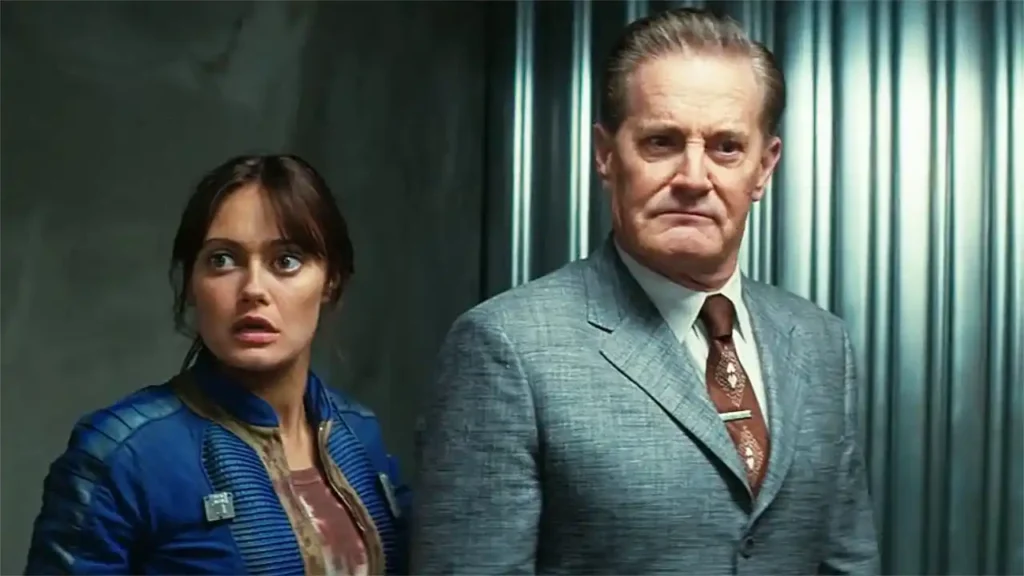
There are shades of this in what’s going on with Lucy and Hank, but I do think that it fares better since it’s a more simplistic, personal arc, and it has had more historical focus throughout both seasons. In essence, Lucy is still trapped in the Vault-Tec HQ, receiving a tour of what has grown into Hank’s mad-science laboratory. He considers it to be a teachable moment, and it really works to see them slip back into the daddy-daughter rhythms. You can see why Lucy would buy what he’s saying, at least in part, but it’s good villain development for Hank that he can’t understand her point about his own actions having ruined the relationship they once had (and that he still pines for).
Hank also struggles to sell the brain-computer interface. He’s trying to imply that it’s some kind of altruistic technology that’ll help cultivate peace and understanding, but his description of it makes it sound worse than straight-up mind control, which doesn’t go unnoticed. What it does, at least as far as I can tell, is remove all the traumatic Wasteland memories and then replace them – this is the risky bit – with new ideas and opinions from a mainframe. So, that isn’t just stripping people of their identities – as evidenced by Biff now having no idea who Lucy or the NCR are – but also programming them with new ones at the behest of someone else. Not a great combination.
A lot of Fallout, as a game and a show, is about rambling quasi-political justifications for heinous self-serving horrors, and Hank really embodies that, just as Lucy is its diametrically opposed opposite. Her moral simplicity is often portrayed as naivete, but it’s really just common sense cutting through a world defined exclusively by party lines and justification rhetoric.
Just A Couple of Ghouls, Hanging Out
All of the classic Fallout action in Fallout Season 2, Episode 7 comes from the Ghoul, Maximus, and Thaddeus, who have now teamed up to raid an NCR armory and suit up to fight off the Deathclaws prohibiting access to Vegas.
There’s some character stuff here, and a funny recurring beat about how Thaddeus’s ghoul state is worsening in increasingly alarming ways, like his arm falling off and a chattering mouth growing in his shoulder. But it mostly exists to get these characters in the vicinity of Lucy and co., and also so we can see Maximus in Power Armor fighting Deathclaws.
Once he gets inside, the Ghoul does get to see House’s face on a giant computer screen, which is a nice image for fans to go alongside all the Deathclaw dismembering. Very on-brand.
Out of the Frying Pan
Weirdly, for a Fallout show, the most illuminating sequences often take place in the past, which is perhaps a consequence of how directly they influence the present. That’s really obvious in “The Handoff”, which is so-called because the flashback sequences are about Cooper trying to hand the cold fusion he extracted from Hank’s neck off to someone who will do some good with it. The only problem is – an idea reiterated by the state of Canada in the cold open – there isn’t anyone in America who would do any good with it.
The best-case scenario for Cooper is to give the cold fusion to Representative Welch and the President, which is obviously a bad idea given what we know about this administration and the lingering knowledge that the bombs still fall either way, but it’s the most viable option at the time. It also leads to the best use of juxtaposition that Fallout Season 2 has drummed up yet.
Here, Lucy discovers what Hank’s “mainframe” is – the severed head of Diane Welch, connected to a whole bunch of wires and with a straw – presumably for some kind of sustenance – hanging limply from her lips. Just in case it wasn’t obvious that Cooper’s move was a bad idea.
RELATED: