Summary
Star Trek: Starfleet Academy delivers a genuinely substantive hour in “Vox in Excelsio”, chewing over a meaty Klingon conflict that handily doubles as great character development for Jay-Den.
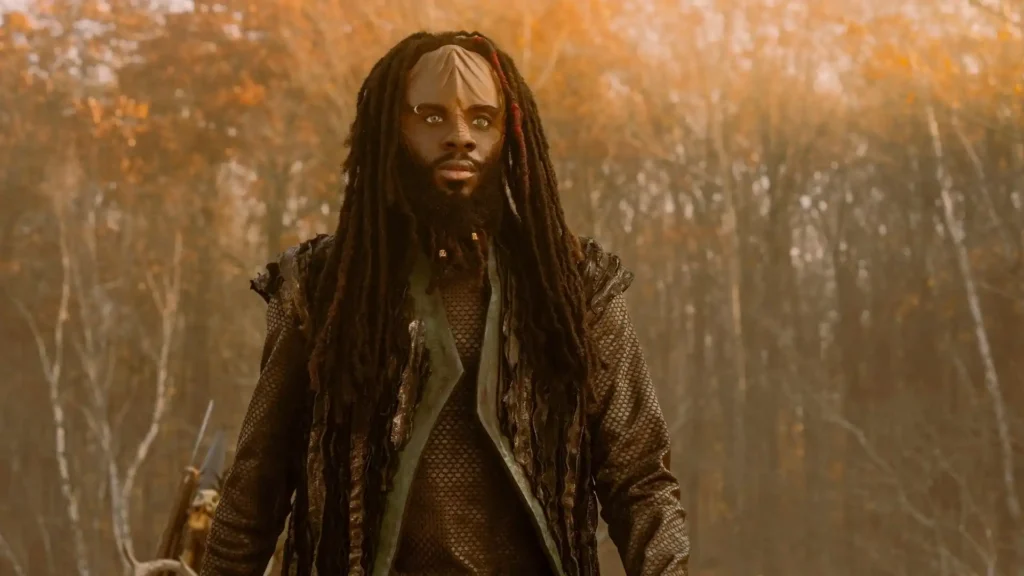
The Klingons are one of the few alien races that even non-Star Trek fans have generally heard of. But the pop understanding is generally pretty simplistic – big-headed, angry warmongers, lots of makeup, deep voices. Episode 4 of Starfleet Academy is one of the better efforts to dispel this impression in recent times, with “Vox in Excelsio” doubling up as a run-down of the state of the Klingon Empire post-Burn, and a pleasing character study of Jay-Den Kraag and the internal turmoil he feels trapped between the radically different worlds and ideals of the Klingons and Starfleet.
This is a much better character-driven episode than what Darem and Genesis got, and writers Gaia Violo and Eric Anthony Glover really dig into the complex underpinnings of Jay-Den’s internal conflict and the political and cultural challenges of the Klingons’ accelerating extinction. Some will quibble with the script here and there – a debate tournament provides a spine, and there’s an unironic “facts over feelings” bit that hews too close to try-hard signalling than really suits – but the overall effect is legitimately compelling.
The Klingon State of Affairs
“Vox in Excelsio” finds the Klingon Empire eking out a life as refugees following the destruction of their homeworld, Qo’noS, during the Burn. The surviving houses are on the cusp of species-wide extinction, yet they still refuse to accept what they perceive as charity from the United Federation of Planets. This stubbornness has only worsened the predicament, and as luck would have it, the situation reaches a boiling point at exactly the time that Starfleet Academy happens to have a Klingon cadet.
One of the key debate topics in this episode is whether it is the Federation’s responsibility to house the Klingons, but Jay-Den surprises everyone by approaching the topic from a different angle. His pro-Klingon stance is to allow the Klingons their independence by not intervening in their plight, even if it might mean their destruction. Naturally, the answer is somewhere in the middle, but it requires an understanding of both viewpoints to bring about a solution.
A New Homeworld
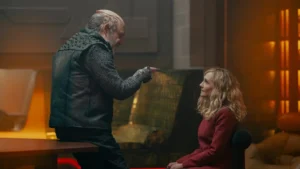
Even though Jay-Den’s public debate with Caleb is functionally the “climax” of this argument, the issue manifests more overtly in Jay-Den’s involvement in securing the Klingons a new homeworld in a way that they’re happy and satisfied with. This involves Nahla’s longstanding (romantic!) relationship with Klingon leader Obel Wochak, Lura relating to Jay-Den on a personal and sincere cultural level – the most serious that character has been by far – and Jay-Den embracing both his heritage and his current circumstances as a Starfleet cadet.
The idea is for the Federation to offer the Klingons Faal Alpha, an ecologically similar planet to Qo’noS, but not to simply offer it up as a gift, since the Klingons are too proud for that. Instead, Jay-Den suggests that the Klingons must “conquer” Faal Alpha, which involves the USS Athena leading an armada into the system to accuse the Klingons of trying to conquer the planet unlawfully, leading to a minor skirmish that Starfleet quickly retreats from.
This ticks all the boxes. Nobody is harmed, the Klingons get a new homeworld, and they get to acquire it through conquest, thus saving face and retaining their honour. Their cultural mandate is fulfilled, and their species won’t go extinct. Everyone’s a winner.
Jay-Den Becomes A Warrior
As if this didn’t make it explicitly clear, the Klingons are a warrior culture, though Jay-Den’s growth doesn’t take the usual form that might be expected of a Klingon coming-of-age. Through flashbacks, we’re made privy to Jay-Den’s past, particularly the death of his brother, Thar, and his subsequent abandonment by the rest of his family for failing to make a kill that would have promoted him to the rank of warrior.
On account of this, Jay-Den, a pacifist who has always dreamed of being a healer, not a warrior, has never come to terms with the idea of his individual nature being antithetical to his culture. His brother understood this, since upon discovering a recruitment beacon for Starfleet Academy, he realised intuitively that this was Jay-Den’s destiny. But his father, Enok, destroyed the beacon and demanded he shoot a native bird on Krios Prime to cement his Klingon honour. His inability to do so, causing Enok to miss the killshot himself, resulted in his perceived abandonment.
It’s only through Lura that Jay-Den entertains the idea that Enok missed his killshot on purpose, giving him an excuse to “free” Jay-Den from Klingon cultural expectations to pursue his obvious destiny in Starfleet. That decision ultimately ends up saving not only the lives of his parents, who are among the surviving refugees, but the entire Klingon people.
How’s that for coming of age?
Brothers in Arms
Naturally, Star Trek: Starfleet Academy Episode 4 can’t resist keeping Caleb in the limelight, so a lot of the chewy thematic undercurrents of this episode are depicted as Jay-Den clashing with him directly, since Caleb turns out to be a shrewd debater – while Jay-Den has a crippling fear of public speaking – and takes the position that Starfleet have a moral responsibility to “save” the Klingons.
Caleb’s support of Jay-Den comes from a good place – they do have a lot in common – but I’m thankful that Jay-Den’s arc didn’t become realizing that Caleb was right. Through the help of a Khionian breathing ritual taught to him by Darem, Jay-Den is even able to “win” their debate, helping his classmates understand the Klingon plight on a more intimate level. But it’s also undeniable that Jay-Den wouldn’t have been able to reach that point without the support of his friends.
And isn’t that, on some level, what Star Trek is really all about?
RELATED: