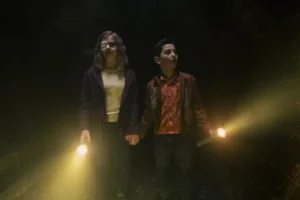
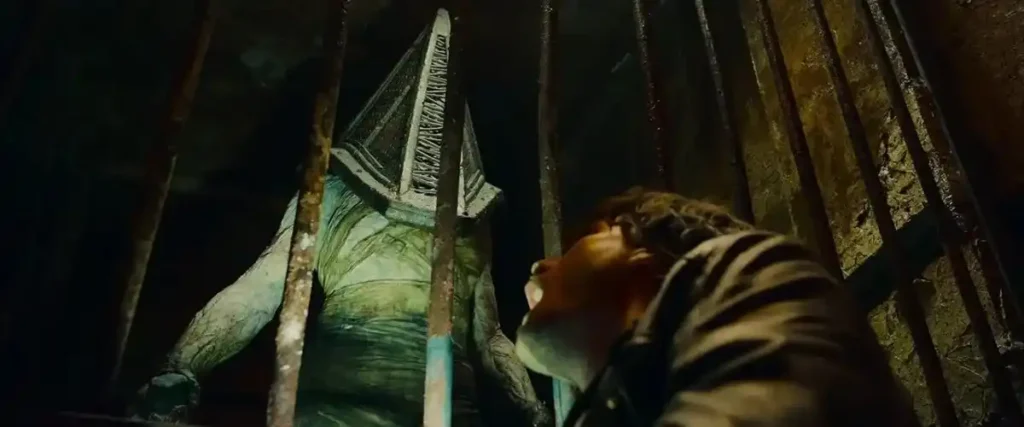
Unlike Christophe Gans’s first cinematic foray into the world of Silent Hill, which wasn’t based on any of the games in particular and instead pulled together a hodgepodge of franchise touchstones with a particular hard-on for the iconic Pyramid Head, Return to Silent Hill is a fairly direct adaptation of Silent Hill 2. Given that’s the game that introduced Pyramid Head in the first place, you’d think that’d be a good thing. But you’d be wrong. You’d be dead wrong.
This is a film and TV site, so some of our distinguished readership might not know a great deal about Silent Hill 2. To put it in the most easily understood terms possible, in the realm of video game horror, Silent Hill 2 is the equivalent of The Godfather. It’s a peerless example of psychological terror, oppressive atmosphere, and memorably terrifying creature design, and for various reasons, it’s almost impossible to adapt, which this movie proves.
But some of the wounds are self-inflicted, stemming from major changes to the game’s storyline that fundamentally alter it on a core, textual level. I’m very much in favour of trans-media adaptations making necessary adjustments, but the problem with some of these changes is that they miss the point of what Silent Hill 2 is, what it might mean, and to whom. So, let’s talk about it.
Note: This isn’t a nitpicky, comprehensive list of every single little thing that’s different between the movie and the game. Instead, I’m focusing on the stuff that wildly misses the point.
The Broad Strokes
At a glance, things are very similar. Gans has nailed the look and feel of Silent Hill on a general level, doing a good job replicating the creature designs, and several locations are almost one-to-one accurate, sometimes even framed in the same way. But this style gets less and less prominent as the movie descends into a mess of CGI nonsense.
Story-wise, too, we’re in familiar-ish territory. James Sunderland is once again drawn back to Silent Hill by a letter from his wife, Mary, which is weird because she’s dead. Depressed, drunk, and confused, this version is a struggling artist with a bit more caddish energy, but he’s nonetheless still deeply unlikable and pained. So far, so good.
But then the problems emerge.
“Our Special Place”
This version of the story provides us with ill-advised flashback sequences to James and Mary’s meet-cute, and a key change reveals itself here. For a while, James and Mary lived in Silent Hill, and the latter even grew up there. This is a change meant to facilitate some later revelations, all of which are bad, but it’s the first sign that Return to Silent Hill fundamentally misunderstands the essence of its source material.
In the game, James and Mary took a vacation in Silent Hill, and Mary had a very specific yearning for the place because it’s one of her key tethers to a time when she felt truly happy and unburdened. Having James and Mary live there and be active in the local community saps some of that idealism away, and makes James’s return feel weird.
As I said, though, this is in service of another change. An even worse one.
Cult Following
After a while, it becomes clear that Mary was part of a cult, which in the context of the Silent Hill franchise shouldn’t come as too much of a surprise. The first and third games, among others, revolved heavily around religious fanaticism, and The Order, a doomsday cult active in the town, is really prominent across the series. But crucially, they’re not prominent in Silent Hill 2, and for good reason.
Here, Mary was groomed by her sadistic father, whom the followers of the cult worship even after his death, and was offered up to his followers, a tradition which continues even while she and James are in a relationship. It’s a fittingly horrific idea, but it undermines the texture of Silent Hill 2 as an exploration of grief, trauma, and the very specific manifestations of the same that Silent Hill as a setting conjures up in the minds of people who venture there.
It also has a knock-on effect for an even more detrimental change, because it makes a change to the nature of Mary’s unspecified terminal illness, which is central to her death and, by extension, to James’s entire arc.
Permission Granted
In the game, the root cause of James’s spiralling mental illness is the fact that he murdered Mary, who was dying from a vague illness that gave her terrible mood swings and made her physically repulsive. Mary had expressed a wish to die, and for James to end her suffering, but his decision was not a merciful act. It was a selfish way for him to reclaim the life that he believed had been lost in being her caregiver, and he used her words to justify his own inability to cope with her decline.
In Return to Silent Hill, Mary is dying as a consequence of prolonged exposure to a drug that the cult gave her to sedate her, and she explicitly asks James to end her life. He does so reluctantly. It’s a completely different take on the idea, and earthquakes a huge amount of the surrounding fiction, given that everyone and everything James encounters in Silent Hill is a manifestation of his trauma and guilt.
By making Mary central to Silent Hill, the movie also makes all of its denizens central to her. Original characters from the game who were representative of something meaningful to James are now aspects of Mary herself, literal manifestations of her in different stages of her life, or aspects viewed differently by James. Laura, in the game a kind of surrogate daughter of Mary’s who is fundamentally uncorrupted to the extent that she doesn’t even see any of the horrors in the town, is now an increasingly monstrous version of Mary’s younger self. Angela, in the game a survivor of heinous physical and sexual abuse who ultimately succumbs to her despair, is here just another doppelganger of Mary, the representation of her cowed victimhood. This takes novelty away from Maria, who in the game was a dead ringer for Mary but was much more sexually extroverted, a manifestation of James’s multifaceted guilt. Ironically, Maria is the character in Return to Silent Hill who is most accurate, in a story that has made everything interesting about her and what she represents surplus to requirements.
I think that sums it up.