Summary
The ending of Fallout Season 2 unmistakably enjoys the liberty of an already greenlit third season, but it’s still a satisfying climax that leaves things in an interesting position while delivering some meaningful character payoffs.
People haven’t been especially keen on Season 2 of Fallout, for some reasons that make a degree of sense and some that don’t, but it’s hard to imagine how Episode 8, “The Strip”, could be perceived as anything other than a really good finale. Not perfect, of course; it has the unmistakable DNA of an ending that is operating with the security of an already-greenlit third season, but in terms of shuffling the pieces into a good position for that and delivering some meaningful personal payoffs, it really works.
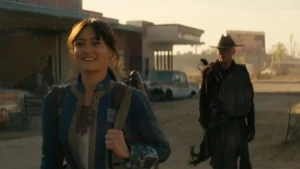
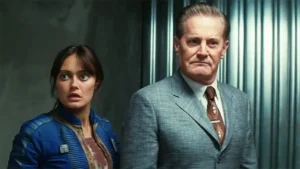
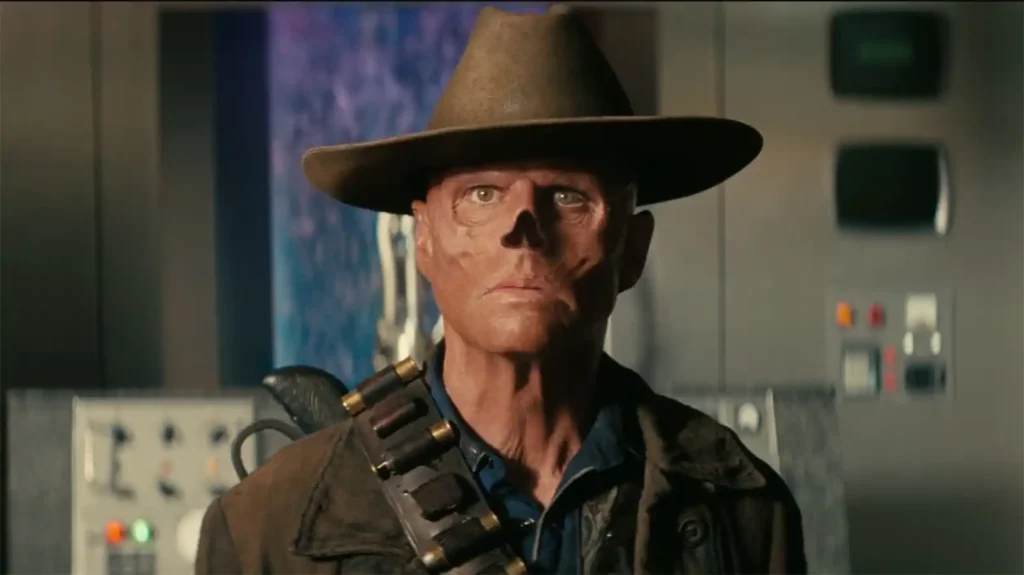
It helps that the characterisations have remained fairly consistent. The Ghoul’s arc has been simple but worthwhile, his post-apocalypse personality becoming steadily more heroic as the flashbacks to his decisions as Cooper contextualised why he became so embittered in the first place. Lucy, meanwhile, has experienced several trials by fire in the wasteland and ultimately been confronted with her staunchest obstacle yet – a direct confrontation with her father, and therefore her insular childhood.
Maximus, who has been admittedly less well-served by the script, mostly flitting in and out of some episodes while being totally neglected in others, has been having a fairly simple hero’s journey, figuring out what he stands for and how far he’s willing to go to protect those ideals. Simple, but undeniably effective, or at the very least effective for me.
The Coming War
It’s worth noting that looming over this finale is the threat of war. In a brief cold open, we’re reminded that Caesar’s Legion is still operational, and thanks to a bloody coup, Lacerta Legate is in charge and has designs on reclaiming Vegas. After the opening, this isn’t returned to much, but it lives in the background of the drama, since the idea of surviving what’s inevitably coming informs a lot of decision-making, especially for Hank.
This notion of security is also pretty significant to the digital head of Robert House, though admittedly not solely in relation to the Legion. Picking up where we left off, the Ghoul is guided around by House’s disembodied voice, as they come to an arrangement. If the Ghoul is allowed into the Vault, he won’t destroy the cold fusion diode keeping House’s consciousness afloat. This is agreed, but he has to venture inside wearing a Pip-Boy, which House is pretty smug about, considering him an employee.
House’s whole deal was about protecting Vegas, protecting its future, and his. But Cooper’s decision in the past to hand the cold fusion off to the president empowered the Enclave, hence the Deathclaws guarding the city and so on. This also provides House with a looming threat that he can use to try to manipulate the Ghoul, but it doesn’t quite work out that way for him.
Betting On Hope
All of the Ghoul’s scenes in the vault are interspersed with flashbacks that find him and Barb celebrating the decision to give the cold fusion to the president, discussing a possible move to Bakersfield or Colorado. Of course, Cooper didn’t then realise the mistake he had made. But House did. Even House, though, could respect Cooper’s decision and his efforts to play the hero, which he tells him when he picks up a ringing phone. He bet on hope, and he lost.
Cooper is arrested and volunteers to take the fall so that Barb doesn’t go down with him. That decision kept her fate – and that of their child – disconnected from his, which is why, in a roundabout way, the Ghoul has spent 200 years looking for them. Here in “The Strip”, he finally finds them, or at least their cryochambers. But both are empty. There’s nothing there except cold air and a postcard reading, “Colorado was a good idea.”
But this is enough for the Ghoul. For the first time in two centuries, he knows his family is alive. That frees him from any obligation to House or fear of the Enclave. He removes the Pip-Boy despite House’s protestations and leaves the Vault with Dogmeat, heading for Colorado.
Miniatures
After Lucy’s macabre discovery of the severed head of Representative Welch, Hank is forced to explain himself. And his explanation is defensible in his eyes, albeit a little creepy in practice. House’s intention was apparently to turn everyone into mindless robots, whereas Hank’s agenda was to add a little personality to that product with the brain-computer interface. His end goal was making a tiny device that was undetectable, meaning that nobody would ever know who was automated and who wasn’t, meaning peace in a very circuitous way. Since Welch had qualities that Hank thinks the world would have benefited from, her brain would serve as the mainframe.
Hank intends to use one of the mind-control devices to make Lucy his obedient little girl again, but the Ghoul arrives in the nick of time and saves her, taking out Hank’s goon and sliding Lucy a gun. The choice is ultimately hers, though. Instead of shooting her dad, she implants him with one of the devices, so she can turn him into the father she thought he was. First, though, she wants some answers about what Hank was really working on. He remains cagey until the end, revealing that the surface was the experiment, not the Vaults, and that he has already sent his undetectable R&D department into the Wasteland to carry out some vague orders. And with that, he activates the remote himself, wiping his own mind so he can’t tell Lucy anything else.
Deathclaw Showdown
Maximus’s arc in the ending of Fallout Season 2 is becoming his own kind of hero, and that begins with taking out the Deathclaws outside Vegas in a knock-down-drag-out Power Armor brawl. He’s outnumbered, but he keeps fighting until his suit malfunctions, and then prepares to fight with nothing but a roulette wheel and a stick. But he’s saved by a sniper, the first wave of the NCR, who march into Freeside with the intention of taking over from there.
After their respective ordeals, Maximus and Lucy reunite. Together, they peer out of House’s penthouse suite at the Lucky 38 and hold hands as they consider the coming war, with House’s face popping up on the monitor.
Phase 2
There isn’t a great deal of Vault action in this finale, but there is some. In Vault 31, Ronnie leads the dwellers in an uprising against Norm, but it quickly descends into an attack by Ma June’s roaches that butchers almost everyone – except, crucially, Norm. After, he finds Claudia alive and tells her he’s taking her home.
In Vault 32, meanwhile, Stephanie is still stuck in her office, being hunted by the angry mob who just discovered she was secretly Canadian. At a loss, she retrieves a Pip-Boy from a box of Hank’s old keepsakes and sends out an emergency broadcast on an Enclave frequency, saying she’s Hank’s wife and instructing them to initiate “Phase 2”. We see the message is received, among others, but there’s no real clue yet about what this eerie second phase might consist of.
Post Credits
In a post-credits scene, Dane delivers some remnants to a reborn Quintus, now “The Destroyer.” The remnants are plans for Liberty Prime Alpha, a superweapon combat robot from the games.
All in all, it’s a pretty good setup for Season 3.