Summary
DTF St. Louis is immediately funny, striking, and original in “Cornhole”, raising all kinds of questions in a totally unique way.
At first blush, DTF St. Louis is a show you’ve seen before. The HBO murder-mystery is about three people circling the drain of a sexless middle age, and one of them turns up dead, casting the other two in suspicion. It isn’t the most unique of elevator pitches. But there’s something about the way that Steven Conrad has written and directed the series that is totally modern and unique, which is obvious even in Episode 1, “Cornhole”. Everything from the gags to the odd absurdist flourishes to David Harbour’s pendulous stomach contributes to an incredibly bizarre but immediately engaging piece of work.
Initially, the premiere seems to be about two men; the third vertex of the love triangle only emerges later, quite by surprise. In the meantime, there’s a meet-cute quality to the relationship between semi-famous TV weatherman Clark and his sign language interpreter, Floyd. Clark is successful but uptight, and things have cooled off between him and his wife, Eimy, who stays up so late working on “charity stuff” that by the time he rises at 4 am, they’re forced to high-five in passing like roommates. Floyd isn’t faring much better. He’s ostensibly happily married to Carol, but his libido has been perhaps irreparably damaged by her working part-time as a Little League umpire; whenever he looks at her, he sees her in the ridiculous-looking gear.
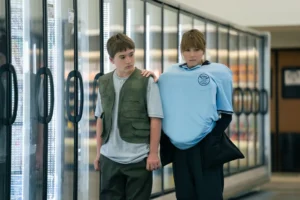
Floyd is also trying — and failing — to bond with Carol’s dead-eyed rock-throwing son. One of the earliest scenes of the premiere, which finds Floyd and the kid locked in an awkward hug while the former reads out a poem he has written, is a good indicator of Floyd’s well-intentioned inner character and also a mission statement for the show overall. If you find the tone of this too ridiculous, you’re probably going to struggle. But if, as I did, you find it pretty hilarious, then you’re going to be in for a treat.
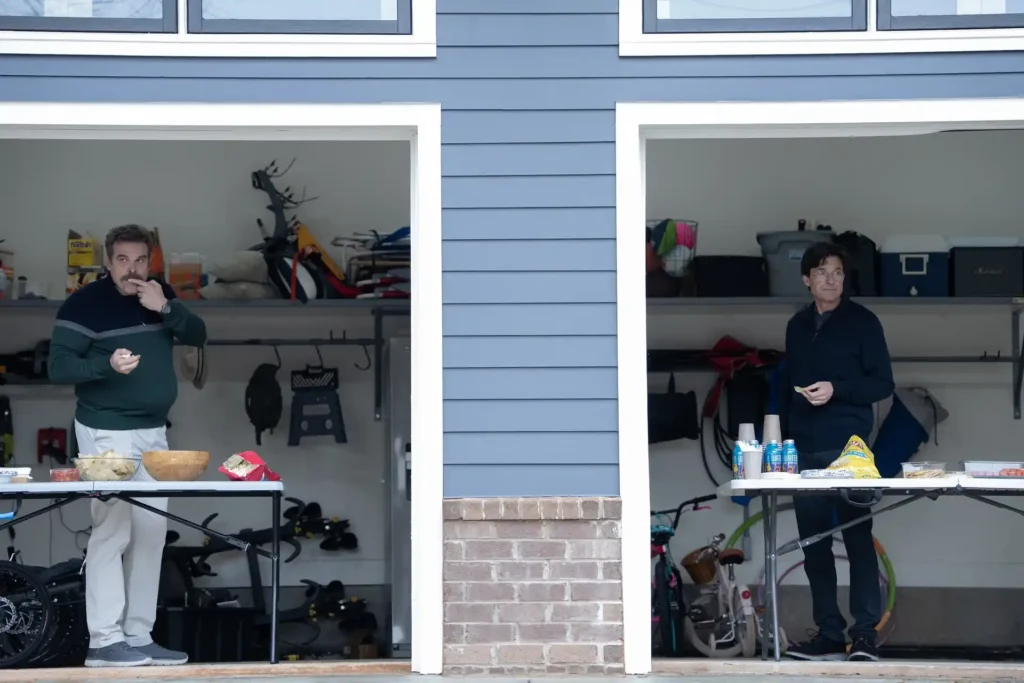
Clark and Floyd quickly become firm friends. They work out together, since Floyd is trying to lose his belly as his clothes don’t fit him anymore and he thinks buying a bigger size is a slippery slope, and Floyd gives Clark lessons in ASL. They have barbecues, and their families intermingle. All seems well. But all, as is often the case, isn’t quite what it seems.
Soon enough, Clark becomes weirdly obsessed with a dating app called DTF St. Louis, a way for happily married couples to engage in extramarital affairs. He pitches it vaguely at first, but eventually enlists Floyd as a full-on conspirator, the two of them helping each other craft ostensibly true but nonetheless cool-sounding personal profiles. Clark is the more desperate of the two; we later learn that his relocation of the kids’ swing set was so he could “safety test” it and swing high enough to gawp at the sunbathing next-door neighbour. Floyd is less inclined, but a stressful attempt at playing a board game with Carol and her son tips him over the edge.
This is only 25 minutes or so into DTF St. Louis Episode 1, and Floyd turns up dead at the Kevin Kline community pool, his belly still drooping from the bottom of his shirt. Next to him is an empty can of Bloody Mary and an Indiana Jones-themed Playgirl centrefold. According to Jodie Plumb, the porn-positive major crimes detective investigating the case, there’s something oddly asexual about the flaccid image. This is news to the more traditional Sheriff’s Department detective, Homer, who technically has jurisdictional authority but is clearly going to need Plumb’s help in navigating the modern world of dating apps and polyamorous relationships.
Quickly, Clark emerges as the prime suspect in Floyd’s murder. And the evidence isn’t circumstantial, either. When Homer acquires a search warrant to look through Clark’s phone, he uncovers a months-long affair between Clark and Carol, which the latter had ended and gotten over, and Clark hadn’t. Floyd’s Bloody Mary had been laced with a pharmaceutical amphetamine. That’s motive and method accounted for, so Clark is arrested live on air while delivering a forecast.
As a final stinger, “Cornhole” ends by revisiting an earlier scene of Clark and Floyd practicing ASL, but this time with subtitles, which translate what Floyd said. It was confirmation that he knew about the affair. Does that make Clark more likely to be guilty, or less? I expect there are many more twists to come.
RELATED: