
Summary
Vladimir is a masterfully complex and devious adaptation anchored by an award-worthy leading performance by Rachel Weisz.
Vladimir might be the best TV show of the year thus far. It’s a big claim, that, but I think it’s quite defensible. Truly adult television is rare, and by “adult” I don’t mean explicit sex and violence, of which there’s an abundance everywhere. Vladimir, an adaptation of Julia May Jonas’s provocative 2022 debut novel, is adult in the context of its themes and complexity of its ideas, in the even-handed explorations of those things, and in how it refuses to kowtow to an increasingly prevalent idea that there is a simple, binary, zero-sum approach to what have historically been complex topics. Jeanie Bergen, who has adapted the novel into an eight-part limited series for Netflix, loses none of what makes the text “adult” in leaping the transom from page to screen.
And thank goodness for that, frankly, since none of what Vladimir is about would work otherwise. And again, “about” isn’t as simplistic a term as it appears. At first blush, this is a show about an age-inappropriate relationship, but it’s not really about that, not in the same way it’s about internal turmoil and existential dread and desire itself as a loose, fluid thing, a primal base instinct to be avoided or a source of creativity and freedom to be cultivated. It asks big questions and is content to give potentially wrong answers as long as the attempt to interrogate them is earnest. It lives in the grey spaces between black and white, introducing loathsome characters who’re impossibly charming and well-intentioned ones who are naive and oblivious. It gives you predicaments you think you understand and then constantly reminds you that you don’t.
You will think, for instance, that you have a good measure of Rachel Weisz’s unnamed tenured literature professor, whose husband, John (John Slattery, The Rainmaker), another tenured professor on the same campus, is embroiled in a sex scandal for sleeping with multiple students a decade prior. Weisz’s character – she’s referred to as “M”, sometimes, so that’s what we’ll call her for ease – knew all about the affairs, since she and John have been in what modernity would call an “open marriage” for years. To what extent she knew the details, though, especially those involving students, isn’t entirely clear. Which is the point.
John never seems especially worried about the accusations – he claims it was a “different time” then, all the relationships were consensual, and it’s yesterday’s news. One of the ways in which Vladimir subverts expectations is by having M and several other characters, including other members of the faculty, basically reflect this opinion. The only reason this is all coming to the fore now is thanks to an oft-discussed sensitivity of the modern student, a refusal to blithely accept what was, back in the day, considered no big deal. John is sometimes talked about as a bit of a chancer, and M as something of an enabler, but neither is vilified as creeps in the way you’d probably expect, which is in itself an incredibly bold foundation on which to build the rest of the story.
Most of that story revolves around M’s increasing obsession with a younger new colleague, the titular Vladimir (Leo Woodall, so much better here than in Apple TV+’s Prime Target, that he’s almost unrecognisable). M has long-since learned to take an intellectual approach to what are historically emotional contracts – such as, you know, marriage – but still has needs she has decided would be best serviced by a young, smart guy with similar interests. The extent of Vladimir’s reciprocity to her overtures is in itself highly ambiguous; he might be charming with everyone, or he might be nursing the same kind of designs on M that she is on him.
Unavoidably, though, Vladimir also becomes a symbol of all the most desirable characteristics she worries may be waning in her middle age. She has had multiple affairs over the years, some with colleagues, but they’ve all fizzled out. The contemporary student doesn’t nakedly pine for her the way those of previous generations once did. She’s an author of some renown after a debut bestseller that she has failed to ever follow up; a recurring thread becomes an obsession with Vladimir reading her book, a need to be intellectually as well as sexually validated by him. M’s attraction manifests as a sexual desire, but for pretty much the entire runtime, the only sexual elements exist solely in her imagination. Which is, again, the point.
Vladimir is married to Cynthia (Jessica Henwick, Glass Onion), a younger, hipper version of M who is on track for tenure herself and has an empathy for the students’ modern mindset that M can’t even pretend to share. Just like that, Vladimir, or at least an aspect of him, becomes an existential threat, and M’s dilemma becomes risking ingratiating herself with him and his wife to protect her own career while also refusing to fully turn on her husband, despite the accusations. It’s all more complex than this, granted, but saying any more would probably be giving too much away.

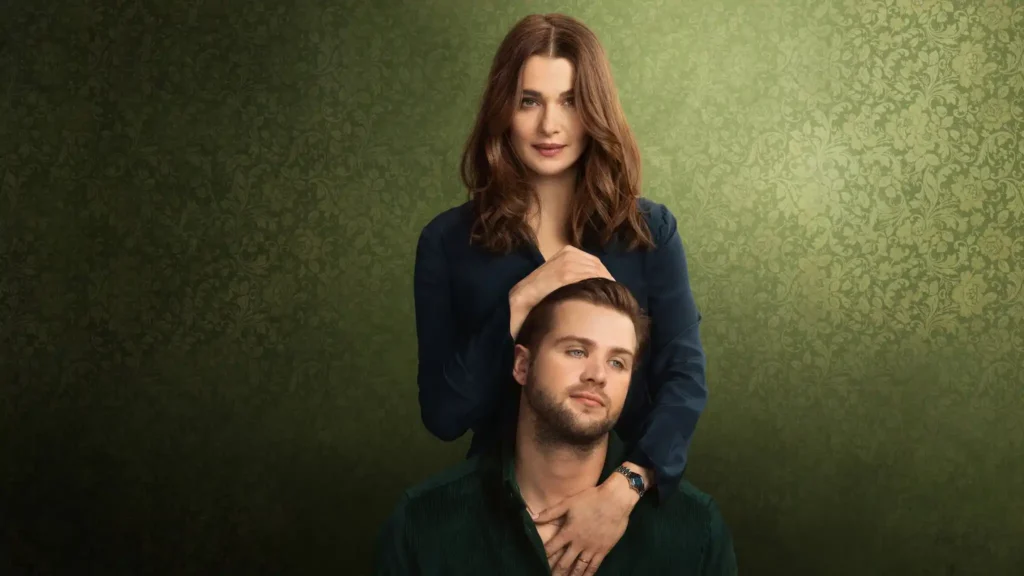
Rachel Weisz and Leo Woodall in Vladimir | Image via Netflix
All of these things are dealt with primarily through M’s constant fourth-wall-breaking monologues, a form of direct address that is common enough in literature and theatre but extremely rare on television because it’s so difficult to pull off. It requires deft writing and an extremely multifaceted performance. Initially, I had doubts about the credibility of Rachel Weisz, of all people, playing an older woman who has lost her lustre – she’s married to James Bond, for crying out loud – but her turn here is award-winningly brilliant.
Her monologuing is also complicated by the fact that she’s an increasingly unreliable narrator, and after a while, it becomes impossible to separate her fantasies from reality, for us and, increasingly, for her. But her fantasies don’t just pertain to Vladimir, but to everything. She so desperately wants her colleagues to see her point of view about John – and many of them do – and her students to buy into her fanciful ideas about Daphne Du Maurier’s Rebecca, or Edith Wharton’s The House of Mirth. A late scene in which M hosts an open forum to answer questions about John’s improprieties is framed in exactly the same way as her earlier lectures, an effort to convince righteous know-it-alls that there are infinitely more complex ways of looking at and thinking about things than they’re allowing themselves to experience. Is it just a coincidence, though, that the old-fashioned approach is also exactly what M needs them to embrace to preserve her own career and marriage?
As I said, there are no easy answers. One of Vladimir’s most compelling threads finds M and John’s bisexual lawyer daughter, Sidney (Ellen Robertson, Black Mirror), warring with her innate desire to protect her family and see her father in the best possible light, while also understanding much more intimately than M or John are capable of that his actions resolutely were not as innocent as her parents claim. Sidney is perhaps the most interesting of the show’s supporting characters since she is one of the few who are older than the students but younger than most of the faculty; she’s grown up enough to have learned that nobody’s conscience is clear and nobody’s intentions are as pure as they’d like, but young enough to a remember a time when she still believed the opposite.
Vladimir filters its own construction through the same uncertainty that underpins its narrative; it’s very funny but absolutely not a comedy, and it’s intermittently sexy while having almost no sex in it. Its honesty lies in how nobody ever quite knows to what extent they’re telling the truth, and it’s daring simply in its willingness to acknowledge, at a time when every contentious issue has been boiled down to its most simplistic opposing extremes, that reality is a messy, complicated, contradictory thing, and that growing up is simply coming to terms with that. Enjoy it. Shows like this don’t come around all that often.
RELATED: