Summary
One Piece hasn’t lost a step in Season 2 – on the contrary, it’s better than ever, providing a rich bounty of imagination underpinned by earnest sentiment, great world-building, and lovable characters.
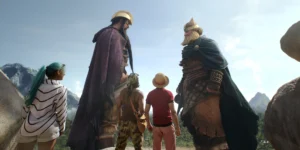
One Piece was one of Netflix’s better original offerings, despite nobody really expecting it to effectively adapt Oda Eiichiro’s extremely popular – and thoroughly bonkers – pirate manga. But part of the reason it worked so well is that it was content to be bonkers, to embrace the series’ penchant for grand theatricality, ridiculous character designs, and totally out-there ideas. In Season 2, this isn’t just equally but is perhaps even more true, as the Going Merry reaches the Grand Line and more and more nutcase heroes, villains, and worldbuilding concepts continue to be introduced.
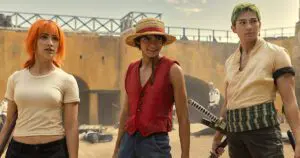
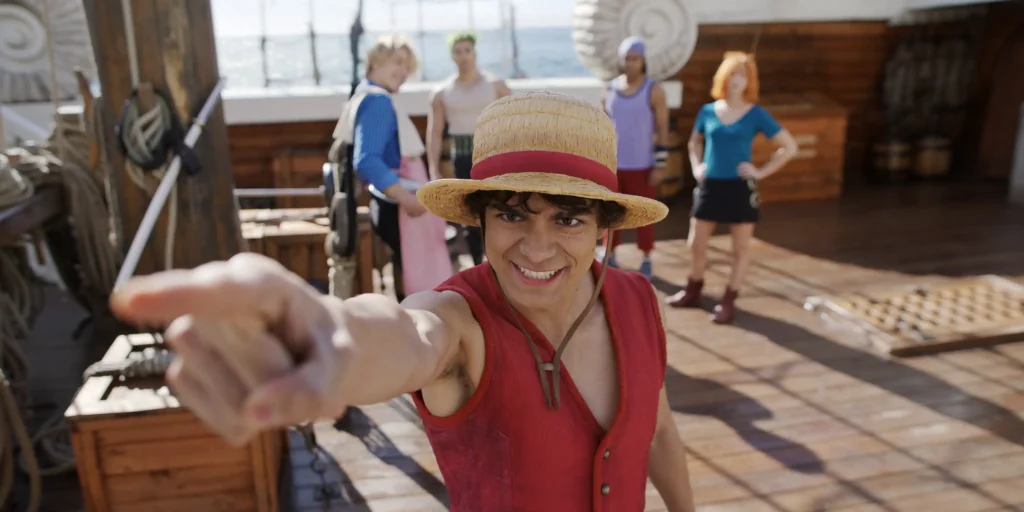
But I should slow down. It has been a couple of years since One Piece debuted, and since it’s a fairly dense and esoteric show, a brief refresher may be in order. When we left things, our hero, Monkey D. Luffy (Iñaki Godoy), had assembled a small crew of pirates called the Straw Hats, mostly on account of his unbridled positivity and enthusiasm, with designs on sailing into the Grand Line and retrieving the titular One Piece, thus becoming King of the Pirates. This remains the overarching goal in Season 2, but it’s less an arc than a herky-jerky scrawl from one fun side quest to the next.
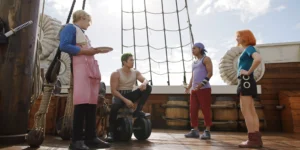
The crew of the Going Merry includes Luffy, former bounty hunter Roronora Zoro (Mackenyu), navigator Nami (Emily Rudd), high-kicking chef Sanji (Taz Skylar), and engineer Usopp (Jacob Romero). These guys were all recruited during Season 1 and got the lion’s share of their backstory there too, but they continue to develop in interesting ways as they’re confronted by the new and varied challenges of the Grand Line, not to mention the various evildoers on their tail, which include the Marines, primarily represented through Captain Smoker (Callum Kerr) and his protege, Tashigi (Julia Rehwald), and a sinister group of colourful assassins known as the Baroque Works, including the fan-favourite Miss Wednesday (Charithra Chandran) and the dangerous, enigmatic Miss All Sunday (Lera Abova).
A note should be made here that while this is a lot of characters, they’re easy enough to keep track of thanks to their outlandish designs and strange powers, which One Piece Season 2 delights in showcasing at every opportunity. Luffy can stretch his limbs, as we well know, which continues to be put to novel use, but then you have Smoker, who can turn his body into a plume of smoke and keeps cigars in a bandolier around his uniform so he can smoke two at a time, and Miss All Sunday, whose power is making people sprout multiple additional limbs that choke them to death. It’s properly bonkers all the time, and the show has such a joyous, infectious enthusiasm for all the ways in which it’s bonkers that what should be ridiculous and cheap-looking conceits end up being the primary appeal.
This, of course, and the snappy, island-hopping structure which borrows from the episodic style of the manga and the anime without losing the sense of serialisation that comes from collapsing a full story arc into a single season. It’s a best of both worlds approach, with the settings – brought to life by wondrous production design – providing a diverse array of side quests and supporting characters while the core conflict and personal development still feel coherent and appropriately epic. For all of its stylistic flourishes, this is, on a core level, a very good television show, not just a bottomless fount of imagination but also a precisely-engineered, character-driven quest full of legitimate emotional sentiment and operatic, imaginative action.
But the best thing about One Piece remains the fact that it’s boldly, unashamedly bizarre. It looks and plays out like nothing else, and is a rich bounty of moments that never cease to surprise and thrill in both their novelty and underlying construction. It can’t have been easy to make this, especially given the commitment to the tactile feeling of practical effects, and while a lot of the story’s brilliance comes from the source material, Netflix deserves rare credit for adapting that material with so much craft and gumption. People will complain, I’m sure, since people always do, but as far as I’m concerned, One Piece remains one of the streamer’s better original offerings – at least in part because it truly feels original in a way that most other shows don’t.
RELATED: