Summary
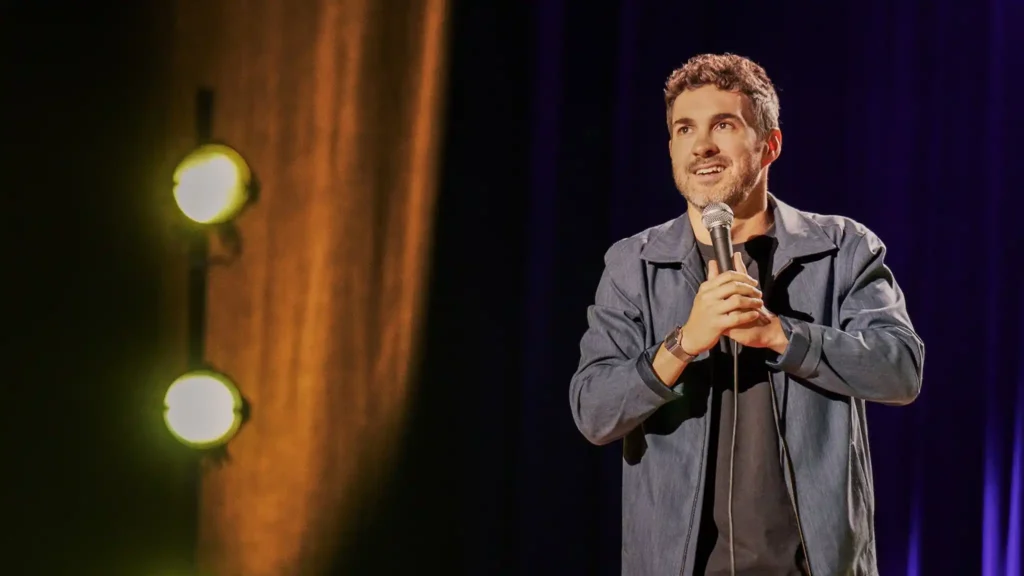
Mark Normand’s style has never really evolved, which is kind of the point of a special like None Too Pleased, which plays out like an all-you-can-eat buffet of zingers designed to be equally offensive to everyone — just as it should be.
Mark Normand has always been an equal opportunity offender, someone whose material runs the whole gamut of hot-button topics, racial stereotypes, and gender cliches, with the obvious intention being to upset everyone all at once, and thus, really, to upset nobody at all. Normand’s 2023 Netflix special, Soup to Nuts, was perfectly titled for precisely this reason, and while None Too Pleased isn’t as obvious in its wide-ranging approach, it’s reassuring to see that Normand’s style hasn’t really evolved at all.
There’s the introductory half-hearted fist-pump; None Too Pleased even opens with a montage of that. There’s the reflexive, “Hey, comedy!” reminder, with the stress on the final syllable, whenever the crowd seems a little too offended, or a joke doesn’t land. I only counted one instance of that throughout this special, which just goes to show how effectively Normand has whittled down his target audience over the years. And there is, of course, the insistence on referring to himself as Kevin Hart, which he does here during the outro with such a complete lack of ceremony that it still makes me laugh every time. There have got to be some people, somewhere, who really do think his name is Kevin Hart.
But it’s most obvious in the material. The official Netflix synopsis of None Too Pleased, which was filmed at the Boulder Theatre in Colorado, uses terms like “free-for-all” and “anything goes” to describe Normand’s rapid-fire zinger-a-minute style. The joke format is the same as ever. Normand isn’t quite a one-liner comic, but he’s close. Each argument, usually highlighting some kind of inherent hypocrisy or drawing an out-there comparison — an anatomical analogy for the Israel-Palestine conflict, OnlyFans being for men what the WNBA is for women, how being married is like being in the military — and using it as an excuse to slip in off-colour gags about classic taboo topics like Hitler and 9/11.
The reasons this works so well for Normand are varied, but the biggest one is that he’s good at it. The punchlines are often cleverly put together and snuck in where you least expect them, and some of the core contradictions he highlights are just astute enough to become interesting jumping-off points. Cats are a lot like heroin addicts. It is weird that the body positivity movement seemed to disappear when Ozempic arrived. It is a bit odd that we assume kids overexposed to pornography won’t want to have sex, but that kids overexposed to action movies will shoot up schools. What are the rules?
This ties in to the other reason why Normand’s style works. Most people are more like him than contemporary culture would encourage them to admit. Most people find dark humour appealing because it feels — ironically — like a safe space where everyone isn’t performatively sensitive about everything. Most people think both extremes of the political spectrum are equally stupid and ridiculous. Most people agree that cultural appropriation only seems to apply to sombreros, kimonos, and hairstyles, whereas driving a Japanese car to an Indian restaurant with a Mexican wife is all perfectly fine. Most people can laugh not just at others, but also at themselves.
None Too Pleased does find Normand touching on fresher subjects for him, like being a husband and father, and for society, like the inevitable AI and robot uprising (though, thankfully, nothing about the Diddy trial, which Katt Williams and Sommore both got worryingly bogged down by). But they’re all filtered through the same nobody-is-off-limits approach, poking fun at his own wife, his own kids, his own culture, and his own insecurities, such that everyone feels totally comfortable when he takes aim at other targets. The scattershot style unavoidably creates a wavering quality that some will find off-putting, and there’s a case to be made that every decent joke about Hitler has already been told, but are people still watching Mark Normand specials and expecting them not to include Holocaust gags? Comedy and the rules that bind it are ever-changing. You can’t keep up with which subjects are fit for mockery and which are totally off-limits. What would have made you a household name two, five, or ten years ago might make you a pariah today, and definitely will tomorrow. In that landscape, the best thing about Mark Normand is that you can always rely on him to be Mark Normand, for better and for worse.