Summary
DTF St. Louis is funny, clever, tender, and utterly unique, and this episode might solidify it as the best show on TV right now.
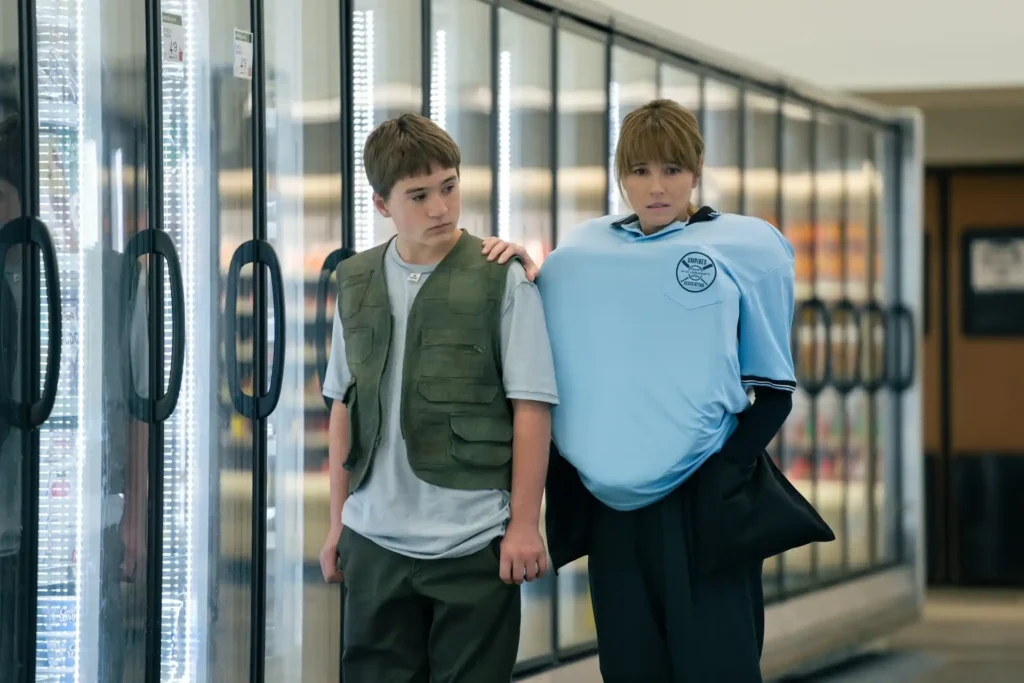
It’s a testament to how good DTF St. Louis is that the cold open of Episode 4, rather drily titled “Missouri Mutual Life & Health Insurance Company”, is so funny, real, and oddly touching, despite Linda Cardellini spending almost the entirety of it dressed as a Little League umpire. We’ve heard about and seen this before, obviously — not to mention the Purina fleece which I now can’t stop noticing — so it shouldn’t come as much of a surprise. And yet it’s still funny. Sometimes the show plays that up, with Carol doing increasingly elaborate gestures and dances as she gets more into the role, occasionally with Floyd in the bleachers looking utterly perplexed. But there’s more to it than that.
Everything the show is about is bundled up in Carol’s ump gear. She and Floyd were in dire straits, financially, trying to save up enough money to send Richard to a private school in the hopes of curtailing some of his more worrying behaviour (which includes smashing gallons of milk on the floor of a grocery store for no reason at all). She was doing it out of necessity. But Floyd was gingerly honest about what the optics of her ump gear were doing to his libido, and thus their intimacy as a couple. This is occurring right before Carol met Clark for the first time. The financial hardship, the unfulfilled desires, the awkwardness, the feelings of defeat and debasement — it’s all here in the shoulder pads and the chest plate as Carol wrackingly sobs in the middle of the lawn maintenance guys that Floyd once again forgot to cancel.
There’s no wonder Carol was attracted to Clark; his aggressively milquetoast boring bullsh*t was the stability she craved. Listen to how he describes an upcoming, slightly homoerotic wine biking trip he’s taking with Floyd. The perfectly balmy temperatures; drinking a little wine, but not too much. He’s the human embodiment of risk-averse, squared-away middle-age. Everything he says is utterly discordant with the idea that this is pillow talk with the wife of his best friend. And Carol could obviously sense that, which is why he made such an easy mark.
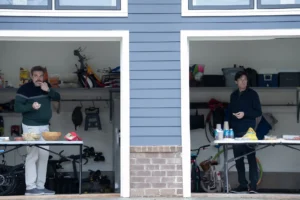
And he was a mark, there’s no doubt about that. You can’t listen to Carol swearing him to secrecy about her planting the seeds of covering Floyd’s bills and taking out a life insurance policy without also hearing her create plausible deniability for herself. Maybe she got something out of the tryst, but it can’t have been much, since all she wants to talk about is getting Floyd on the straight and narrow so she can live this kind of life with him. Clark hears it, but he’s too agreeable to confront it. Then again, though, Clark seems to unambiguously enjoy helping Floyd. Their hesitant scenes together are richly earnest; Clark raising the idea for the first time, Floyd weeping with relief, discussing their plans in ASL, training together, and, in the great nutcase sequence of DTF St. Louis Episode 4, creating and performing a rap song about how the “Thunder Boys” are going to pass the life insurance physical.
What Clark said in the previous episode about loving Floyd more than he loved Carol is plainly obvious here. These two do seem to love each other earnestly and sincerely. Sure, there’s unavoidably a bit of homoeroticism to it, but I don’t think that’s it. It’s an understanding thing. Clark and Floyd get each other in a way that Floyd and Carol, and Clark and Eimy, don’t. The show continues to constantly reiterate the theme of understanding: “No one’s normal, it just looks that way from across the street.” It’s a nugget of wisdom espoused by Modern Love, of all people, when Homer and Plumb interview him together to get a sense of whether Clark’s insistence on Floyd’s heterosexuality is accurate, but it’s Floyd who embodies the idea more than anyone else in the cast. We see his profound sense of vulnerability and empathy everywhere; in the nerves and self-consciousness of his life insurance physical, in his little frisson of pride when Richard tells him he’s a good father figure.
Modern Love, who turns out to be quite the philosopher — and a wind-up merchant, based on how he immediately senses Homer’s latent homophobia and starts telling him that he’s suddenly attracted to bald, mature authority figures — sensed this in Floyd, even though he has nothing but nice things to say about him otherwise. By all accounts, Floyd wasn’t into men and was simply too thoughtful to hurt the feelings of a man who had just confessed to spending most of his life feeling othered. The sentiment is beautifully expressed without really being expressed at all. That feeling of inherent decency is nebulous, hard to articulate. I think part of why David Harbour’s performance is wonderful in this is that he has found a way to play that idea without speaking it aloud.
Philosophical musings notwithstanding, Modern Love also inadvertently leads Plumb to a sudden understanding of what Floyd’s mystery key unlocks. It’s PO Box 260, where he keeps his life insurance documents. Carol stands to gain $1,000,000 from Floyd’s death. That sounds like a motive to me, and it does to Homer and Plumb, too.
But this quietly wonderful hour ends with a reminder that we’re missing something. Floyd knew about Clark and Carol’s affair. We now know that during one of their ridiculous pool boy role-play sessions, Floyd was hiding in the closet, watching. What did he do with that information? What happened after he confronted Clark about it? There are three remaining episodes — I hope Floyd’s decency survived them all, even if he didn’t.
RELATED: