Summary
Bodycam wastes an effective gimmick and provocative subtext on increasingly ridiculous horror cliches, devolving into a third-act that goes completely off the rails.
Immediacy is in vogue at the moment, and there’s nothing more immediate than a first-person perspective, something that video games have understood forever but that movies – for various reasons, most of them technical – have struggled to realise on-screen. I was naive enough to have believed that Hardcore Henry, which itself felt like an outgrowth of that one great scene from the otherwise-terrible early-career Dwayne Johnson-starring adaptation of Doom, would usher in a wave of imitative flicks determined to play with perspective, but nobody other than me seemed to like Hardcore Henry, so the idea largely fell by the wayside. These days, found-footage horror is really the only place you can consistently get front-facing filmmaking, which makes Shudder’s Bodycam interesting, since its central gimmick roots its action to its characters’ POV.
Bodycam footage isn’t new either, of course. Netflix’s hauntingly good The Perfect Neighbor deployed it to chilling effect, and I was intrigued to see how that same style could be applied to the structure of what seemed like a haunted house movie. But Bodycam isn’t a haunted house movie, really, even though it does sometimes resemble one. Instead, it’s a timely critique of trigger-happy American policing and how it’s now forced to grapple with accountability through always-on video technology, and then it’s a madcap medley of horror tropes, and then Vecna from Stranger Things turns up for no reason at all.
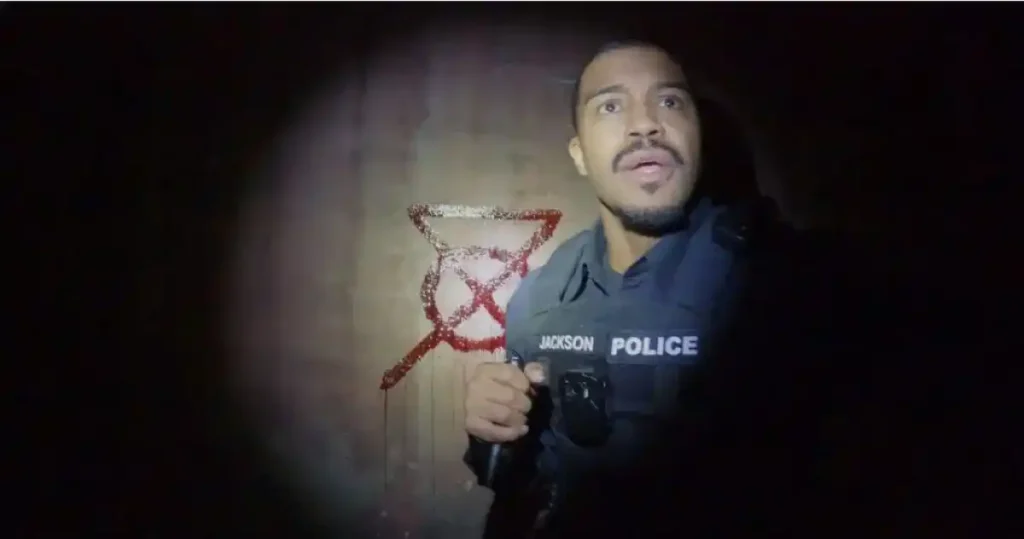
Early signs are mostly positive, though. Officers Bryce (Sean Rogerson) and Jackson (Jaime M. Callica) respond to a domestic disturbance in a cartoonishly run-down neighborhood full of drug addicts, and their initial, tentative exploration of the property in question, which features all kinds of alarming red flags, is exceptionally tense. Writer-director Brandon Christensen has a great feel for shocks and eerie images, and the filmmaking style, all fisheye distortion and pinhole framing, effectively embellishes what would in a traditional horror movie be blasé scares. I was expecting Bodycam to proceed in this manner and would have probably been content with the novelty of its aesthetic doing all the heavy lifting, but it takes an alarming turn when Bryce guns down one of the addicts inside, possibly unlawfully, and the narrative shifts temporarily to focus on the logistical challenges of the bodycam footage making the crime near-impossible to cover up.
The movie is condemnatory of the officers, especially Bryce, from the jump, but it’s also too eager to be a walking tour of bodycam versions of genre cliches to make a coherent point on such a testy subject. The casting isn’t an accident. Bryce is white, and his broad opinions on the state of the neighborhood that his Black partner grew up in, are clearly intended to speak to a kind of racially-coded prejudice that underpins law enforcement, like every other strata of society. We meet Jackson’s mother, Ally (Catherine Lough Haggquist), who runs an addict support group from her home that eventually veers into quasi-cult territory, and she’s deeply dismayed by her son’s chosen traitorous vocation. The messaging isn’t subtle, since none of the movie is subtle, but it is completely mired in the grime and out-there excess of its horror ambitions.
Bodycam is ultimately a high-concept B-movie with a reach that exceeds its grasp. It’s worthy of some respect for daring to be about something, and committing to being about it for the duration, even when things get uncomfortable, but it’s hard to imagine how anyone thought the final third was a good idea on any level. It isn’t just the feints in the direction of exceedingly hollow moral relativism, but also just a flat-out terrible-looking string of “scares” that become so ridiculous they actively undermine the rest of the movie’s earnest attempts at being grounded. Some effective jumps and moments of nastiness all feel undermined by the laughable climax, and by that point, anything that the script had to say has devolved into gibberish.
Still, it was a respectable effort for a while.