Summary
Hoppers is a tremendously big-hearted and empathetic movie brought to life with a surprising amount of technical skill.
Maybe it’s just me, but a Pixar movie release doesn’t seem as big of a deal as it once did. Hoppers is simultaneously validating (nobody seems to be talking about it, at least in my circles) and a reminder that Pixar have still got it where it counts, so maybe folks should be paying more attention after all. Daniel Chong’s movie is big-hearted and funny; it’s about things without being preachy, and feels modern while also harking back to the glory days of Pixar’s past, not to mention a few other obvious touchstones – someone says aloud this isn’t like Avatar at one point, though it really is quite a bit like Avatar – that it riffs on with considerable charm.
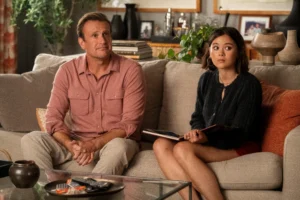
The story finds Mabel Tanaka (newcomer Lila Liu briefly as a child; The Morning Show’s Piper Curda as a 19-year-old college student, though the art style doesn’t make much distinction between the two) battling the efforts of Beaverton’s glad-handing mayor, Jerry Generazzo (Jon Hamm, Landman), to build a beltway through a picturesque woodland glade once teaming with natural life. The glade is particularly important to Mabel, since it was where her kindly grandmother (Karen Huie, Eyes of Wakanda), who she was raised by for reasons that aren’t explained but aren’t necessary to know, used to take her when she was young. To Mabel, the glade represents a reassuring, grounding natural world, not to mention a symbolic tether to her late grandmother, whose loss she hasn’t managed to process.
Chong – working from a script by Jesse Andrews – establishes these fundamentals with typical Pixar economy. We meet Mabel as a youngster stealing a colourful menagerie of classroom pets from the captivity of her school; as a teen, she skateboards, which is always movie shorthand for someone being a wildcard. Fair warning: Mabel’s scenes with her grandmother, including one at the beginning and several hazy flashbacks throughout, don’t quite hit Up levels of emotional trauma, but they’re in the same ballpark. There’s one a bit later on that had me blubbing like an idiot, and its intuitive tenderness is the vibe that underpins the entire movie.
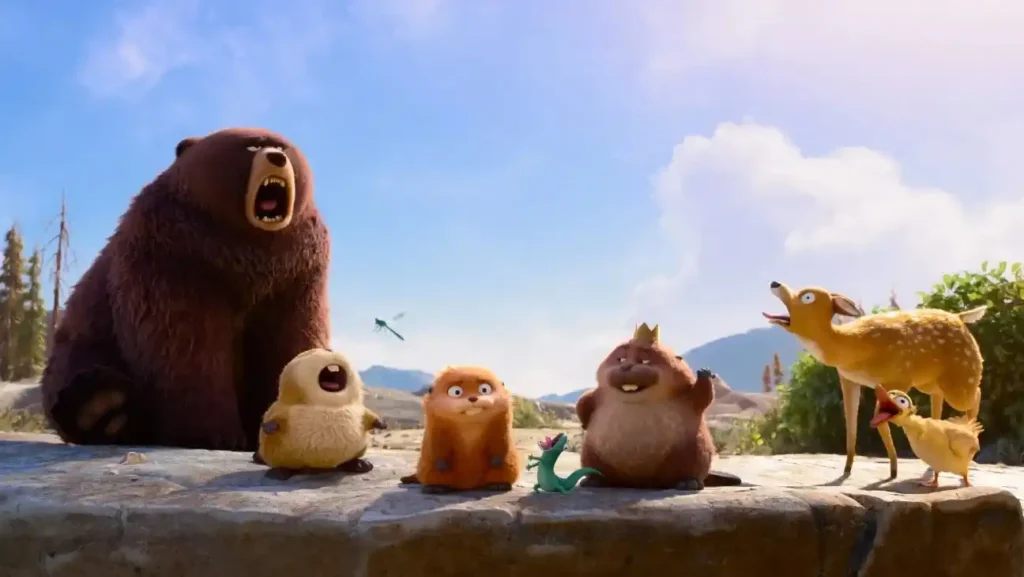
But Hoppers has grander ambitions for itself than this. Mayor Jerry’s justification for demolishing the glade is that it’s no longer an animal habitat, for reasons that are initially mysterious, so Mabel needs to find a way to rebuild the natural population to halt the construction. Conveniently, she discovers that her college professor, Samantha Fairfax (Kathy Najimy), has secretly developed a technology that allows human consciousness to be transferred to an incredibly life-like 3D-printed beaver. Beavers, some exposition informs us, are a keystone species. If Mabel relocates one to the glade, the rest of the local wildlife will rally around it, so she impulsively “hops” into the beaver and escapes into the woods for a recruitment drive.
This is where the movie comes alive. Mabel, posing as the beaver, can understand all the animals in the woods, and ingratiates herself with George (Bobby Moynihan, The Fall and Rise of Reggie Dinkins), another beaver who is also the king of the mammals, part of a fractious interspecies council including birds, amphibians, insects, and reptiles, which is how Meryl Streep sneaks in playing a butterfly with an entitled caterpillar son named Titus (Dave Franco, The Studio). Life in the glade is governed by “Pond Rules” and pulled this way and that by competing priorities and politics, so getting everyone on the same page to fight back against Mayor Jerry is easier said than done, and evolves in some genuinely surprising and novel ways.
Hoppers isn’t the most straightforward of family movies. Mabel has a lot of internal and external conflicts, some of which are addressed with surprising sensitivity, and her dynamics with the various animals she meets aren’t always simple. She’s also being pursued by Dr. Sam and a couple of her interns, who occasionally pop up in the form of other robot animals, and Mayor Jerry has his own agenda which refreshingly avoids the 2D portrayal of a greedy politician, instead evolving into something more interesting. The action sequences are quite brilliant, with genuinely inventive orchestration that incorporates vivid ideas like a shark named Diane being carried though the air by countless flapping birds, and it all comes together in a fist-pump payoff that is a lovely interpretation of the movie’s underlying sense of empathy, community, and cooperation.
It’s just a lovely, positive, warm movie of a type that people will be snooty about without necessarily appreciating how much skill it’s constructed with. We could use more stories like it, brought to life with the same passion and craft, espousing the same wisdom of looking, listening, and being a part of something bigger than ourselves.