
Summary
DTF St. Louis continues to contort everything we thought we knew about these characters in “Amphezyne”, hinting at darker backstories and weirder dynamics that we realised.
One of the broader arcs in Episode 5 of DTF St. Louis is Detective Homer realising that the murder of Floyd Smernitch isn’t as open-and-shut as he thought. A career big city cop, he made the mistake of assuming that suburban folks were normal. Of course, this season’s mantra has been, simply, that nobody’s normal, even if they appear that way at a glance. “Amphezyne” clarifies repeatedly that there was nothing “normal” about Floyd, Clark, and Carol. But its genius — and its beauty — lives in the idea that the ways in which Floyd was abnormal were so sweet, earnest, and well-intentioned that the main mistake Homer and Plumb are making in their investigation is not observing each new clue through the lens of how truly great Floyd was. That seems to be the crux of everything.
Some of this show’s more eccentric flourishes — such as, for instance, opening the episode with a lingering medley of Floyd’s fully nude Playgirl issue — seem designed to be performative red herrings, but they’re not, really. That version of Floyd, younger and in better shape and with a full-on, un-curved penis, is integral to understanding the version of him slumped dead at a public pool, his enlarged gut drooping from a too-tight shirt, a spilled can of Bloody Mary on the ground spiked with what is revealed to be a lethal dose of the very medication he thought would change his life. All of his issues are bundled up in the image: the loss of his physique, his pride, his manhood, and his money, but his enduring intention to stick around to make things better. For himself, for Clark, for Carol, for Richard. For everyone.
Floyd’s innate goodness is vital to keep in mind because it determines how we view everyone. Carol is deeply suspicious and inauthentic when being interviewed by Homer and Plum, refusing outright to answer any questions about her past criminal convictions — citing a compliance law protecting citizens with sealed or expunged convictions from being compelled to acknowledge their cases — and claiming to have had “cute” little mantras with Floyd that she’s clearly inventing on the fly. But at every opportunity it gets, “Amphezyne” reiterates that Carol loved Floyd. She admired him so earnestly that she often couldn’t help but break into a smile when he spoke.
Clark was the same. He’s looking at the death penalty for first-degree murder and has finally retained legal counsel, but his main objective is preventing any further details from being revealed because the rest of the story would hurt Floyd, even though he’s dead. Like Carol, Clark admired Floyd so deeply that he can’t even bring himself to upset him posthumously. How could either of these two have killed him?
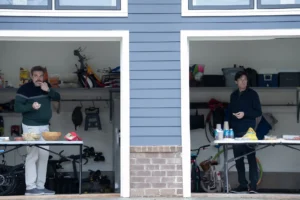
DTF St. Louis also makes a point of using Episode 5 to reframe any potential motives we might have suspected. We get to see the full version of the scene when Floyd confronted Clark about the affair in ASL, but it turns out Carol told him, and he was happy about it. Given the erasure of his own libido and his generally big-hearted nature, he’s just happy to see Carol being happy. His only request was to watch sometimes, so he didn’t feel totally excluded. That recontextualises the cliffhanger from the previous episode. Floyd was in the closet at Quality Garden Suites because he was in on the whole thing. He even got them a discount on the room through a loyalty scheme he had applied retroactively as a goodwill gesture. Through the financials, Plumb learns that the three of them were, technically, a throuple.
I’m not sure where this leaves Carol. She’s still the prime suspect, and evidence mounts up against her this week. There’s that mysterious prior conviction, which Plumb is soon to uncover, having crossed some ethical boundaries by applying for a job in the police department with Carol’s name in order to receive a full background check, which will include the sealed case. There’s the fact that Plumb and Homer eventually secure a warrant to search her garage and find the missing bike inside, the one that was used on the night of Floyd’s murder. And the flashbacks are careful to show that she was very aware that Floyd taking too much Amphezyne would kill him.
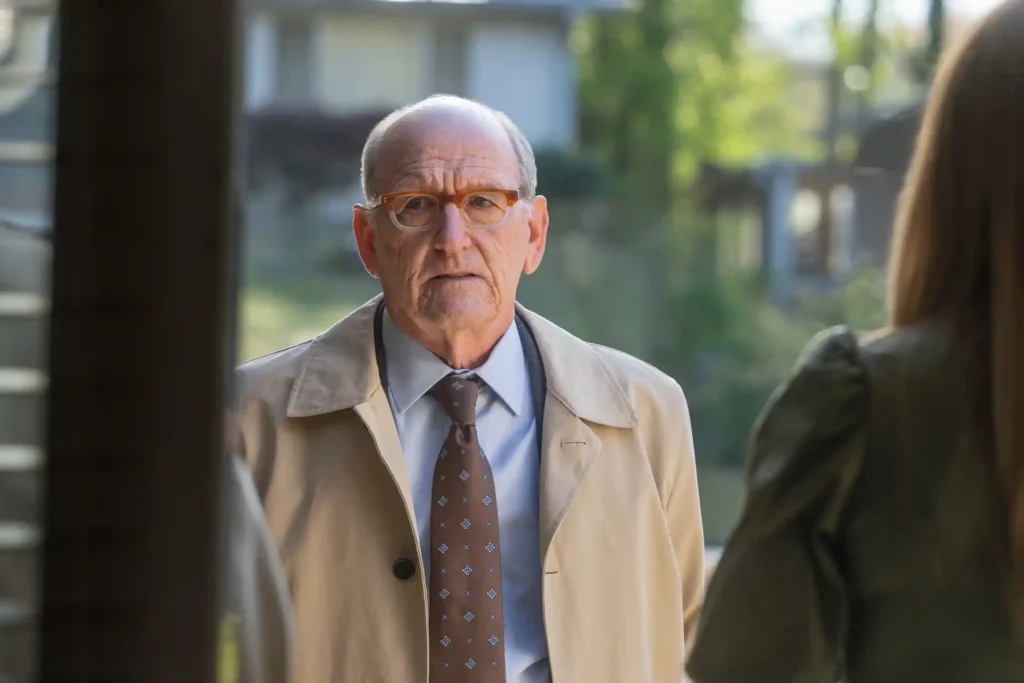
Richard Jenkins in DTF St. Louis | Image via WarnerMedia
But in a lovely, tender scene, during one of Clark and Carol’s liaisons, where the former tentatively suggests rimming to the latter, Floyd bursts from the closet when he spots a blind kid heading directly for the pool. There’s a homecoming dance going on at the other side of the building, and the kid’s parents had dropped him off in the wrong parking lot. Floyd helps to redirect him with enormous grace and understanding, and Carol and Clark simply watch from the room, both in open admiration of Floyd’s character. I ask again: How could either of these two have killed him?
I still persist that in some strange way, Floyd’s curved penis holds the answer. While Floyd is petitioning Clark to take out an Amphezyne prescription on his behalf — the doctor won’t allow him to take it in conjunction with his other meds, one of which is blood thinners for his Peyronie’s disease — he also shares a bit more of the story that resulted in the damaging curvature. After saving a man from being run over in the street, he gave an interview to a reporter, claiming that the guy’s parents were the real heroes for never giving up on their child despite inevitably knowing that something was wrong. While he was distracted, he was in a traffic accident that broke both of his wrists. Then, with both wrists in casts, he attempted to open an umbrella by wedging it between his legs, and a passing motorcycle sent it flying into the air. While roaming with his open umbrella, Floyd saw live ASL through the window of the Deaf Centre, and decided there and then that he was going to devote his life to helping people communicate. He never went to the job interview, and Carol excoriated him for it.
But his penis remained undamaged. Clark and the audience are none the wiser about what happened in that regard, or how it’s relevant to the part of the story that Floyd just shared. But the truth of all this is being unfurled so gradually that I can’t help but believe it’s vital. Maybe this, though, is just another of the show’s smart tricks. You can never be quite sure what it’s saying. A flashback in which Floyd shares with Carol his own “dream meeting” suggestion, which is simply to be able to be “full on” with Carol on account of the Amphezyne, with Clark watching from the closet so that Floyd doesn’t feel quite so small and Clark doesn’t feel mad about making him feel small, seems like it’s designed to draw even more attention to how great of a guy Floyd is. Carol even says it out loud. But this is also the point when she asks him whether a larger dose of Amphezyne will kill him, and there’s a moment right after where Floyd nips inside for some lemonade that leaves Carol and Clark outside in the garden, their conversation obscured from us. Were they plotting to kill him? When Floyd returns with no lemonade, due to an absence of mix, lemons, and sugar, you can almost see the idea — the daylight peeking from beneath her crushing financial burden — fomenting in Carol’s mind.
But that doesn’t mean she killed her husband. Does it?