
Summary
The Testaments delivers a striking-looking and oppressive-feeling premiere in “Precious Flowers”, taking in Gilead from a fresh perspective.
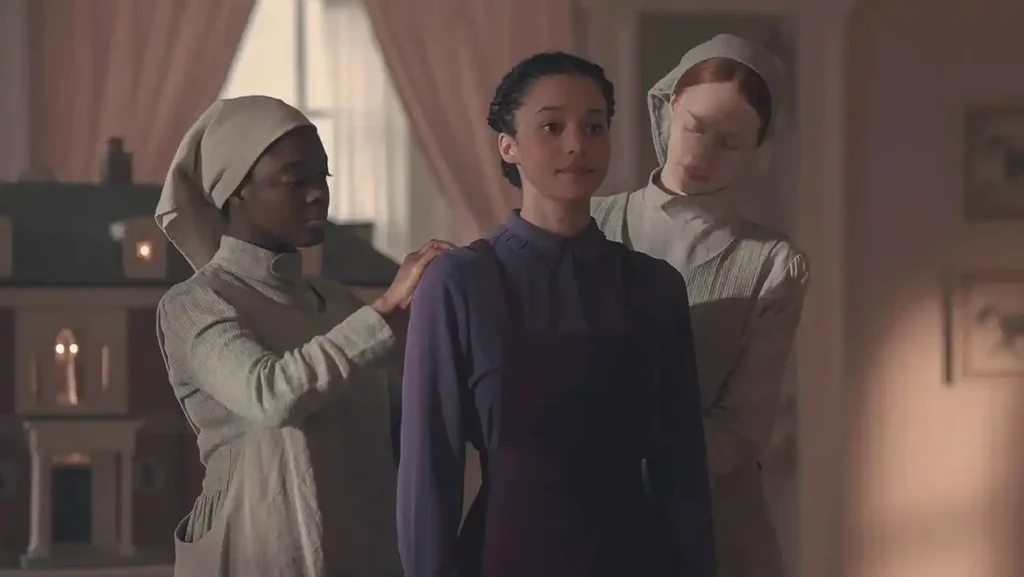
Dystopias don’t tend to be colourful, but colour is at the very core of Hulu’s The Testaments. You see it everywhere in Episode 1, “Precious Flowers”, entire classes of people reduced down to handy blocks of pink, purple, and green. This and a bunch of clever filming tricks — just check out the artistry in the opening juxtaposition of a real house and its miniature version, occupants reduced to pliable doll form in both — help to give this premiere a striking visual quality, even as it unavoidably has to churn through a bit more exposition than is necessarily ideal.
But it has the goods where it counts. When it’s time to turn on the drama, things get horrifying pretty quickly, and the framework of this new season, which is nominally a sequel to The Handmaid’s Tale but nonetheless feels substantially separate from it, provides a compelling basis for the next few weeks of drama. So, let’s break it all down.
The Commander’s Daughter
Our primary point-of-view character here is Agnes, a Gilead loyalist, mostly because buying into the ideas was easier than challenging them. What’s a girl to do? Agnes’s dollhouse, a replica of her real palatial estate, is her only means of minor rebellion, a place where she can trap the avatar of her wicked stepmother in the attic without consequence.
Agnes is the daughter of a Commander, and is a Plum, which is to say she’s an older girl who hasn’t yet started her period. In the warped religious doctrine of Gilead, when young girls come of age, they please God, who largely wants women to get married to well-to-do men and have children. More on the colour scheme in a minute.
As a consequence of her relative privilege, Agnes is tended to by Marthas, domestic helpers treated like slaves. Her closest confidante is Rose; one of the others, Zilla, is a new arrival with a missing tongue. In a perverse way, this is as good as it gets for a young Gilead girl, even if it means putting up with Paula, her new step-mother to whom she must be totally subservient. Except for in the dollhouse, obviously.
Color Coded
Agnes attends Aunt Lydia’s elite preparatory school, which doesn’t have any academic classes but teaches girls everything they need to be uncomplicated, pious housewives. The students are divided up into the Plums, which I’ve mentioned, the Pinks, who are younger, and the Greens, who are fully flowered and enter a fairly aggressive cycle of grooming to marry them off to a Commander as soon as humanly possible. They also get cute badges, which I suppose is an upside.
School field trips include visiting men hanged by the neck until dead, their faces obscured by bags daubed with a red X denoting them as rapists. There’s no evidence of their crimes, but the women are somehow to blame for tempting them either way. “I was a precious flower,” Agnes ponders at one point, “so why did I sometimes feel like a prized pig?”
Agnes has some pals, including the snooty Shunammite, visibly bonkers Hulda, and her best friend, Becka, who is only secretly her best friend, since BFFs are discouraged, but is already a Green and is getting ready to be matched and moved on. I suspect there’ll be more to come from all of these characters, but The Testaments Episode 1 focuses heavily on Agnes.
Meeting Miss Daisy
“Precious Flowers” does, however, introduce Agnes’s counterpart, Daisy. Daisy is a Pearl Girl, the name given to runaway converts scooped up from outside Gilead, and they have a reputation as a collective for ratting other students out to the Aunts. Aunt Lydia tasks Agnes with looking after Daisy and helping her feel comfortable, though she doesn’t bother to explain why. It’s easy to imagine, but specifics will be better left unaddressed until they come up in this series.
Agnes and Daisy spend most of the premiere trying to suss each other out. We learn that Daisy is from Toronto, which she describes as “suffocating in sin”, but she’s playing up the role of a devoted new faithful. The other Plums, notably Shunammite, are nakedly suspicious of Daisy and encourage Agnes to get her in trouble for something — not enough that she lose a tongue or anything, just something that’ll serve as a warning not to go after Agnes.
Agnes does the opposite. When a man is dragged into the classroom on the charge of touching himself inappropriately on the school grounds, Aunt Estee leaves it up to the girls to decide whether or not he’s punished for the crime. They all enthusiastically insist that he be severely punished, which involves his arm being sliced in half by a buzzsaw while he vomits and sobs through a gag. Folks, Gilead remains a place that isn’t ideal for the faint-hearted, which includes, apparently, Daisy, who flees the scene and throws her guts up in horror.
Inside Girl
Daisy is more appalled by the bloodthirsty baying of her peers than she is by the violence, which she sort of explains to Agnes, who can’t quite fathom what she’s shocked by. “He broke the rules,” she says by way of explanation, as though sawing a man’s arm off in front of a mob without any due process whatsoever is simply a run-of-the-mill occurrence. Daisy’s demeanour cracks a bit here, and she blasphemes in front of Agnes before pulling herself together. When she recovers herself, she insists on confessing her sins, but Agnes pinky swears not to tell. God is merciful, she explains, but the Aunts sometimes aren’t.
This bond having been formed, though, we’re led to question whether Daisy might have an ulterior motive. That night — she, unlike Agnes, sleeps in the cramped dorms — she retrieves a portable rebellion radio from her hiding spot, and seems very much to be receiving instructions of some kind from the broadcast. We also get to see a brief flashback of a free Daisy skating along in Toronto, where she’s being watched by none other than June Osborne.
Fittingly, this is the point when Agnes’s narration acknowledges that she doesn’t know who her real mother is — and, promisingly, that things will change when she does. She also points out that meeting Daisy is “when it all started”; at the end of the episode, she starts her period. Things can only get worse from here.