Summary
DTF St. Louis has a predictably unconventional ending, one that won’t satisfy everyone, but I found its finale to be a quietly remarkable study of tenderness and human connection.
I have a sneaking suspicion that people aren’t going to love the ending of DTF St. Louis. And I can see why, honestly. I’m about to argue in its favour, to make the case that its genius is in its mundanity, how it rejects the quintessential idea of a murder-mystery twist ending for something deeper and more complex. But I totally get it. I understand why someone might find its revelations lacklustre and its point obscured. It’s a shame that such a consistently great and original show had to conclude on a note that some may well find divisive, but I can’t really imagine a show like this ending any other way.
On the upside, we have all the answers, even if they might not be the answers we wanted. Everything slots neatly into place. Every loose end is tied up, and the ones that aren’t were never supposed to be. Episode 7 reveals itself to be about something other than Floyd’s murder, though Floyd’s death — and indeed his life — still exists at its gold-plated heart. Fundamentally, this is a story about love, and connection, and the unhelpfully murky way that feelings manifest where and how we least expect them to.
Who Killed Floyd Smernitch?
The biggest question of the finale has the most depressingly simple answer. Nobody killed Floyd.
Floyd died through a combination of things: his pendulous belly and his curved penis, his big heart and his complicated feelings, his Bloody Mary and his boner pills, his step-son and his best friend and his wife. His entire story, in all the unusual and at times hilarious ways we have seen it play out, led him inexorably to his tragic and avoidable death. But nobody killed him.
And yet he died all the same.
Just Two Buds Dancing In Their Underwear
What really happened at the Kevin Kline Junior Community Pools is this. Clark told Floyd to go there, despite the fact that Tiger Tiger wouldn’t be attending. He told him to take his Playgirl spread. He told him that a surprise would be waiting. He told him to stay in the Quality Garden Suites the night before, so Floyd did all of these things, telling Carol he was going out of town for work. The surprise turned out to be Clark himself.
Clark told Floyd that he loved him. More importantly, he told him to love himself. They made each other feel better about their bodies, their jobs, and their internal hang-ups. They stripped off to their underwear and danced together. Clark tried to give Floyd the most powerful gift he could, to become aroused for him, to make him feel seen, like he thought Tiger Tiger might have been able to. But he couldn’t, because Clark wasn’t attracted to Floyd; he was just a lonely guy, confused about his feelings and his purpose. And Floyd understood that and made him feel better, the way he always made everyone feel better.
And then Clark left. All this, he tells Homer and Plumb, after the case against him has been dropped due to both Clark and Carol no longer being viable suspects. Tiger Tiger, whose real name turns out to be Kevin Van Der Lonse, vouches for Clark. Queece, the paper person president of the Umpire’s Association, delivered Carol an Umpire of the Year certificate around the time Floyd was dying, and saw her asleep on the couch. Neither of them killed anyone.
What Happened to Floyd’s Penis?
Perhaps the second-biggest mystery of DTF St. Louis is also solved by the ending. Floyd’s curved penis is a result of Richard hitting it with a baseball bat. It was a price that Floyd was happy to pay; he had, after all, upset Carol in front of Richard. What else would he have done?
Floyd upset Carol by telling her that marrying him meant struggling forever. To Clark, in flashback, he provides new context for what we assumed to be her cruel rejection of his career swerve into ASL translation. Carol had always struggled financially. That sealed conviction in her past turned out to be for stealing toilet paper as a child, for her poor family. Floyd pursuing his dream at the expense of their financial security was a bitter pill to swallow. When she became upset, Richard misinterpreted why and attacked Floyd. Lives were indeed changed that day, but not in the way anyone thought.
Richard’s Mistake
On the night before his death, when Floyd went to stay at the Quality Garden Suites, Richard had a violent outburst for seemingly no reason at all. It’s later revealed, when Homer and Plumb realise that the CCTV footage shows two different bikes on the road at the time of Floyd’s death, that it was because Richard discovered the DTF site on Floyd’s laptop, found details of his planned liaison with Tiger Tiger, and assumed he was cheating on his mother.
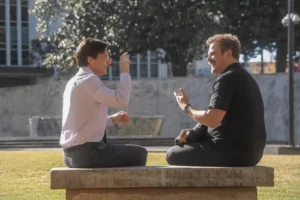
Richard rode to the community pools to confront Floyd and saw him dancing with Clark. After Clark left, Richard confronted him. Floyd didn’t say anything, simply made a hand gesture — Richard interpreted it as “rock on” — and let Richard leave. When Richard explains this to Homer and Plumb, Carol gently corrects him that the gesture actually meant “I love you” in ASL.
In the stress of being “caught” by Richard, understanding how the kid would misinterpret the entire scenario, and the implications that might have on his well-being, Floyd downed the rest of his Bloody Mary. It isn’t totally clear if he was trying to take his own life or drown his sorrows, but the outcome was the same either way. His final action was scratching out his face on the Playgirl spread, erasing the version of himself he once was, the version that Clark had earlier said didn’t make him feel safe the way the current Floyd did. It wasn’t a clue or a message. It was Floyd finally accepting himself for who he was, not the internal, idealised version of himself lost to time.
Clark Is Still Lonely
When Clark, now a free man, gets home, he finds the house empty. Eimy is gone. The man who had everything but couldn’t understand himself lost it all, only to end up none the wiser.
Earlier, when Homer interviewed Modern Love about his roller rink liaison with Tiger Tiger, the former discussed the simple pleasure of holding someone’s hand. Parents do it with their children; husbands with their wives. If DTF St. Louis is about anything, it isn’t Floyd’s death, but those simple acts of fleeting tenderness, of human connection and love. That’s the point of it all.
When Richard showed Homer and Plumb his daily routine on the hostile architecture, echoing Floyd’s sentiment about trying every day, I almost shed a tear.