
Summary
Euphoria Season 3 is immediately all over the place in “Ándale”, with each of the characters now feeling incredibly disconnected and off-kilter.
Euphoria has always been many things – salacious, provocative, stupid, lurid, occasionally brilliant, and so on, and so forth – but chief among them was a teen drama. It was about high school students. Sure, they were supremely dysfunctional, but they were nonetheless recognisable archetypes. Part of the pleasure was in seeing how Sam Levinson contorted the cliches, lent depth to the surface-level ideas of what a jock, say, or a cheerleader, could be. It has been a long time since that zeitgeisty first season, and a lot has changed, not least the show itself, which returns for Season 3 mired in controversy, several years removed from its high school setting, and, if Episode 1 is anything to go by, with no idea what it even is anymore.
High school isn’t just a setting, after all. Here, it was the gravitational centre around which every storyline orbited, the sole reason these people knew each other and had to cross paths every day. Divorced from that unifying element, Euphoria feels suddenly anthological, zipping across Los Angeles to check in on characters who are now almost totally siloed from one another. That’s weird, but it would be forgivable if almost every character hadn’t changed in some noticeable off-kilter way, not in the manner of having grown up, necessarily, but in the sense of having personalities that often aren’t even recognisable from their previous selves. Some get away with it – Lexi, for instance, is pretty much the same – and others, most glaringly Rue, are so different as to feel like transplants from different shows entirely.
Cassie Wants to Make Use Of Her “Talents”
We might as well start with the elephant in the room, the thing that has been doing the rounds on social media already, which is Cassie’s budding OnlyFans career. She and Nate are engaged now and living in a mansion in a “right-wing suburban bubble”. Nate has taken over his dad’s business, so they’re not strapped for cash, but Cassie is determined to monetise her body by dressing as a dog (and so on), ostensibly to fund a $50,000 floral arrangement for their upcoming nuptials but really to annoy Nate, who doesn’t want her to sell her body online, and to satiate her endless desire to court the male gaze.
Cassie’s arguments in favour of this aren’t especially compelling. She reinvents OnlyFans in her mind as a platform to “communicate”, figures she’ll only sell the kinds of pictures that she currently posts for free on her Instagram (embellished with a bit of one-to-one messaging to “make people feel special”), and eventually that she’ll only post either her boobs or her face online, though not the two together, which for Nate seems like a deal-breaker.
A lot of this is very fitting for these two (Cassie wanting to turn a profit on OnlyFans; Nate driving a Cybertruck and having no idea what he’s doing work-wise). But the dynamic feels really bizarre. Nate is an abuser, pretty unequivocally, and you see snippets of his dominance here and there, but it’s also pretty difficult to suggest that the power in this dynamic hasn’t shifted over to Cassie in a major way. A Gothic dinner scene where she basically forces him to approve her OnlyFans plan lest she call off the wedding makes this clear. Cassie comes across like a psycho, which, to be fair, isn’t new, but Nate feels desperate, trying to blag his way through the construction of a “premiere end-of-life transitional facility” before Cassie one way or another tanks his ambitions.
If this were about giving Cassie some agency in the relationship, I wouldn’t mind so much, but it feels less like that than Levinson not knowing what to do with the characters outside of the high school setting, a trend that persists throughout the premiere.
No Business Like Showbusiness
Maddy and Lexi are faring much better. The former is the manager of a soap star headlining a production that Lexi is working on, so the two are in touch regularly and successful on their own terms. They’re also – especially Lexi – looking at more success, with a career trajectory laid out pretty clearly. This feels about right.
To be fair, we learn that Fez is still alive – despite Angus Cloud, the actor who played him, having passed away – albeit serving a 30-year prison sentence, but Lexi isn’t returning his calls, clearly wanting to keep that part of her life separate from her thriving Hollywood reinvention. She also occasionally lets Rue sleep on her couch, but is judgmental about her life choices, which is very fair, even though she doesn’t know the extent of what Rue is really up to, which forms a good chunk of “Ándale”.
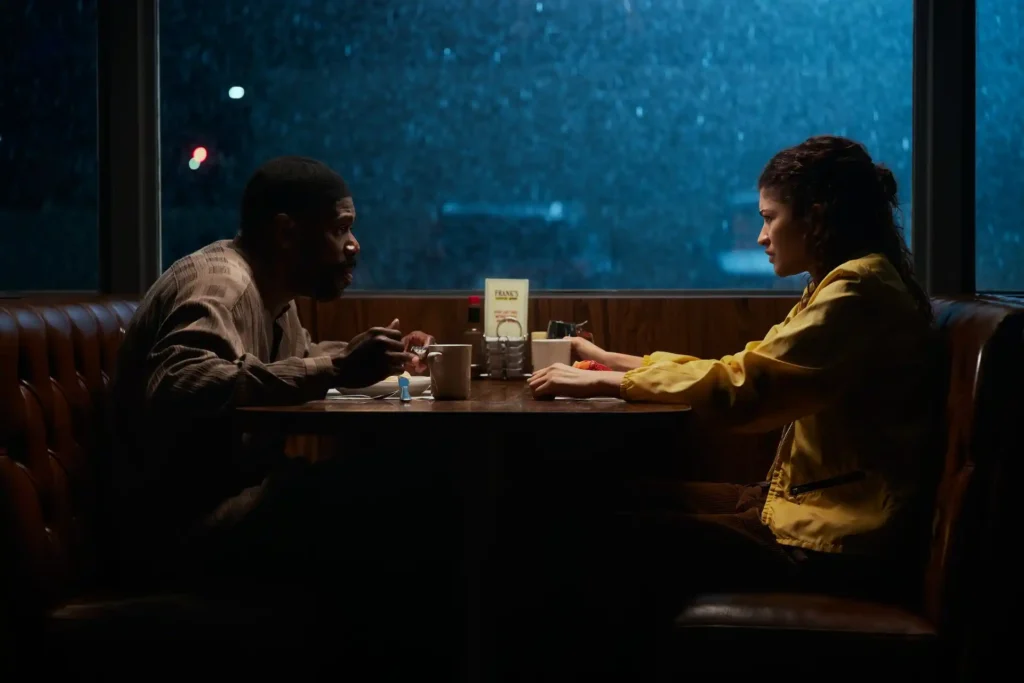
Colman Domingo and Zendaya in Euphoria Season 3 | Image via WarnerMedia
Rue’s Mexican Misadventures
Rue is still in debt to Laurie over that suitcase of drugs she fronted her – the one her mother flushed down the toilet – and thanks to some arcane criminal interest rates, she figures that Rue owes her $43 million. But she’ll settle for $100,000, which Rue doesn’t have either, which is how she finds herself in indentured servitude to Laurie as a drug mule dangerously ferrying balloons of fentanyl across the U.S.-Mexico border.
Levinson’s delight in the balloon-swallowing scene is a real warning sign that Rue’s addiction and general sense of desperation are being used to exploit her in much the same way that Sydney Sweeney’s comeliness and titillating public persona are being leveraged to essentially make fun of her in Cassie’s subplot. But Rue’s misadventures also feel miles away from everything else, both literally and tonally, with Rue’s entire personality having been altered in a way that feels extremely discordant. She’s now a centre-of-attention extrovert, her compulsion to pursue her own ruin more of a frolic than a hopeless descent into an inescapable abyss. Most of the predicaments she finds herself in here in Euphoria Season 3, Episode 1 are entirely of her own making.
But Levinson wants to have his cake and eat it, so Rue is also nursing a kind of private Christian fantasy inspired by a brief stay at a house on the Texas border with a god-fearing family whom she conned into believing she was a journalist writing an anti-immigration article (oh, the irony). She shares this with Ali, who reassures her that the church probably has a place for her despite all the bothersome homophobia, but it’ll require doubling down on the scripture, which Rue isn’t inclined to do beyond listening to an audiobook version of Genesis between drug drops.
A Career Change
Rue is dropping drugs at a party at the behest of Wayne, the possibly inbred son of Laurie’s cousin, Harvey, which is where she makes the acquaintance of Alamo, a strip club mogul and self-proclaimed “king of p*ssy”, because she decides to go inside to use the bathroom and ends up dancing with some of the girls. This is a string of deeply silly and out-of-character decisions that really exemplify my point about how much Rue no longer feels like Rue.
But Rue sees an opportunity for a career change in Alamo, since he can employ her as a troubleshooter in one of his clubs, which is presumably better than working for Laurie. “Better” is a pretty relative term, though. As soon as one of Alamo’s girls dies from an overdose thanks to Laurie’s drugs being laced with fentanyl, Rue is on the hook for it. By way of explanation, she tells Alamo that she thinks God brought them together.
To test this theory, Alamo puts an apple on Rue’s head and shoots it with a gold-plated revolver. His unexpected accuracy means that Rue survives – she expresses the relief by laughing like a maniac – but will presumably be indebted to a figure perhaps even more dangerous and unstable than Laurie. It hardly seems like upward mobility in the traditional sense.