Summary
Monarch: Legacy of Monsters Season 2 really coalesces in “String Theory”, an imperfect episode in some respects but one that really capitalizes on the character development and high-concept premise.
The best episode of Monarch: Legacy of Monsters Season 2 thus far does (almost) everything you want from a show like this. A woo-woo sci-fi gimmick being leveraged for maximum emotional payoff? Got it. Glimpses of terrifying monstrosities? Nailed. An egregious overuse of ADR undermining what should be one of the most character-driven moments of the hour? Okay, maybe we didn’t want that bit. But you get the idea. Episode 7, “String Theory”, is Apple TV’s Monsterverse tie-in firing on all cylinders, near enough, and it’s all the better for it, despite some hiccups.
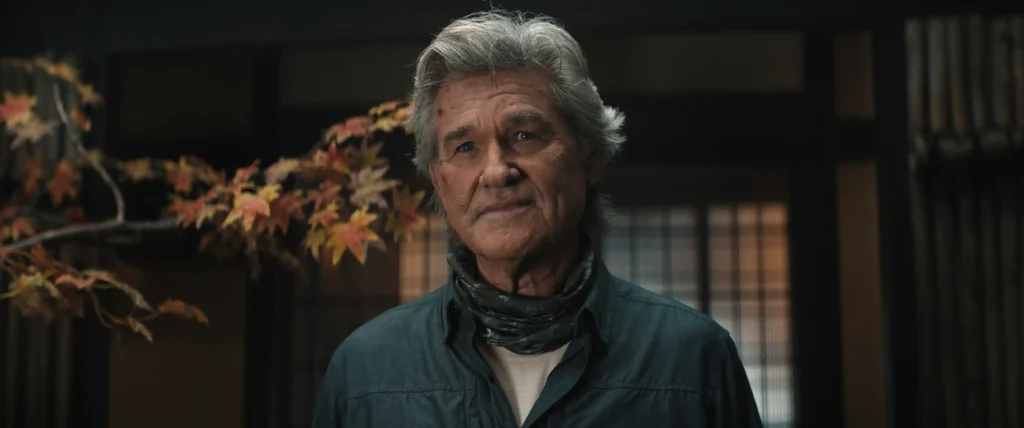
I, for one, have been wondering – sometimes aloud, or at least in print – how the show was going to continue to work in the dual timeline structure, or at the very least the father-and-son duo of Kurt and Wyatt Russell, now that we’ve wrapped up the Santa Soledad section of Titan X’s backstory. “String Theory”, capitalizing on the sudden twist at the end of the previous episode, comes up with a pretty genius idea for doing so. With Lee Shaw the Younger being trapped in the Axis Mundi, where time dilation plays all kinds of tricks on fussy notions of logic and continuity, he’s able to converse with the older version of himself thanks to the rift Shaw and Zook opened last week.
On paper, this sounds significantly gimmickier than it ends up being. But the episode is smart with how much time it allows for the dynamic to develop. Initially, Old Shaw pretends to be a Monarch higher-up tasked with getting Young Shaw out of the Axis Mundi after a disastrous expedition, but pretty quickly, Young Shaw realises that he’s talking to himself. Of course, he also thinks that he’s losing his marbles, but there’s a real sense of authenticity in the interactions that helps Young Shaw to understand, in a way that doesn’t feel contrived, that he’s speaking to his future self.
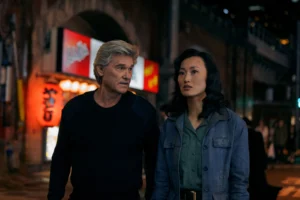
And this works because of the strong character development that has taken place during this season, especially regarding the doomed love story between Shaw and Keiko. There are some giant centipedes knocking about in the Axis Mundi, but Young Shaw’s primary danger is running into Keiko, who is also camped out there. Remember, Keiko’s parting love note mentioned offhandedly that perhaps “in another world” she and Shaw might have been together; Shaw takes this literally and considers approaching Keiko in the Axis Mundi to reignite their love affair in Bill’s absence. The key emotional conflict becomes an older, wearier version of a man who lost the love of his life, having to convince his younger, more idealistic self to let her go for the greater good.
It’s a very good idea to play up the human pathos that is supposed to underpin the series between infrequent bouts of monster action, and the director, Gandja Monteiro, does a great job with Joe Pokaski’s script, really lingering on the pain of the dilemma with help from series-best performances from the Russells. Even though they’re never physically in the same scene, it almost feels that way, and the use of extended close-ups is highly effective in selling the idea.
This is perhaps just as well, since the idea probably raises more questions than it answers in terms of worldbuilding and logical continuity. Time travel is always extremely tricky, obviously, and in making the use of the concept more character-driven, Monarch: Legacy of Monsters Season 2, Episode 7 sidesteps a lot of potential pitfalls. This is about as simplistic as temporal shenanigans typically get; there’s a direct link between what happens in the Axis Mundi and the versions of the characters we know in the present-day – we see, for instance, how Shaw got that scar on his face – but any more exaggerated butterfly effect-style paradoxes are avoided because the entire point of the storyline is that Shaw doesn’t approach Keiko.
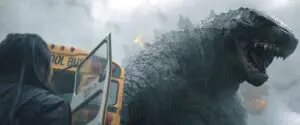
The way all this connects to the overarching plot is that Old Shaw is tasking Young Shaw with putting a tracking device on a hibernating Titan X, which remains there decades later and allows Monarch to be able to follow it now that it has veered off its migratory route. I’m not sure whether it’s a good or bad thing that Shaw’s unrequited love for Keiko is significantly more engaging than anything involving the giant rampaging sea monster, but we do seem to be heading in a very specific direction with all that, which is explored a bit more through Keiko and Cate, who are still trying to figure out the latter’s mysterious telepathic connection to the monster.
This is all quite clunky, since it has clearly been cobbled together through ADR and leans on exposition to try to overexplain how the whole thing works, which takes away from the emotional sentiment that should be at the heart of it. It fares especially poorly given that it’s sharing space with the Shaw subplot, which works for precisely opposite reasons, even though it’s conceptually more complicated. It feels like two different people wrote each half of the episode.
It also doesn’t help that the grand takeaway of the Cate/Titan X connection is basically the same idea we’ve been kicking around for weeks, which is that Titan X doesn’t mean anyone any harm and is just floating about, minding its own business. For now, it’s easy to see how this makes Apex’s efforts to control it all the more abhorrent, but it’s a bit unclear what Isabel Simmons might have to do with it, or how that’ll impact Kentaro, who spends the episode with her. More to come on that front, I guess. But in the meantime, “String Theory” is a very promising sign for the remainder of the season.
RELATED: