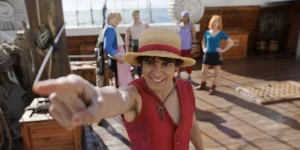
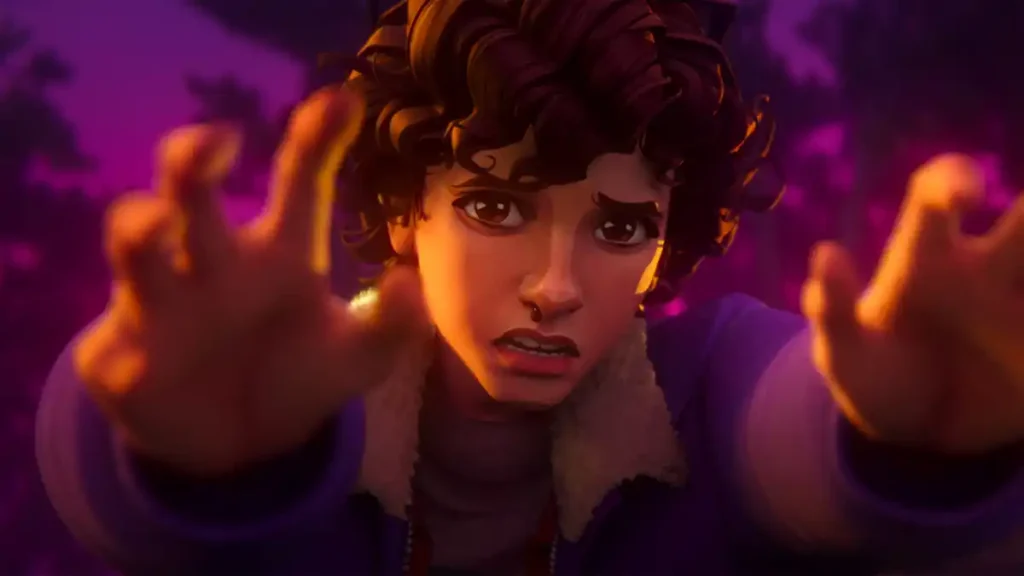
You didn’t think we had left Hawkins, Indiana, entirely, did you? These days, the idea of letting a franchise die is utterly unconscionable, not when there’s so much money on the table, and Netflix, like any other industry leader, has learned that there’s no such thing as an IP that can’t be milked utterly, dangerously dry. Hence, Stranger Things: Tales from ’85, the animated in-universe spin-off from their flagship nostalgia-baiting mega-hit, Stranger Things. The good news is that it’s actually pretty good, at least if you manage your expectations. The bad news is that it’s technically canon, so it brings up a whole bunch of questions about how it fits into the broader established universe. The worst news is that none of those questions is very interesting, and none of the answers is satisfactory.
This is why my macro point is that you shouldn’t really worry about it. Sure, the MCU – and similar – has conditioned you to obsess about these things, lest you miss a crucial connection or reference point, and I’m as big a proponent of expansive multimedia shared universes as anyone. But the proscriptive logic of carefully cultivated continuity needn’t apply to everything. Sometimes it’s a detrimental idea to entertain, because it distracts from the overall point, which is, in this case, just getting to enjoy another Stranger Things adventure with the versions of the characters that everyone still liked. And that’s fine.
Is Stranger Things: Tales from ’85 Officially Canon?
The simple answer to the question of whether Tales from ’85 is an official part of the established universe is “yes”. It takes place between Season 2 and Season 3 of the main show, involves all of the familiar characters, namechecks events that we saw take place, and exists explicitly in the same version of Hawkins. Tales from ’85 is canon to Stranger Things.
But that isn’t even the half of it. In an interview with IGN, showrunner Eric Robles talked about “respecting the canon” as a primary point of concern, which essentially means two things: Nothing that happens here can change any of the established events, and the characters must wind up in exactly the position that they began the third season in.
This creates a scenario that might charitably be described as “soft canon”, which is to say that it doesn’t earthquake the surrounding fiction, but it exists in its own weird pocket dimension – Robles used the term “frozen time” in the same interview – where the audience has to meet it halfway and understand that it was created after the main series and thus nothing that happens in it could ever be called back to. It’s canon with caveats, essentially.
Continuity Isn’t the Point
There is nothing more boring than trying to nitpick how various things that happen in Tales from ’85 don’t technically fit into the established universe. It’s a waste of time. The very nature of the show as a spin-off that exists in the same timeline but was created after basically mandates that it’ll feel closed off and inconsequential. The showrunners are trying to have their cake and eat it, in a sense.
There was a way of doing Stranger Things tie-in media that was canon but told a story that was separate from the main arc, that involved new or perhaps side characters and could take some narrative risks that fleshed out some of the subplots and worldbuilding in the main show. But Tales from ’85 isn’t that, since it’s designed to play up the nostalgia of the franchise from before it grew into outsized proportions. That’s why it involves the usual characters, setting, and plot beats. It’s supposed to be nostalgic. And that’s the way it needs to be considered if you’re going to have a good time with it.
In other words, you should probably stop asking about the continuity. It isn’t worth it.
Tales from ’85 Has the Right Position in the Timeline
Having said all this, if the showrunners were determined to do things this way, I’d argue that they chose exactly the right spot. Setting the story after Eleven closing the gate to the Upside Down in Season 2, but before the opening of the Starcourt Mall and the discovery of the secret Russian base in Season 3, is pretty much the best time to set a side story.
Why? Well, for one thing, this time isn’t especially well documented, but is assumed to have been relatively safe and peaceful. Not a great deal was going on in Hawkins during that period. The characters were supposed to be experiencing some kind of relative normality, where their world had returned, for the most part, back to how it was.
Only, it hadn’t returned to how it was, and the kids hadn’t forgotten what they had experienced in the first two seasons, which Tales from ’85 is able to acknowledge. The kids’ knowledge of sci-fi monstrosities and the deeper weirdness underpinning Hawkins allows for a new story along those lines that doesn’t need to be grounded all over again. The gang is half-expecting to find monsters everywhere they turn, so when they do, it isn’t much of a shock.
Just Don’t Worry About It
The important thing to remember is that canon isn’t worth worrying about in this instance. Robles’ own explanation for why none of the events of Tales from ’85 are ever mentioned again is laughably unsatisfactory, suggesting that the kids just had bigger things to be worrying about with the Mind Flayer and Vecna. That’s the kind of logic we’re working with, and that’s precisely why the whole thing doesn’t matter:
“Now you could be like, hey, you know what? I don’t remember them talking about pumpkin creatures in Season 3 or 4 or 5, right?” Robles said. “First of all, I didn’t know that the show was going to exist while that was going on, but at the same time, the kids have bigger things to worry about. By the time you’re getting to Season 4, you’re worrying about Vecna. You’re worrying about bigger things than pumpkin creatures… And a lot of times they don’t go back reminiscing about too many things that happen in [previous] seasons… So we just figured, let’s stay within this space, this frozen time, let’s have these great adventures, and then just make sure that we come back by the time we get to the end of however many seasons we do of this thing. Let’s make sure that we respect the audience and make sure that it just comes back and falls in line. Now you can easily remove this whole series out of the timeline and it never exists. Or… Do you want to hang out with your best friends and go on new adventures?”
The spin-off is enjoyable enough on its own terms to enjoy on its own terms, without fretting about whether what happens in it undermines something that happens elsewhere. Come to terms with the idea that it’s all inconsequential, despite the official branding, and you’ll have a better experience. Presuming that’s what you want, obviously. But if it isn’t, why not?
Maybe that’s a more interesting question.
RELATED: