
Summary
Michael Jackson: The Verdict does a solid job of delving into the details of its subject’s darkest era, but at just three episodes, even its interrogative approach doesn’t feel like enough to unpack such a complex legacy.
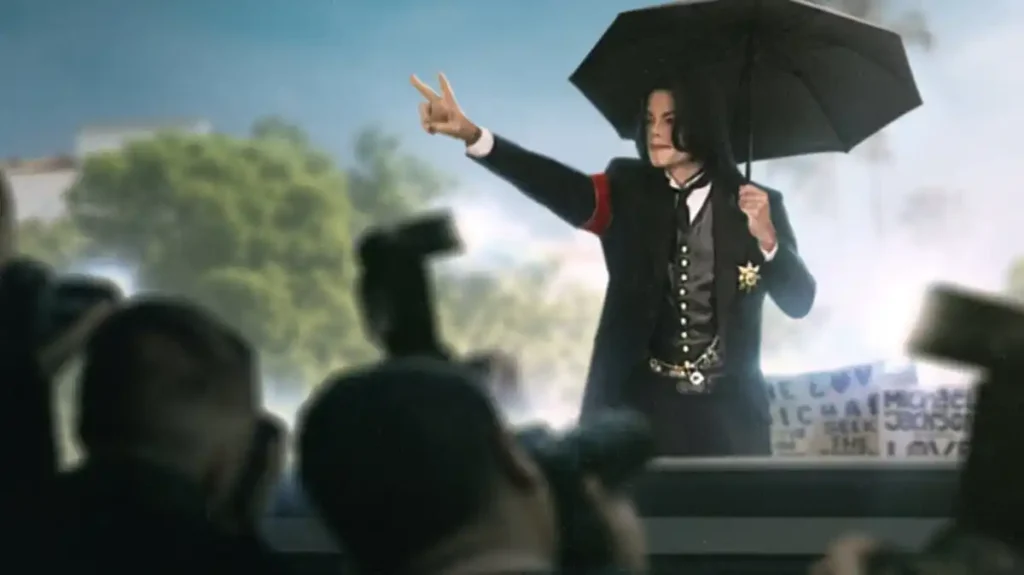
With Michael Jackson’s biopic currently introducing a whole new generation to the King of Pop, the timing of Nick Green’s unnervingly accusatory three-part Netflix docuseries Michael Jackson: The Verdict seems telling. While the artist’s musical accomplishments can’t be denied, and have been appropriately celebrated in his recent biographical feature, his overall legacy as a public figure remains much more complex, and this sometimes alarming focus on his 2005 criminal trial, during which he was accused of molesting 13-year-old Gavin Arvizo, is a pretty cogent reminder of that.
It’s worth mentioning out of the gate that Jackson was acquitted on all counts, with the jury citing insufficient evidence. But the idea that the story ends there is naïve; on the contrary, four years after Jackson’s death, Wade Robson, one of the witnesses for the defence, reversed his position and filed a lawsuit alleging that Jackson had molested him, too. The media circus surrounding the trial, and Jackson’s unique status as a global celebrity of unrivalled renown and a victim of extremely well-publicised domestic abuse, both conspired to hang Jackson in the court of public opinion and provide a litany of justifications supporting his guilt and suggesting his innocence. This incredibly murky and self-contradictory maelstrom means that three episodes scarcely feels like enough to unpack the full extent of the trial.
But the docuseries has a good go. Featuring talking head interviews with many of the people involved in the trial, from attorneys and journalists to some in Jackson’s inner circle, and footage from interviews with Arvizo and law enforcement raids of Jackson’s Neverland Ranch, there’s plenty to go on, leading to multiple distressing allegations and bombshells, some of which are tough to argue with.
Even the ranch thing is, in itself, weird. A grown man living in what was functionally a paradise for children is a bit of a red flag, but it’s also just as likely the outgrowth of a mind trapped in its own childhood, pining for the normality and healthy relationships it was consistently denied. But testimony from people like Vincent Amen, who worked for Jackson at Neverland and looked after the Arvizo family, the children of which seemed to have been given lewd nicknames by Jackson and referred to him as “Daddy”, speaks to a more frightening undercurrent of grooming and abuse.
Amen is pretty central to Michael Jackson: The Verdict, providing a behind-the-curtain look at Neverland’s goings-on, which include – or may have included, for legality’s sake – Jackson circling videos of naked children in an illegal magazine for his long-time friend and assistant, Frank Cascio, to order for him. Writing this off as “a phase” seems pretty difficult to do, especially since Cascio, known as Frank Tyson, couldn’t be reached for comment. I suppose it would be difficult to provide one that didn’t make the accusation sound even worse.
This is a perennial component of Jackson’s life and legacy. Accusations are one thing, but accusations so specific and consistent and bizarre are another thing entirely, and Jackson, who could never, even in his pomp, be described as even-keel, was both an easy target and an obvious suspect. His predilection for spending time with teenage boys was no secret, but what he was doing with them wasn’t clear; his own childlike persona was obvious, but his stardom gave him access to endless adult-only substances; and his relationships were defined almost exclusively by a parade of yes-men who had something to gain from their association with him.
The contradictions didn’t escape the jury in the trial. How do you parse the testimony of a child without feeling inherent sympathy, but also acknowledging how susceptible it is to manipulation? How do you divorce Michael Jackson the hit-maker, whose music and dance moves defined an era, from Michael Jackson the man, potentially a drug-addict predator? At what point does investigative journalism of a suspected abuser – Martin Bashir’s 2003 British television documentary Living with Michael Jackson forms a crucial thread – become a spiteful trapping of a vulnerable man? If one thing is true, does it invalidate the other? Can multiple uncomfortable interlocking realities exist simultaneously?
The truth is that we’ll probably never know. All of us have our viewpoints, of course, but now, as then, there are probably as many people as furious with Jackson over his alleged crimes as there are those who believe that he himself was a victim of a cannibalistic celebrity culture and a litany of bad actors who had something to gain from what Jackson himself described as a “conspiracy” to ruin his name. Michael Jackson: The Verdict goes some way towards providing a balanced viewpoint on the ever-knotty issue of his legacy, but sometimes a topic is too singular and specific for even the most interrogative approach to ever feel like enough.