
Summary
USA 94: Brazil’s Return to Glory is a fairly standard sports documentary, but it builds genuine suspense through its construction, boasts plenty of never-before-seen footage, and is threaded with a touching tribute to the late, great Ayrton Senna.
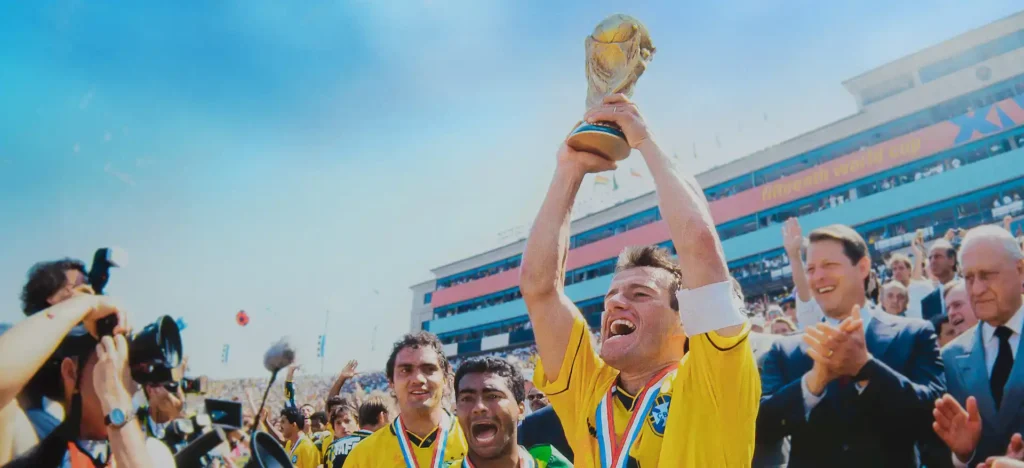
With Netflix currently milking the 2026 World Cup for all its worth, a documentary like USA 94: Brazil’s Return to Glory is likely to be met with some eye-rolling, like a piece of well-timed propaganda (there’s even a degree of glazing for the historically garbage USA national team, which feels a bit disingenuous). But any sports fans and historians should be cautious in overlooking this movie, which recounts Brazil’s victory at the 1994 World Cup – their fourth in total, after a lengthy period of falling short – and the victory’s cultural implications, since it’s assembled with a decent amount of skill and is threaded with a genuinely touching tribute to the late, great Ayrton Senna.
The focus on Senna, who died in the same year, is unexpected. At first blush, the documentary’s real selling point is a considerable amount of never-before-seen handheld camera footage taken at the time by the Brazilian team, which included players like Romário, Bebeto, Dunga, Branco, Raí, Zinho, Viola, and Jorginho, almost all of whom are present for the obligatory talking-head segments. The present-day interviews and archival footage combined with these exclusive home videos provide enough meat on the bone to justify the documentary’s existence. But the Senna stuff gives it a different, richer contour.
To football fans, Brazil are largely considered to be titans. They have won the World Cup more times than any other nation, and even here, they’re gunning for their fourth go at an accolade most countries never come close to. They have reputations as perennial winners, and many of the finest players to ever pick up a football have been Brazilian. So, this context is important. After a drought of national silverware and the untimely deaths of Senna and 23-year-old footballer Dener, who also passed away in 1994, the entire nation was grieving. And that nation was so intimately tied to sporting success, especially footballing success, that success at the ’94 World Cup felt like more than just winning a tournament. It was national healing.
The pressure of carrying a country’s grief and hopes on their shoulders gives the footage captured by the players more oomph. It embellishes the structure of the tournament, which is also unavoidably the structure of the movie, following Brazil through the Round of 16 and difficult knockout legs against top-class international opposition. Often, the spectre of old losses haunts the crop of players and the legions of fans watching along. After so long without winning anything, failure always seemed uncomfortably close.
I’ve said this before, but sports have built-in dramatic stakes. The shape of a knockout tournament works pretty beautifully across 90 minutes, and as in Untold UK: Liverpool’s Miracle in Istanbul, also streaming on Netflix, the climactic penalty shootout which decided Brazil’s final game against Italy in California’s Rose Bowl is relayed with genuine suspense. Knowing the outcome in advance, as basically everyone does, isn’t a knock against Brazil’s Return to Glory. Instead, the additional context and mutual respect stemming from the footage and the interviews enhance the emotional power of the outcome.
And there’s that Senna thing again. The Brazilian team dedicating their victory to him, and the players still getting emotional in the present day simply recalling how momentous the achievement was at the time, gives Luis Ara’s film an earnest sense of national pride, helping to sell the immensity of such an achievement, and its importance not just for the players who lived it, but the fans who got to see it when they needed it the most.
RELATED: